A magnetic fieldsensor is a device that detects the presence, strength, and sometimes direction of magnetic fields. These sensors range from simple compasses to highly sensitive quantum devices that can measure fields a billion times weaker than Earth's magnetic field. They are crucial for scientific research, medical diagnostics, and navigation.
History
The first magnetic fieldsensor was the compass, used in China over 2,000 years ago. Modern electronic sensors were developed in the 19th and 20th centuries, with quantum-based sensors emerging in recent decades.
How it works
Magnetic fieldsensors operate on various principles. Some use the Hall effect, where a voltage develops across a conductor in a magnetic field. Others use magnetoresistance, where a material's electrical resistance changes with the magnetic field. Advanced sensors, like those based on nitrogen-vacancy centers in diamond, exploit quantum spin states that are sensitive to magnetic fields and can be read out optically.
In practice
Magnetic fieldsensors are used in smartphones for orientation, in medical imaging (magnetoencephalography), in geological surveys, and in space missions to study planetary magnetic fields.
Fun fact
Some magnetic fieldsensors, like those using superconducting quantum interference devices (SQUIDs), can detect magnetic fields from brain activity, which are about a million times weaker than Earth's magnetic field.
Imagine a soundproof room where you tune a tuning fork: the faintest rustle throws off the tuning. In the world of ultra-precise atomic measurements, that rustle is the magnetic field. It imperceptibly shifts transition frequencies, and to get a reliable standard, physicists had to carefully calibrate the field.
In a quiet room with no magnets anywhere, two electrons in a silicon trap still feel a faint trembling. It comes from the nuclei of silicon and germanium atoms, which spin randomly like the needles of broken compasses. This trembling was once considered noise, but now it has become a measuring instrument itself.
For three days straight, a laser blasted a jet of gas, and every second it produced a beam of electrons with the energy of a tiny lightning bolt. Previously, such beams could only be produced in huge halls where the accelerator takes up an entire building. Now the whole setup fits in a room and ran without a glitch for 72 hours.
Electricians working with high voltage are like divers: they need to see what's happening deep underwater without going down themselves. What's needed is a sensor that stays away from the dangerous current and relays information to the surface. Usually, light is used: a beam passes through a transparent crystal, and the electric field slightly rotates it.
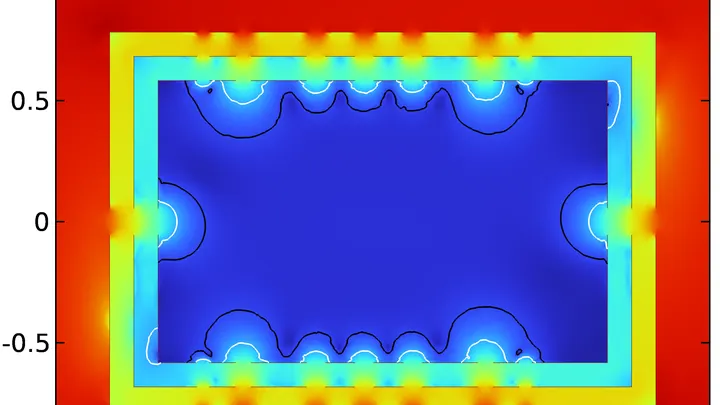
The magnetic field in this setup must be as smooth as glass: the slightest ripple would blur the signal. The engineers built two coils that cancel each other's field externally and packed them in three layers of ferromagnetic plates.
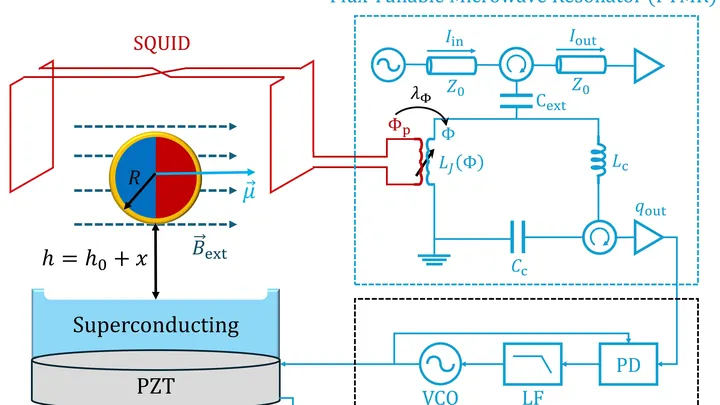
A magnet weighing just a few grains of sand hovers in midair with no support. It doesn't touch the walls, doesn't rub against bearings — it just hangs in a magnetic trap like a speck of dust in a sunbeam. Researchers have turned this tiny object into an ultra-sensitive compass: the device detects changes in the magnetic field of 23 femtotesla.
A radio receiver the size of a palm can measure signal power more accurately than expensive lab benches. Inside, there are no coils or antennas, just a glass head and a cloud of rubidium atoms cooled to near absolute zero.
Ion current through a membrane is like a queue at a turnstile. Sometimes the turnstile is free — ions pass through quickly. Sometimes it gets stuck — the flow drops. A weak magnetic field, it turns out, doesn't push ions from behind; it simply changes the number of open turnstiles.
A laser is like a tuning fork that rings at a single note. But even in complete silence, its sound trembles slightly. Previously, it was thought that this tremor, random kicks from spontaneous emission of light by atoms inside the laser, was the main limit to precision.
Deep underground, iron glows white-hot, and the pressure is so intense that an ordinary instrument would be crushed flat. To peer into this world, physicists built a special microscope based on tiny diamond defects (so-called NV centers).
When a building collapses, steel rebar turns into a chaotic magnetic compass. Entropy, a measure of disorder, increases, but it's this very disorder that points to voids where people might be.
In the pitch darkness of a vacuum chamber, a tiny magnet floats. It touches no walls and loses almost no energy — an ideal sentinel, ready to catch the faintest nudge. Such a sentinel is exactly what you need for axion hunting. These particles are prime suspects in the case of the Universe's hidden mass, which we call dark matter.
A tiny defect in a boron nitride crystal behaves like a microscopic indicator bulb. Shine light on it, and it glows, with the shade shifting with temperature: the warmer it gets, the redder the glow.
Ordinary magnetic sensors lose sensitivity as they shrink. But scientists turned a tiny diamond into a light-based compass. Unlike jewelry diamonds, what matters here isn't purity but artificially created defects — these are what turn the crystal into a compass.
A flashlight shines through skin and bone to gently switch on neurons at the right spot in the brain. That is how transcranial magnetic stimulation works — a coil on the head creates brief magnetic pulses that trigger electrical signals in cells. But if you tilt the flashlight or move it away, the light goes astray.
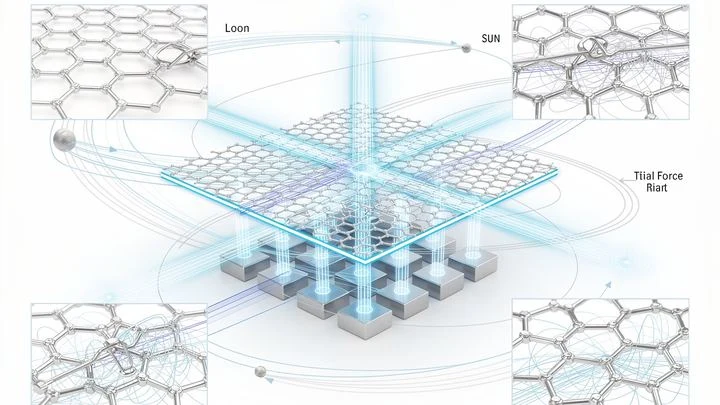
In the quiet of a laboratory, a graphite flake hovers above a magnetic grid. This is not just a demo of diamagnetism's magic — it's listening to the Universe. Like a spider casting its web to catch vibrations from an invisible world, this flake has become a gravitational web.
A magnet the size of a grain of rice floats in a vacuum without touching the walls. It is held by the magnetic field of a superconducting trap — a ring cooled to a state where current flows without resistance.
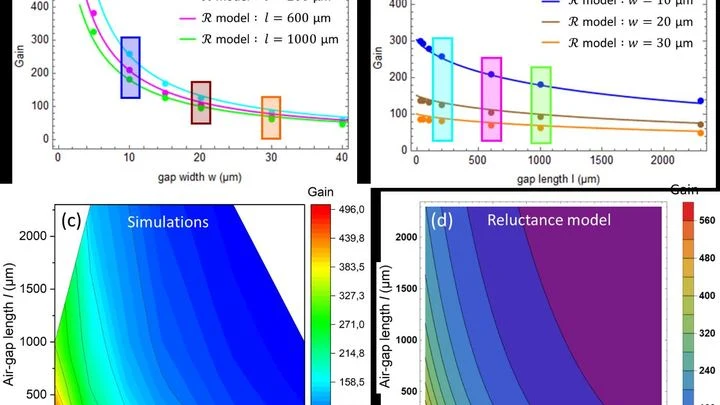
Magnetic sensors smaller than a match head can already detect weak fields — from a beating heart or a distant planet. But making them even more sensitive involves a trade-off: improve one part, and you lose performance in another.
Earth's magnetic field, the one that swings a compass needle, is strong. The new sensor picks up fields a hundred thousand times weaker, and it needs neither liquid helium nor bulky setups. Everything fits on a circuit board, just like the one inside your smartphone.
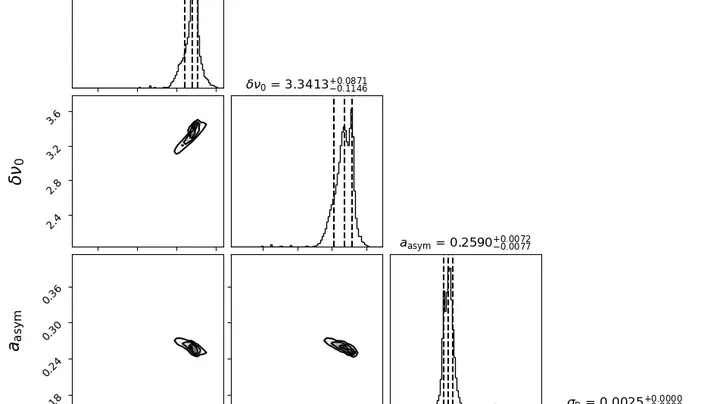
Eight red giants — bloated old stars like the future Sun — are not behaving by the book. Their surfaces oscillate steadily, like a bell, but within this chime there are glitches: some tones are missing, and the rhythm breaks. Scientists suspected an invisible hand inside — a magnetic field — and tried to calculate its strength.
Biologists often tag cells with glowing molecules — it's like searching for a dim light in the smoke. The light quickly fades, and the smoke creates interference.
A quantum magnetometer based on hydrogen nuclei works like noise-canceling headphones. It alternately "listens" to the field in two different ways: the noise is the same for both, but the desired signal is different. By subtracting one from the other, the device extracts the signal, reducing interference by more than 1000 times.
In a particle accelerator, nuclei shatter into fragments like a porcelain cup dropped on the floor. Each fragment flies through silicon wafers, which register the impact and its strength. But to distinguish a real signal from random noise, you need a threshold: below it, readings are considered interference.
Thousands of kilometers of fiber-optic cables lie on the ocean floor. They carry internet traffic, but the cables themselves sense the slightest vibrations in the water and the seabed. If you listen closely to such a cable, you can hear a blue whale singing or the ground trembling thousands of kilometers away.
A power transistor made of silicon carbide operates under voltages thousands of times higher than what comes out of a wall outlet. If the field inside it becomes uneven, the device burns out. Previously, this field was invisible: it is too strong for ordinary sensors, and the device must remain under voltage.
Radio waves surround us, but our eyes can't see them. This new sensor, the size of a fingernail, turns them into a colored patch on a tiny screen.
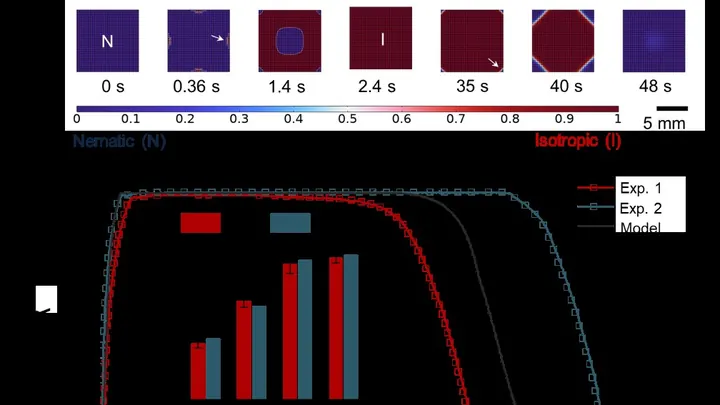
Inside the chip is a layer of liquid crystals — the same kind used in phone displays. Among them are embedded thin ferromagnetic nanowires. When a radio wave arrives, the nanowires heat up quickly.
A white dwarf is what remains of a star like the Sun after it sheds its outer layers. What's left is a hot core the size of Earth but with a mass close to that of the Sun. A teaspoon of this material would weigh as much as a truck. Some of these stars have extremely strong magnetic fields — a billion times stronger than Earth's.
In laboratories where atoms are cooled to near absolute zero, even a tiny change in the magnetic field throws off all the settings. Conventional sensors, Hall plates or coils with ferrite cores, sit a few centimeters away from the vacuum chamber because they themselves create interference.
A tiny needle glides over the surface like a finger over a page written in Braille. That's how a scanning tunneling microscope works: it feels the atomic landscape and turns bumps into a picture. But when you need to add a magnetic field, the design hits a wall.
A tiny defect in a diamond crystal works like a sensitive antenna. When a magnetic field oscillates nearby, this defect, a nitrogen vacancy, responds by glowing. Previously, to hear the signal, you had to accumulate many repeated measurements, like listening to a whisper with your ear pressed against a door. Now a single short "look" suffices.
A pigeon flies home from hundreds of kilometers away. Inside its head, in the inner ear, fluid sloshes around, like water in a bottle you shake. When the bird moves, the fluid moves too, helping it maintain balance. Recently, scientists proposed that this same fluid might act as a tiny generator.
Even Einstein predicted gravitational waves — a trembling of the very fabric of spacetime. Today they are captured by gigantic installations like LIGO, created thanks to Rainer Weiss and Kip Thorne.
A magnetic sphere hangs in a vacuum above a cold metal plate. No strings, no stands — only the invisible field of a superconductor keeps it from falling. Give the sphere a gentle nudge, and it starts to oscillate up and down; the frequency of those oscillations depends on how strongly the plate pulls on it.
Diamonds sometimes have a defect: instead of two adjacent carbon atoms, there is one nitrogen atom and an empty spot. This defect acts like a tiny antenna that responds to magnetic fields. Scientists aimed a laser and microwaves at such a diamond, and the defect started spitting out electrons.
Catching a whisper in the middle of a noisy train station: that's roughly the challenge facing physicists searching for the neutron's electric dipole moment. This is a tiny shift of charge inside the particle. If it exists, it breaks the symmetry between matter and antimatter and could explain why our world exists at all.
A tiny defect in diamond is like a microscopic ear, able to pick up the magnetic 'breath' of the heart. Such sensors work at room temperature and are no bigger than a grain of sand.
The magnetic field you want to measure is like a melody played in a noisy hall. A quantum sensor is a microphone that can pick up the faintest notes, but it also hears more than just the music: rustles, creaks, the breathing of neighbors. All of that mixes into the signal and spoils the recording.
Two stars orbit so closely that their outer layers merge into a shared envelope. Matter flows from one to the other, like water spilling from an overfull cup into its neighbor. In this cosmic dance, where stars literally touch each other, astronomers have for the first time detected magnetic fields in large numbers.
In the 1930s, Fritz Zwicky, observing the Coma cluster, noticed anomalously high galaxy velocities: their motion pointed to a huge hidden mass gravitationally binding the system.
We’re used to time flowing only forward. But quantum laws let it become like a coin showing heads and tails at once.
Take a particle with its own spin — its intrinsic rotation. In a magnetic field, it spins like a top. Send this particle through a device where two opposing magnetic flows fight each other — and it will start moving into the future and the past at the same time.