Momentum space is an abstract mathematical framework where each point corresponds to a specific momentum state of a particle — its velocity and direction, weighted by mass. In quantum mechanics, particles are described by wavefunctions that can be expressed either in position space (where you ask 'where is it?') or momentum space (where you ask 'how fast and which way?'). These two descriptions are linked by the Fourier transform, a mathematical operation that converts one into the other.
History
The concept emerged in the early 20th century with the development of quantum mechanics, particularly through the work of Paul Dirac and others who formalized the mathematical structure of quantum states. The use of momentum space as a tool for calculations became standard in the 1920s and 1930s.
How it works
In momentum space, a particle's state is represented by a wavefunction that assigns a probability amplitude to every possible momentum. The uncertainty principle of Heisenberg states that a particle cannot have a precisely defined position and momentum simultaneously; in momentum space, a sharply localized point means the particle has a definite momentum but its position is completely unknown. Conversely, a spread-out distribution in momentum space corresponds to a particle that is well-localized in position.
In practice
Momentum space is essential in solid-state physics for describing electron behavior in crystals (band structure), in particle physics for calculating scattering amplitudes, and in cosmology for analyzing the distribution of cosmic structures.
Fun fact
In momentum space, the Schrödinger equation for a free particle becomes a simple algebraic equation, making it much easier to solve than in position space.
Quantum matter rarely treats us to the spectacle of self-motion. Where the classical world teems with starling murmurations, fish schools, and bustling bacteria, quantum thermodynamics long remained serene.
A regular object moves along a predictable path, like a ball. In the quantum world, a particle is smeared into a probability cloud. To find order in this fog, scientists have recast Schrödinger's equation in the language of flowing water.
A pebble falls into a pond, and ripples spread across the water. In the quantum world, the pond is not made of water but of many identical particles, and the pebble is also a particle, just a foreign one. Such a foreign particle is called a Fermi polaron.
In the mountains, there is a saddle — a point where the trail from one valley crosses over into another. Standing exactly on it, you take a step and are already descending the new slope. In chemistry, such a place is called the transition state: a brief moment when atoms are frozen on the threshold of transformation.
A thrown stone follows a smooth arc: its path is easy to predict. But if the stone skips across water, the trajectory becomes jagged and far more interesting. Quantum particles behave much the same way when their state is not a calm wave with fixed energy but a turbulent mix of several waves at once.
For nearly a century, astronomers have watched galaxies spin as if held together by invisible mass. Fritz Zwicky first noticed it, and Vera Rubin precisely measured the speeds of stars at the edges.
The quantum world is usually drawn with points, but real instruments only see blurry spots. Heisenberg and von Neumann long suspected: precision is unattainable.
A translator gets distracted by every rustle in the hall, and a one-hour meeting stretches into two. That's roughly how ordinary quantum mechanics works: a particle evolves in time, while space serves as the stage. But what if we swapped their roles? Then the particle 'moves' through space, and time becomes a static backdrop.
In one model, spacetime is a smooth lake, and quantum particles are fish swimming in it. Their motion inevitably creates ripples. The math insists that the water trembles — otherwise the theory collapses. This trembling is strictly ordered and comes in two types.
A handful of rice grains falls onto a hot skillet, and they start jumping. Each grain pushes its neighbors, and the whole pile stirs without any external hand. That's active matter: a multitude of particles that draw energy on their own and convert it into motion.
An ultracold cloud of atoms trapped in laser light can 'breathe': it rhythmically contracts and expands, much like lungs. Physicists have long been able to observe this breathing, but only now have they realized that its amplitude is not just a pretty picture: it is a precise measure of hidden energy jitters inside the cloud.
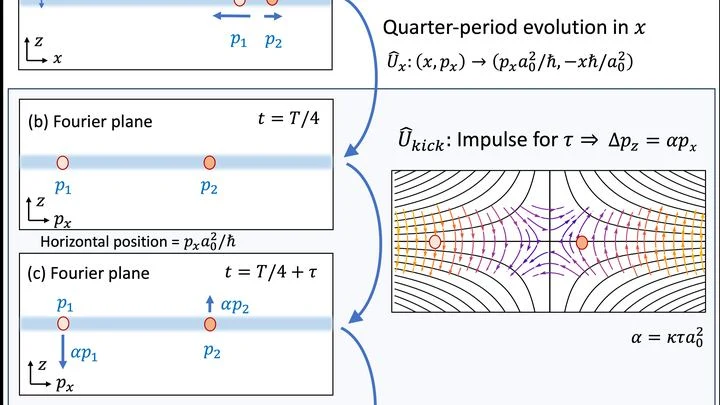
Fireflies flash in a dark forest: you see each flash, but not the flight. A quantum gas microscope can show individual cold atoms, like those fireflies. But until now, it couldn't tell you how fast they're moving.
Now scientists have found a way to fix that.
A quantum particle quantum particle can exhibit backward motion even if its overall direction is forward. Imagine a river: the main current rushes toward the mouth, but individual currents suddenly swirl and momentarily dart against the flow, creating local disorder.
A woven basket holds its shape not because it has a rigid frame, but because each strand is interlaced with its neighbors. Pull one out, and the pattern unravels, leaving a heap of twigs. Quantum mechanics, according to a new paper, works the same way: its elementary objects do not exist independently, but only in interweaving with each other.