Fourier analysis is not just a mathematical trick. It is a way to see through chaos. A stock chart that seems random may contain hidden cycles; an old film marred by scratches is restored by removing periodic noise. Even the shape of a musical instrument — a violin or a flute — is determined by the spectrum of harmonics it produces. In radio engineering, Fourier analysis allows hundreds of conversations to be superimposed on one carrier frequency and then separated again. And in computed tomography, doctors obtain a three-dimensional image of the body by processing X-ray detector signals using the fast Fourier transform.
History
In 1807, Jean-Baptiste Joseph Fourier presented a work on heat propagation to the Paris Academy of Sciences, where he claimed that any periodic function could be expanded into a trigonometric series. Leading mathematicians of the time (Lagrange, Laplace) were skeptical due to rigor; full convergence proofs came later (Dirichlet, Riemann). The fast Fourier transform (FFT), which made the algorithm practical, was independently discovered by Cooley and Tukey in 1965, though elements of the method go back to Gauss.
How it works
The forward Fourier transform of a function f(t) is defined by the integral: F(ω) = ∫ f(t) e^{-iωt} dt. The inverse: f(t) = (1/2π) ∫ F(ω) e^{iωt} dω. Physically, the quantity |F(ω)|² dω represents the fraction of signal energy in the frequency band [ω, ω+dω] (Parseval's theorem). In digital processing, the FFT is implemented, with complexity O(N log N) instead of O(N²) for direct DFT. Convolution in the time domain becomes multiplication in the frequency domain, which is convenient for filtering. The short-time Fourier transform adds time localization at the cost of frequency resolution — a compromise overcome by wavelets.
In practice
Mobile communication, the internet, and JPEG image compression use Fourier analysis to transmit and store data in compressed form.
Fun fact
The human ear is a natural Fourier analyzer: the cochlea of the inner ear breaks down complex sound into individual frequencies, allowing us to distinguish voices in a noisy room.
A doctor places a stethoscope on the chest and listens: lub-dub, lub-dub. The rhythm is there, but how do you measure it when it's noisy around and the patient can't lie still? Conventional devices look for sharp peaks in the heartbeat recording, like catching hammer blows. But if the hammer hits a pillow instead of an anvil, the peaks blur and the device gets lost.
CORAL, the new method, works differently.
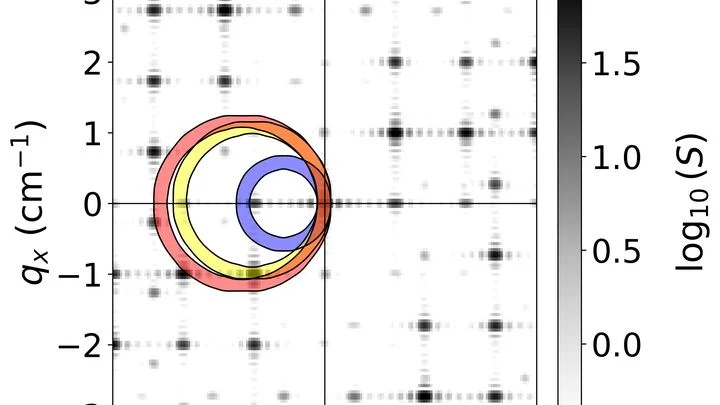
Waves on the water's surface usually break against any obstacle — a rock, a piling, an island. But what if you arrange obstacles so cleverly that the wave barely notices them? In a new study, scientists assembled a pattern of many points on the water, arranged according to special mathematical rules, and sent waves through them.
Waves on the water's surface usually break against any obstacle — a rock, a piling, an island. But what if you arrange obstacles so cleverly that the wave barely notices them? In a new study, scientists assembled a pattern of many points on the water, arranged according to special mathematical rules, and sent waves through them.
During surgery, an anesthesiologist watches a screen where pressure and pulse curves run. But behind these lines hide several other quantities: how much the vessels constrict, how fast the blood flows, how elastic the artery walls are. Precise instruments for measuring them are only used in the most severe cases because it's risky — a needle in the artery, a catheter in the heart.
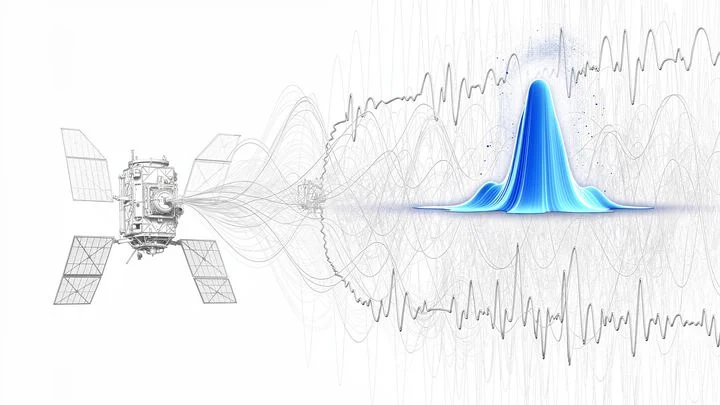
You're listening to the faint whisper of stars, and nearby someone keeps moving a chair. In gravitational wave telescopes, that role is played by scattered light: it reflects off trembling surfaces and creates false signals.
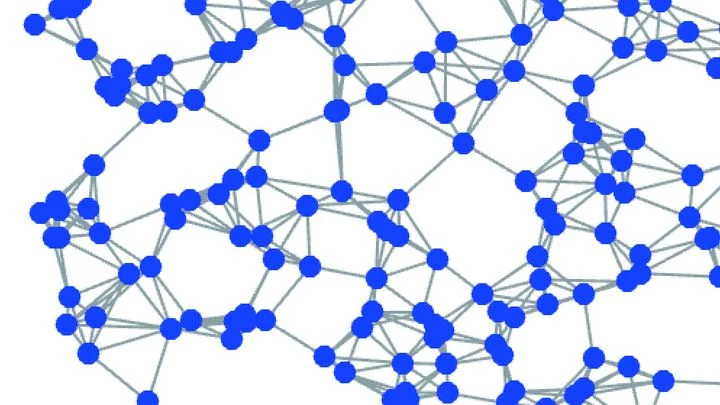
An ordinary road map with traffic is a heap of numbers. Sending them all as is takes too long. But you can reduce the volume without losing the gist. Researchers found a clever solution: first redraw the map so that streets become points, and intersections become bridges between these points.
A human effortlessly picks out the desired voice from the clamor of a party. For a computer, the same task is still at the edge of its abilities. Previous programs trained on sterile recordings, free of echo or the clinking of appliances.
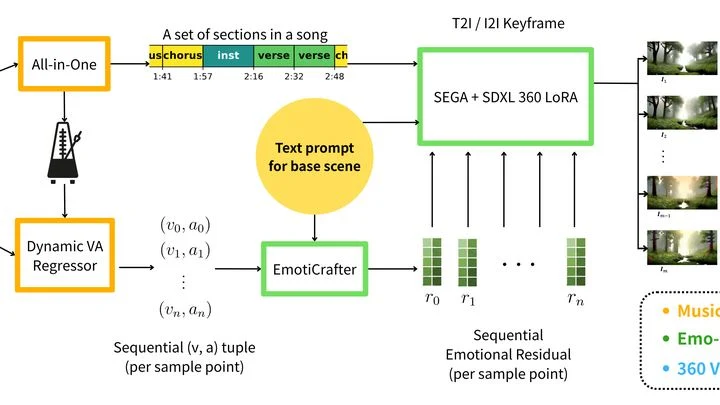
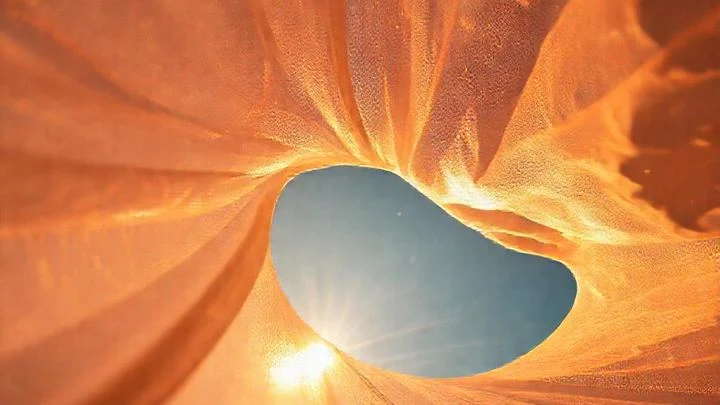
A conductor holds not a baton but a brush, and each stroke gives birth to color and form. New technology works the same way: it transforms a song's mood into a panoramic video that surrounds the listener.
First, the algorithm decomposes the track into emotions, similar to how light is analyzed by spectrum.
Learning a foreign language is like tuning a musical instrument. The new technology works like a smart tuner: it takes your recording and a native speaker's reference speech, stretches or compresses them in time (like adjusting a string) to align them precisely, and evaluates three key parameters: clarity of sounds, rhythmic precision, and intonation.
Imagine a kinked garden hose: water meets resistance, and pressure drops. A similar process occurs in arteries when they lose their straight geometry. Vascular tortuosity is not just a cosmetic defect but a factor that disrupts hemodynamics and poses a threat of ischemic stroke.
Data analysis on the internet or sensor systems has long resembled trying to conduct an orchestra where each musician is locked in their own booth, and the conductor cannot leave the podium.
Assessing image quality is a job for a meticulous inspector with a toolbox. The IQA-T1 neural network acts exactly like that: it doesn't just stare at the picture, but applies either a spectroscope or a light meter.
In fast-moving vehicles, mobile internet slows down: the signal, traveling at the speed of light, blurs like the scenery outside the window. Engineers have found a way to pack data more densely without letting them mix up. It's like a multi-lane highway where packet-cars drive not with a safe interval, but almost bumper-to-bumper.
Human hearing is wired so that the brain prioritizes familiar patterns — a friend's voice, the patter of rain, a car horn. But a new system works on a different principle: it registers any sound burst, even one never encountered before.
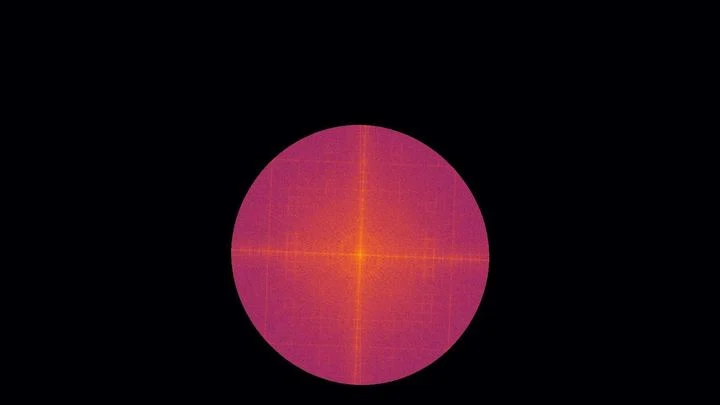
Tomographs don't produce ready-made pictures. They collect numerous 'shadows' — projections of innards from different angles or using various signals — and mathematically reconstruct a 3D picture from them.
Cleaning speech from noise is like tuning an old TV: twist the contrast knob too far, and faces become unnatural. Researchers separately adjusted the 'volume' and 'time shift' for each frequency of sound, as if splitting it into a rainbow — a method known as spectroscopy. It turned out the key knob is volume, not phase synchronization.
The standard way of digitizing speech: taking volume readings thousands of times per second. It's like tasting broth with a teaspoon: each sip is watery, with almost no detail. The data stream swells, though the substance is minuscule.
Scientists proposed first "simmering down" the audio signal.
The gamma sky, captured by the Fermi telescope, is a grand symphony of thousands of sources. Here, the rhythmic pulsations of pulsars, the powerful chords of active galactic nuclei, but most of all — unidentified objects, whose part remains a mystery.
A protein in a cell is not a frozen sculpture. It is constantly in motion: bending, breathing, jittering. This motion, its dynamics, determines how the protein works. But peering directly into the dance is hard, and computer simulations often demand enormous computing power.
A new approach, named DynaMode, views protein motion as a musical piece.
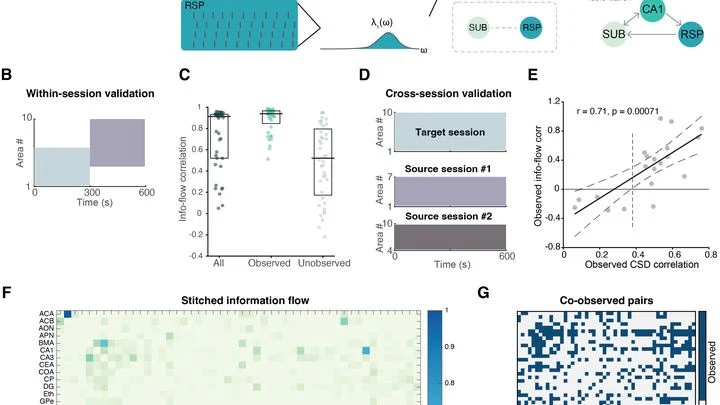
A patchwork quilt where each patch is a recording of activity from a small brain region. One patch was stitched on Monday in London, another on Tuesday in New York, and a third a month ago in Tokyo. This mosaic covers the brain only partially, and there is no common seam to join them.
When the conductor leaves the orchestra, the musicians keep playing from memory for a while. But without a unified rhythm, each one starts to speed up or slow down on their own, and the harmonious symphony turns into disjointed noise. According to new research, the brain and heart behave much the same way in the last hours of a person's life.
Astronomers listen to the cosmos like an old radio: they twist the knob not to find a particular station, but to catch any unusual noise. This approach breaks the mold: instead of hunting for gravitational waves using memorized patterns, they catch everything — without bias.
A rock concert blares at full volume, and you're trying to catch your friend's whisper. That's roughly how radio detectors feel when they pick up signals from cosmic dust particles. A particle slams into the atmosphere and spawns an air shower, a cascade of millions of secondary particles, and this shower emits a short radio pulse.
A spectrum is like a photograph of a material's inner workings, taken with light. When a beam passes through or reflects off a sample, molecules leave characteristic dark bands, peaks, on that photograph. But if the image is overexposed or veiled in gray, making out details becomes nearly impossible.
Any light measurement runs into a fundamental limit: photons hit the camera sensor unevenly. This natural ripple (shot noise) blurs fine details, like trying to pick out a quiet instrument in an orchestra through the noise of the hall.
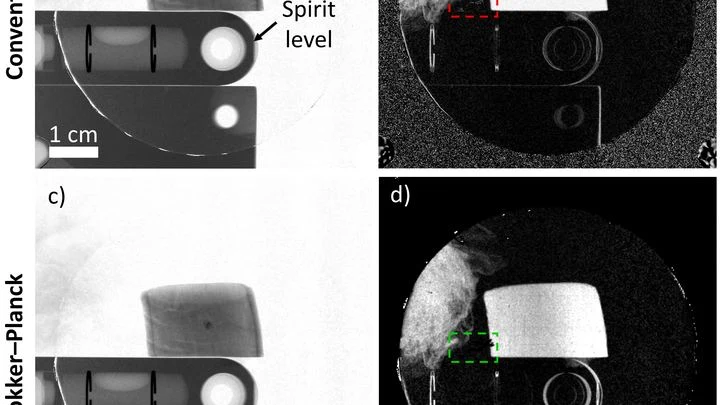
An X-ray machine with gratings takes not one but three pictures at once: a regular image, a map of beam deflections invisible to the eye, and an image of tiny structures that scatter light. Together, they help spot, for example, emphysema or pulmonary fibrosis. But there's a catch: to separate these three layers, you need a clever mathematical trick.
When a person breathes, air doesn't flow in a steady stream but in waves. Previously, doctors and scientists only looked at overall numbers: how much air entered per breath, what the peak flow was. But within a single breath, there are nuances — small variations that speak to the workings of nerves and muscles. The new approach breaks a breath into parts, much like a musician breaks a chord into individual notes.
The lungs are not two bags but millions of tiny sacs where air enters and blood flows close by. To see how they work, doctors sometimes use MRI without contrast: the scanner picks up weak signals from the tissues themselves. But these signals are like a radio in a thunderstorm — breathing is irregular, pulse jumps, and the image falls apart.
The quantum Fourier transform is like a musical instrument that breaks a signal into pure notes. If the instrument is slightly out of tune, the melody sounds wrong. Scientists are checking whether you can spot the detuning by listening to just a few random notes.
Previously, it was thought that if the instrument plays well on average, it would also work for complex pieces.
The heart doesn't contract all at once but as a wave: an electrical signal travels through the muscle, and behind it, like ripples spreading on water, a contraction rolls through. In arrhythmia, this wave goes awry: it stalls in one spot, loops in another, and the pump starts working in a disorganized way.
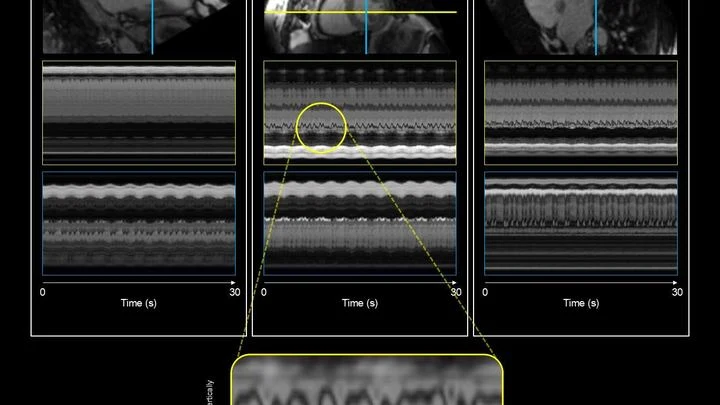
The heart beats irregularly. Standard MRI pretends all beats are the same: it stacks them on top of each other, like a photographer shooting a dancer with a long exposure. The result is a blurry smudge — pretty, but useless if you need to see each individual movement.
The new approach films the heart like a video: frame by frame, with no gaps.
The heart beats, and on a paper ECG strip, each beat looks like a sharp spike with two humps: a quick rise, then a smaller wave, then a descent. A doctor looks at such a strip and sees the rhythm, but the shape of each spike, how exactly the muscle contracted, is hard to discern, especially if the recording lasts a full day.
This new method turns that strip into a colorful carpet.
Light passing through ripples on a water surface paints dancing patterns on the bottom of a pool. Engineers have used a similar idea to make light compute. They fabricated a tiny plate with a wavy relief: each ridge and groove deflects rays in its own way. When an image falls on such a surface, the light transmitted through it converges at different points behind it.
An X-ray image of a battery looks like a photo taken through frosted glass: fine details blur into a gray smudge. The culprit is the detector itself, which cannot distinguish features smaller than its pixel size. Engineers proposed getting around this barrier by illuminating the sample not with a uniform beam but with a striped pattern.
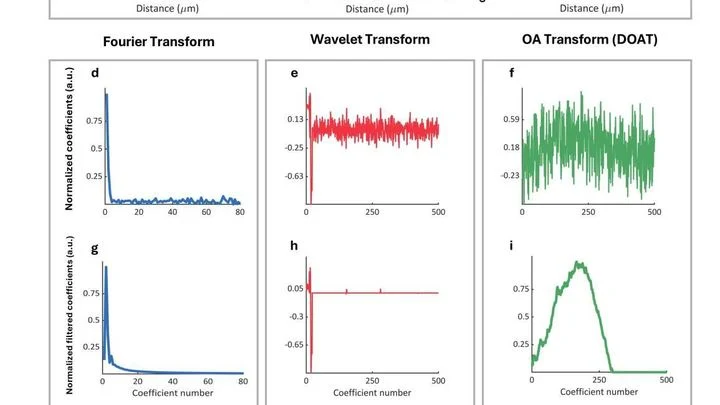
A laser beam hits the skin, and tissues respond with a barely audible ultrasonic echo. From that echo, doctors can see blood vessels and tumors without making a single incision. But before the picture appears on the screen, the signal has to be cleaned of noise, just as a cook skims the foam off a broth to make the soup clear.
An echocardiogram is like a window into the engine room: you can see the chambers contracting and relaxing. The key question is how much blood the heart pumps out with each beat. Doctors calculate this by hand, and two specialists can differ by 10–15%. A computer could be more precise, but typical neural networks are like black boxes: they give an answer but don't say how.
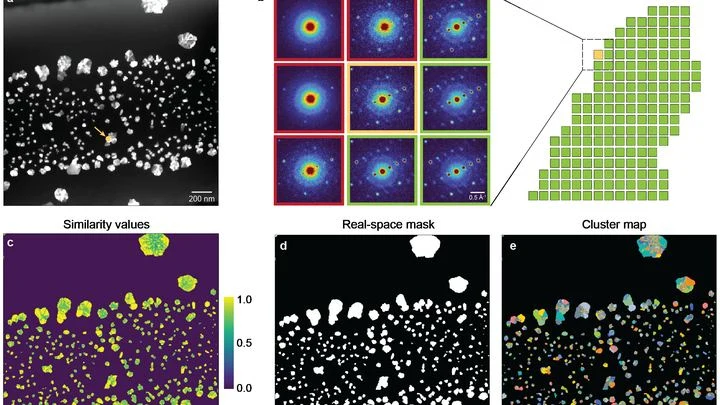
An electron microscope scans a sample and records how electrons scatter off atoms at each point. The result is a giant stack of images — one for every point. These images encode information about how atoms are arranged: in neat rows or with a tilt, the orientation of the crystal lattice, and whether there are internal strains.
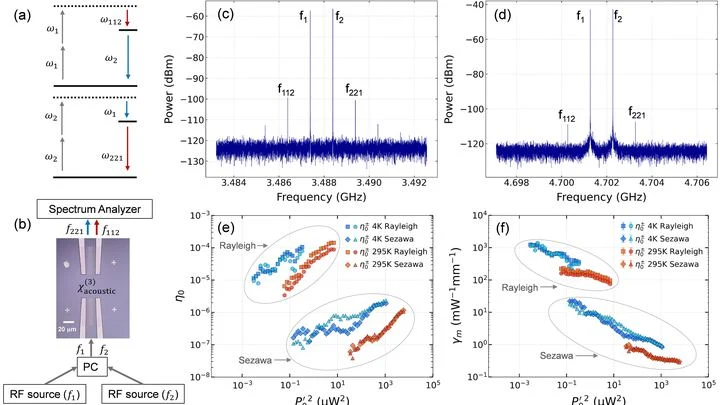
In the kitchen, when two broths are mixed in one pot, the resulting flavor is new, unlike either of the originals. A similar trick is possible with sound: two waves meeting on the surface of a crystal give birth to a third, with a frequency that neither of them had.
Inside a tiny crystal, sound is trapped like light in a mirrored room. It bounces off the walls and forms standing waves — a multitude of harmonic oscillations, each with its own frequency. Physicists have learned to use these oscillations as qubits — the basic units of quantum information.
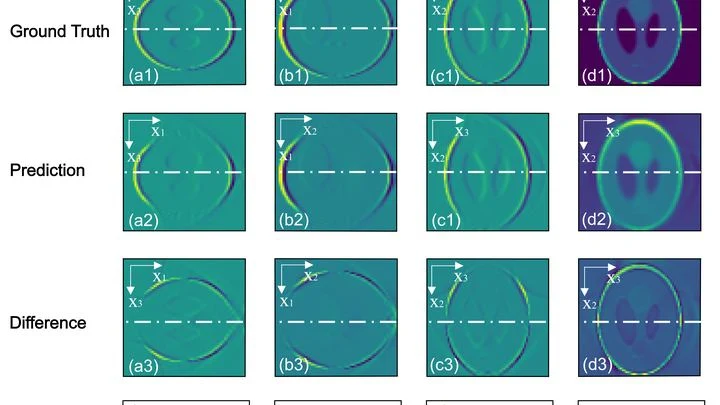
A laser hits tissue, and the tissue responds with a barely audible click — a sound wave. Sensors pick it up, and from that, an image of what's inside is built. That's how photoacoustic imaging works: light reaches deep, and sound carries the picture out.
In the new scheme, there are no sensors. Instead, several thin light beams are sent through the area where the wave has passed.