Monte Carlo methods are a class of computational algorithms based on repeated random sampling. They allow numerical estimation of high-dimensional integrals, solving differential equations, and optimization problems. The key idea: instead of analytical calculation, one resorts to a statistical experiment. Convergence is slow (error decreases as 1/√N) but independent of dimensionality, making the methods indispensable in multidimensional space. In finance, for example, they estimate the value of complex derivative instruments, in biology they model population evolution, and in computer graphics they create realistic scene lighting (ray tracing).
History
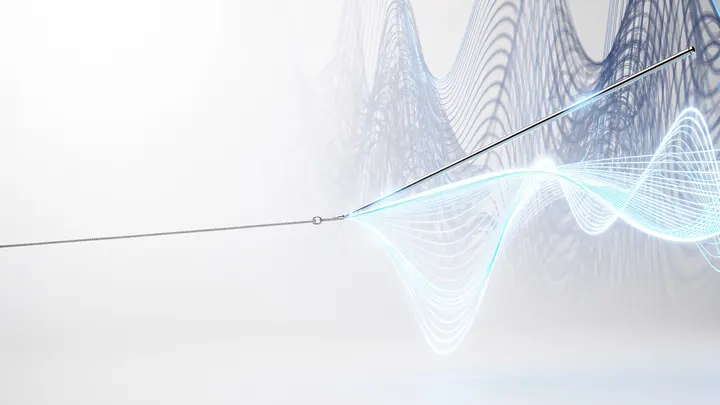
The idea goes back to Buffon's needle experiment in the 18th century, but as a computational tool it took shape in the 1940s. Stanislaw Ulam, recovering from an illness, thought about solitaire games and realized that instead of complex combinatorial calculations, one could simply replay a random game many times and estimate the probability of winning. He discussed this with John von Neumann, and they applied the approach to neutron diffusion calculations. In 1953, the seminal paper by N. Metropolis et al. on the sampling algorithm appeared.
How it works
To estimate the integral I = ∫ f(x) dx, one introduces a probability density p(x) and generates N points xi ~ p(x). The approximation: I ≈ (1/N) Σ f(xi)/p(xi). In MCMC, a Markov chain is constructed with a transition kernel that ensures ergodicity and stationarity on the target distribution. For complex distributions, ensemble sampling and Hamiltonian Monte Carlo are used, which utilizes gradients of the log-density.
In practice
Engineers use them to verify the reliability of bridges, financiers forecast stock prices, and physicistsmodel nuclear reactions.
Fun fact
The most famous example is computing π: by throwing points into a square with an inscribed circle and counting the ratio of those that fall inside the circle to the total, one gets an approximation 4×(inside/total).
The orchestra plays without a conductor. Each instrument follows its own schedule: the violin on Monday, the flute on Wednesday, the timpani on Saturday. Astronomers hear not music but isolated notes scattered across the calendar. A telescope sees a star only when it is above the horizon and when the schedule has allotted time for it.
In a noisy hall, an interpreter tries to catch every word, but rustles and echoes muddle the meaning. That's roughly how conventional computer methods handle complex quantum systems: the more particles and the stronger their correlations, the faster calculations drown in interference.
The standard approach to a certain class of machine learning problems is like a spring that's been stretched and then forgotten: standard methods artificially inflate the problem's size, turning computations into a black hole for memory and time.
Power systems with solar panels and wind turbines are like a chess game: cloud cover and load changes are the opponent's moves, impossible to foresee. To maintain balance, operators used to run through dozens of scenarios (uncertainty) — that took too much time and computing power.
Imagine a fleet of many ships, resembling a galaxy — a vast stellar system where every element follows the overall dynamics. From time to time, one ship breaks down, exploding like a supernova — a catastrophic event that can disrupt the integrity of the entire formation. If the damaged unit isn't replaced in time, the fleet loses combat capability.
A tightrope walker steps onto the wire. Every move is a calculation: shift your weight just right, or you’ll fall. In the world of quantum particles described by the Dirac equation, there’s a different kind of abyss — the wave function’s furious oscillations.
On a topographic map, raindrops choose their path: falling on one slope, they flow into River A; on the other, into River B. An observer sees only the winding rivers (the response variables Y) and knows which slope the water came from (the instrument Z), but cannot see the drops themselves (the unobserved factors ε).
A lab robot counts molecules, and gets it wrong. One tube shows 0, another 12, a third 3, though in reality they all hold roughly the same amount. Such 'raw' numbers are common in biology: DNA sequencing, counting species in a water sample, gene activity. There's plenty of data, but it's sparse and more scattered than simple randomness would predict.
A cell is like a library where thousands of books are copied every day. Molecular machines, polymerases and ribosomes, slide along a template chain and assemble a copy, link by link. These machines have several states: they can slow down, make mistakes, or switch. Previously, calculating such a process took hours.
Many cutting-edge physics calculations hit a brick wall — not for lack of ideas, but because of arithmetic. We're talking about integrals that express particle collision probabilities or the shape of gravitational wave bursts.
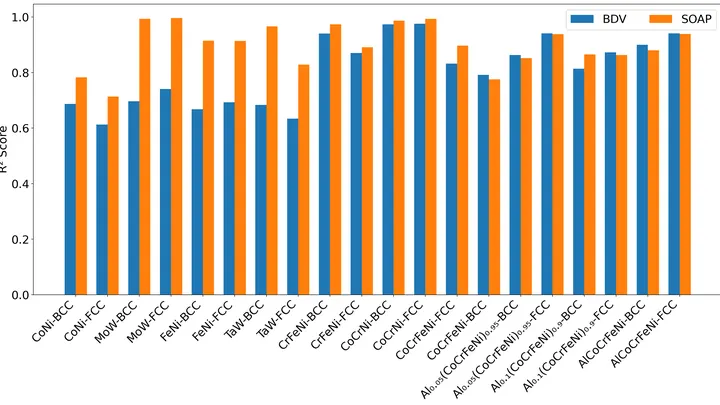
Creating an alloy from several metals is like cooking a soup from mysterious ingredients: guessing the final texture without trial and error is nearly impossible. Conventional models often get it wrong when there are more than three different kinds of atoms.
Picking out a single faulty microchip from a million, without any clue what the fault looks like, is a classic needle-in-a-haystack problem. A classical computer would test each chip one by one.
Pairs of black holes dance in three different styles before merging. The first is a neat waltz: the objects swirl in the same direction, like partners facing the same way. Such pairs are born from binary stars and often have unequal masses. The second is chaotic disco: spins are scattered, masses nearly equal.
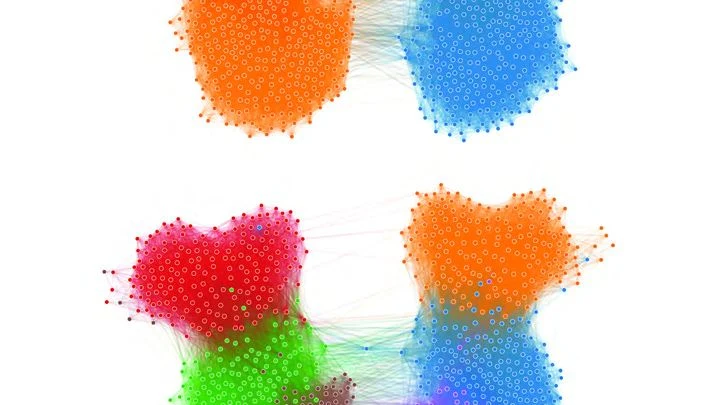
A social network is like a city: there are giant neighborhoods and tiny alleys. When an algorithm looks for tight-knit groups, it often picks out a couple of huge clusters and many small fragments. But the client (say, a municipality) needs districts of roughly equal size to distribute clinics or schools evenly.
Seven snapshots of the sky after the eruption of Mount Pinatubo. Each snapshot is a map of concentrations for dozens of substances. The question is simple: which substance turns into which? But how do you infer a causal chain from seven frames when you have more variables than time points?
M-CaStLe looks at the map differently.
Cosmic rays are particles from deep space, accelerated to colossal energies. Smashing into the atmosphere, they trigger particle showers with radio waves. These waves are fingerprints, revealing the energy and direction of the intruder.
Prostate cancer radiation therapy requires precise calculation of the radiation dose at every point in the body. The classic Monte Carlo method simulates millions of particles and takes hours, while adapting the plan to daily anatomical changes needs seconds.
When matter is compressed to pressures of millions of atmospheres and heated to thousands of degrees, it is neither solid nor gas. This warm dense state is like the interiors of giant planets or the moment of a meteorite impact. You can't look inside directly, but you can shine X-rays and see how they scatter off electrons.
When light passes through a turbid medium, like a glass of milk or frosted glass, it scatters in all directions. But sometimes, instead of spreading out, it gets trapped in tiny 'pockets' inside the material. Physicists call these pockets localized modes: light falls into them as if into a trap and cannot escape.
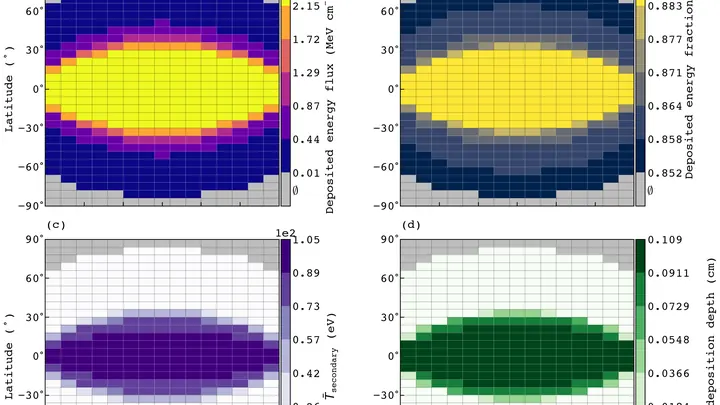
Europa's surface is an icy armor continuously bombarded by charged particles from Jupiter's magnetosphere. Electrons slam into the ice's crystal lattice, lose energy, and kick off chemical reactions. Until now, there was no tool to show how deep such bombardment pierces the ice.
A seven-metal alloy is like a team where every player is pulling the blanket their own way. Atoms of iron, cobalt, nickel, aluminum, titanium, tantalum, and vanadium can either fall into a strict pattern or scatter into random positions. This determines whether the material will be as strong as steel or as light as aluminum.
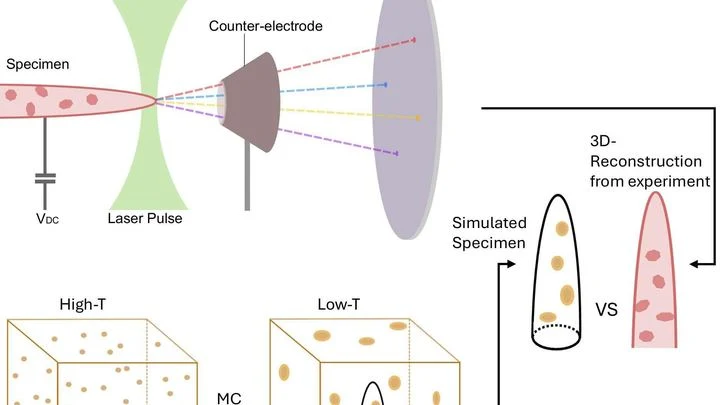
A radiation sensor in the city is like a street musician: it has to hit the right notes even when fingers go numb from cold or the instrument is baked by the sun. Usually, such devices are kept in greenhouse conditions, with heating or cooling, otherwise the energy scale (which distinguishes harmless potassium in concrete from dangerous cesium) starts to lie.
A programmer writes code, runs it, sees an error, and fixes it. Now this process can be handed over to the program itself. Machine learning can already improve algorithms, but it usually requires lots of data and ready-made examples.
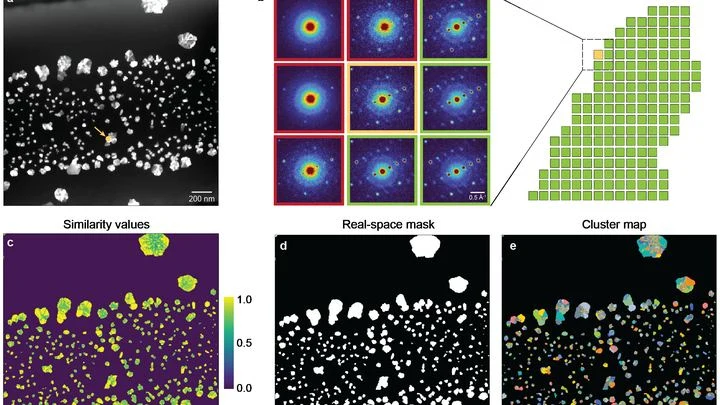
An electron microscope scans a sample and records how electrons scatter off atoms at each point. The result is a giant stack of images — one for every point. These images encode information about how atoms are arranged: in neat rows or with a tilt, the orientation of the crystal lattice, and whether there are internal strains.
A sheet of paper released from a window flutters, tumbles, and sometimes pauses flat for a second. Until now, to honestly predict such behavior, you had to run millions of equations on supercomputers for every drop of air. That's like simulating every atom of a cash register to count change at a store.
The new approach is smarter.
In disordered materials, such as organic semiconductors or inks made from two-dimensional materials, electrons don't move smoothly like water through a pipe. Instead, they hop from one spot to another, like a ball bouncing across a rough surface. This kind of motion is called hopping transport.
A blindfolded sapper searches for a mine by tossing pebbles at random. He cannot see the map or calculate where the charge is buried. But if he throws enough pebbles and listens for which one lands with a duller thud, he can pinpoint the danger. That is roughly how a new method for predicting El Niño works: the warm current that every few years alters weather across the entire planet.
A translator who learns to correct their own slips works more accurately. In the world of forecasting noisy processes, a new method takes on this role: a reservoir computer that adds a random correction to its prediction at each step.
Imagine an interpreter who gets distracted by every rustle in the hall. The more rustles, the more errors in the translation, even though the meaning of the speech hasn't changed. The same happens with data: if measurements are unevenly spaced, standard analytical tools start "hearing" changes that never occurred in the underlying process.
On an old film strip of rainfall, only the brightest frames are visible, and between them lies noise. A meteorologist assessing flood risk long looked only at such frames, that is, at annual rainfall maxima. Everything else, thousands of daily observations, remained off-screen. The new method develops the entire film, and details that were previously invisible come into view.