The lighthouse that dimmed its light ✛
At night, a lighthouse on its rock doesn't go dark, but sometimes the keeper draws the curtains over the lamp. The light is still there, just less of it. Something similar happened to the X-ray pulsar 4U 0114+65: it didn't disappear, it merely dimmed its emission.
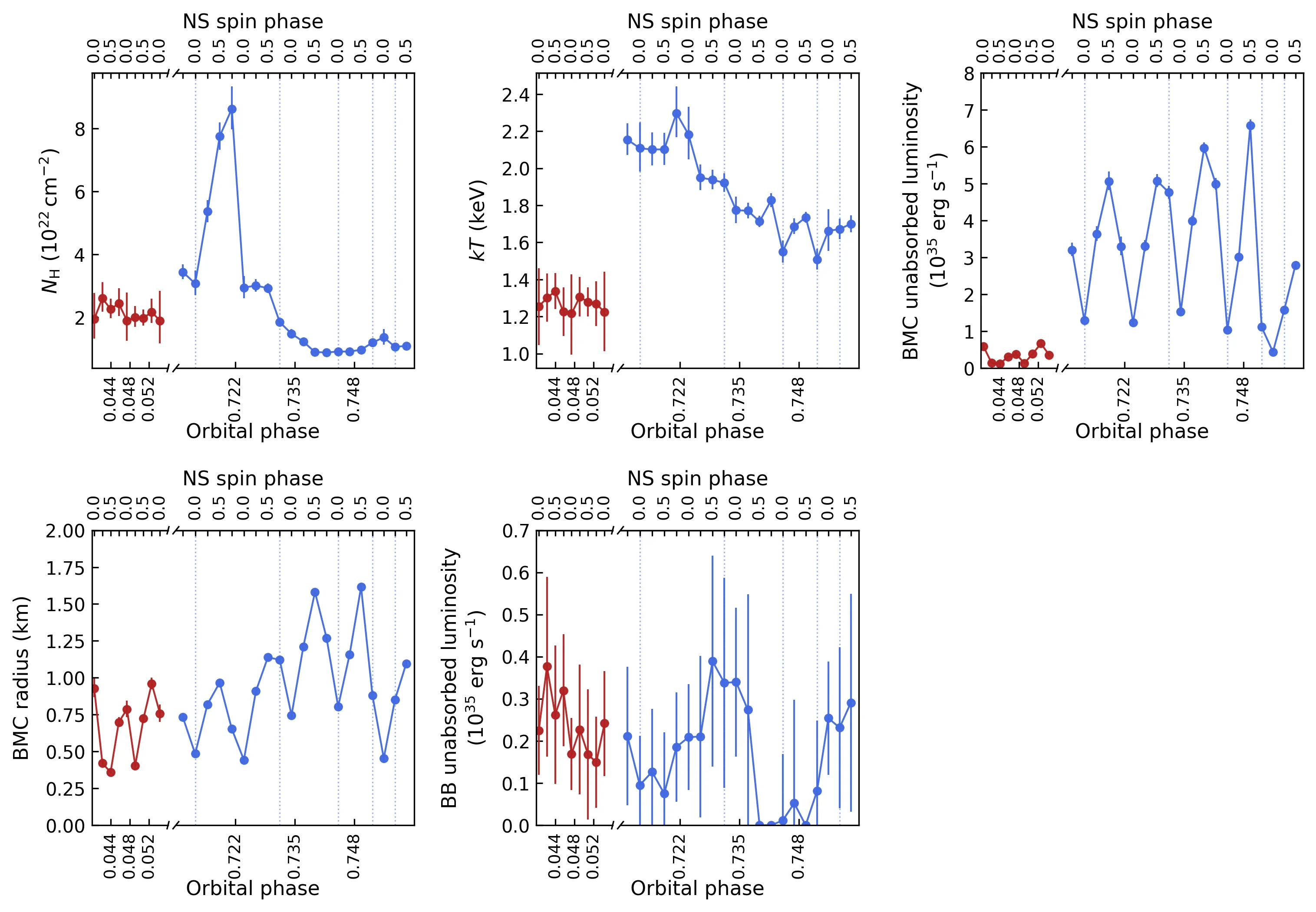
Ten years ago, this lighthouse shone brightly and steadily. Then in 2025 it stopped showing up in Swift/BAT monitoring, and astronomers urgently turned the XMM-Newton telescope on it. It turned out the pulsations hadn't gone anywhere; they had simply grown weaker by roughly a factor of ten. The main loss came from the Compton component, the part of the light produced when fast particles boost photons. The soft thermal glow, by contrast, dropped only by half.
Why did this happen? The wind from the donor star barely changed: the mass-loss rate stayed the same. What did change was the ratio of two radii. The Alfvén radius is the boundary where the star's magnetic field halts the infalling matter. The corotation radius is the distance at which matter would rotate at the same speed as the magnetic field. In 2015, the first radius was three times smaller than the second, and by 2025 it had grown to half of it. The magnetic boundary has crept closer to the zone where centrifugal forces begin to fling matter away.
It's a bit like curtains on the lighthouse being lowered further and further. The light hasn't gone out, but some of it no longer escapes. The system is probably entering a strong-coupling regime: the toroidal magnetic field, wound around the star, becomes comparable to the poloidal field, which runs along the axis. In that state, accretion is partially suppressed, and the pulsar spins down faster.
The lighthouse hasn't gone dark. It just dimmed its light, and now astronomers know what that process looks like.
The neutron star in 4U 0114+65 spins with a period of about 2.6 hours, making it one of the slowest known accreting pulsars. For comparison, a typical pulsar in the Crab Nebula completes a rotation in 33 milliseconds.
Stanisław Lem's novel Fiasco describes a neutron star with extreme magnetic fields that influence the surrounding matter. Although it deals with a different scenario, the idea of a 'magnet star' suppressing accretion echoes the discussed regime of partial centrifugal inhibition.