A pulsar glitch is a sudden, tiny increase in the rotation rate of a pulsar, followed by a slow relaxation back to its normal spin-down. Pulsars are neutron stars that spin with incredible regularity, but occasionally they 'stutter' — their rotation speeds up by a fraction of a percent in a matter of minutes or hours. These glitches are among the most dramatic events in neutron star physics, offering a rare glimpse into the interior of these extreme objects.
History
The first pulsar glitch was observed in 1969 in the Vela pulsar, just two years after the discovery of pulsars themselves. Since then, hundreds of glitches have been recorded, with the Vela pulsar glitching roughly every few years.
How it works
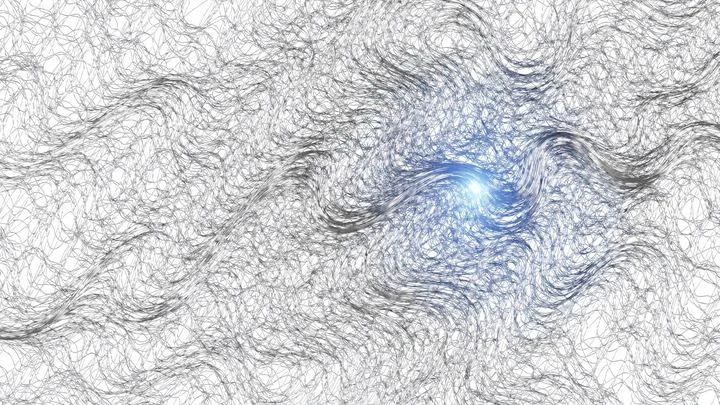
The leading explanation is that a pulsar's interior contains a superfluid of neutrons that rotates independently of the outer crust. As the crust slows down due to magnetic braking, the superfluid continues to spin faster. Eventually, the velocity difference becomes so large that the superfluid suddenly transfers angular momentum to the crust, giving it a kick — the glitch. This is analogous to a spinning ice skater pulling in their arms, but on a cosmic scale.
In practice
Glitch observations help constrain the equation of state of nuclear matter — the relationship between pressure and density inside neutron stars — which is crucial for understanding the most extreme states of matter in the universe.
Fun fact
The Vela pulsar's glitches are so regular that they have been compared to a cosmic clock that occasionally ticks twice — and this behavior was used to rule out some models of neutron star interiors.
At night, a lighthouse on a rock doesn't go dark, but sometimes the keeper draws the curtains over the lamp. The light is still there, just less of it. Something similar happened to the X-ray pulsar 4U 0114+65: it didn't disappear, it merely dimmed its emission.
A pulsar is a neutron star that captures material from a neighboring star and emits X-ray pulses with every rotation.
It's like a sprint record: to break it, you need a perfect run-up. But for sub-millisecond pulsars, the run-up is too short. The fastest known pulsar, PSR J1748-2446ad, spins 716 times per second — faster than a kitchen blender. If it were the size of Earth, a point on its equator would move at about 0.24 times the speed of light. But why doesn't any pulsar spin even faster?
Pulsar PSR J1637−4642 is like a drum with a ratchet: it spins at enormous speed, and each radio flash is a click marking time. For nine and a half years, astronomers listened to this rhythm on the 64-meter Murriyang telescope in Australia, and heard not a single skip. The mechanism seemed to work flawlessly.
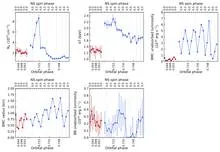
A lighthouse doesn't flash steadily but in short, bright pulses. The neutron star in the system 4U 1323-62 is such a lighthouse in the X-ray range. It pulls gas from a companion star, and when enough material accumulates on its surface, a thermonuclear explosion occurs — an X-ray burst.
In a binary star system, one star pulls matter from its companion. Over centuries, this material settles onto the surface of a neutron star — the ultra-dense remnant of a dead star. This process, called accretion, usually proceeds smoothly. Gravity behaves as general relativity predicts, without surprises.
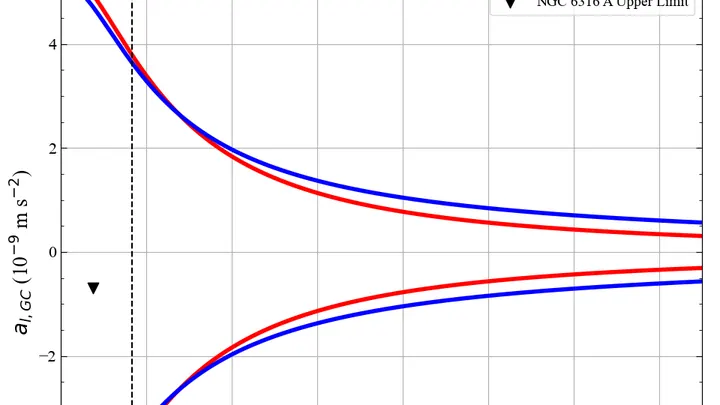
A globular cluster, a dense swarm of hundreds of thousands of stars, plows through a galaxy like a bullet through water. In ordinary dark matter (the invisible mass that holds galaxies together), it should quickly lose speed due to dynamical friction.
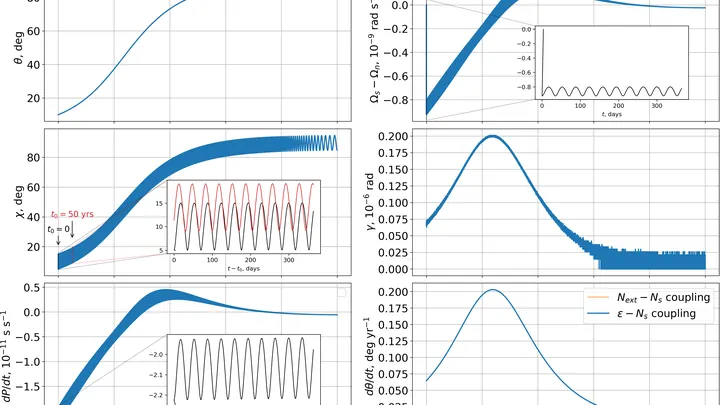
89 milliseconds. That's how long a vortex avalanche lasts that abruptly speeds up the rotation of the Vela pulsar — one of the most famous 'glitching' pulsars. Pulsars are rapidly spinning neutron stars born in the collapse of supernovae.
A spinning top that makes a hundred turns per second suddenly starts losing speed dramatically — much faster than any known top. That's exactly what pulsar J0435+3233 is doing. It's a dead star, crushed to the size of a city, but whirling at a furious rate.
For over a century, astronomers puzzled over the capricious behavior of RR Lyrae stars: their brightness periodically waxed and waned with unpredictable amplitude, like a lighthouse with a faulty mechanism. The Blazhko effect, discovered in 1907, taunted scientists for decades.
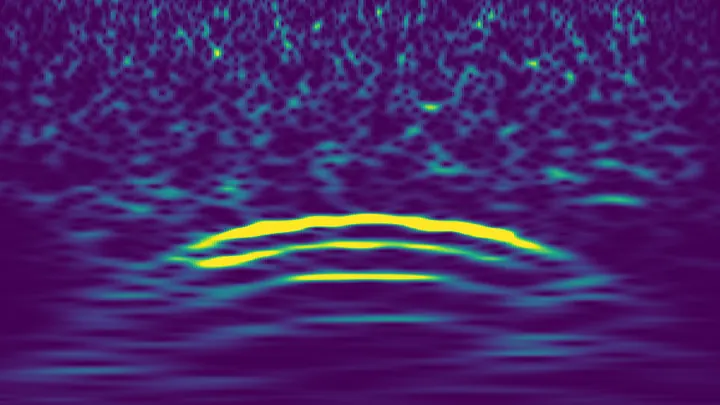
Gravitational-wave detectors are like sensitive microphones, listening for the whispers of distant cataclysms. But every now and then, a sharp crack bursts in — a brief noise spike known as a glitch.
Hidden in the globular cluster Terzan 5 is the binary system IGR J17480-2446. One of its members is a neutron star that behaves strangely. It spins at just 11 hertz (11 revolutions per second) and cools suspiciously slowly after an outburst. Usually, such stars spin hundreds of times faster and cool briskly — here, it's the opposite.
A pendulum swings on its own, but sometimes it suddenly starts swinging so violently that it nearly breaks free from its mount. That's roughly how the white dwarf GD 1212 behaves — a star the size of Earth but with a mass almost like the Sun's.
In the accretion disks that gird the nuclei of active galaxies (quasars, discovered by Maarten Schmidt way back in the 1960s) a river of incandescent gas and dust churns. In its backwaters, where turbulent flows subside, against all odds, planets are born.
A radio telescope is not just an antenna, but a computing machine that builds an image from millions of equations. This mathematical prism is as fragile as glass: one wrong digit in the calibration, and the real sky splits, spawning phantom sources.
Since their discovery in 2007, fast radio bursts (FRBs) have teased astrophysicists with their elusive nature. These millisecond signals arrive from distant galaxies and carry colossal energy: for an instant, they radiate as much as the Sun does in a month.
In the centers of galaxies, where supermassive black holes lie dormant surrounded by stellar swarms, lights of monstrous power sometimes flare up — tidal disruption events. But some of these events behave oddly: they repeat again and again, and each new ignition is dimmer than the last.
Every quantum particle has spin — an intrinsic magnetic property, like a tiny arrow. In an experiment, a beam of such particles passing through a magnet splits in two, like a coin that lands either heads or tails. That’s exactly how particles like a hydrogen atom behave.
Imagine a spinning top the size of a city, weighing more than the Sun and making hundreds of revolutions per second. That's a neutron star — the remnant of an exploded star. Occasionally, its rotation suddenly speeds up, as if something inside has switched. Astronomers call these jumps glitches and suspect that invisible vortices in the star's superfluid interior are to blame.
A spinning top that wobbles as it rotates: that's roughly how astronomers picture the neutron star in the binary system Hercules X-1. It completes one full turn on its axis every second, but its axis slowly traces a cone with a period of 35 days.
When hot soup cools, clumps form on the surface — similarly, as the early universe cooled, it gave birth to threadlike clumps of energy: cosmic strings. Some of them are like a stretched rubber band: as long as it's intact, it's stable. But if you nick the band, it snaps.
A neutron star is a spinning top with the mass of the Sun, crushed to the size of a city. It's born in the fire of a supernova and usually only slows its spin. But sometimes, for no apparent reason, it suddenly speeds up — such a jerk is called a glitch.
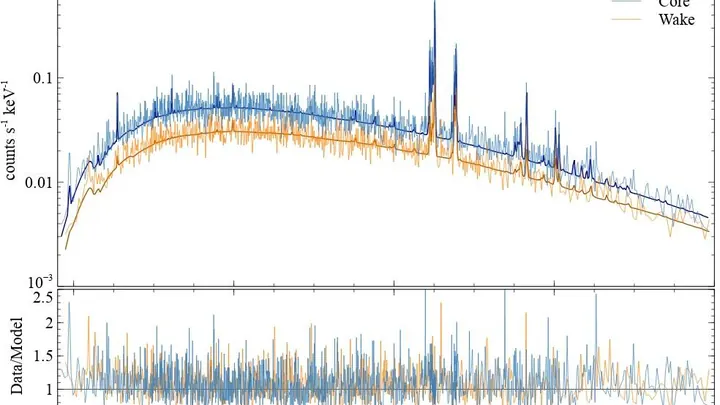
At the heart of the Ophiuchus galaxy cluster floats a bubble of hot plasma the size of several galaxies. It rises like a giant hot-air balloon in the atmosphere, leaving a wake behind it — a region where gas is set in motion.
When a heavy atomic nucleus splits, it doesn't break into even halves. First, two fragments form that look like pears pressed together at their narrow ends. Then the junction begins to smooth out, like two droplets merging and the surface quickly leveling.
In that brief moment, the surface moves inward, and particles inside the nucleus can bounce off it, like a ball off an oncoming wall.
Globular clusters, dense swarms of hundreds of thousands of stars, hide millisecond pulsars. These are dead stars spinning at breakneck speed: one rotation every few milliseconds, like a kitchen blender on max.
In 2017, the IceCube detector caught a neutrino from the distant galaxy TXS 0506+056. It was like hearing a phone ring from across the ocean: the signal came from where the most energetic particles in the Universe are born. At the same time as the neutrino, astronomers spotted a gamma-ray flare, and two to three years later, radio waves. Why was the radio late?
A wormhole is a hypothetical tunnel that shortens the path between distant corners of the universe, like a soap bubble stretched between two points. To keep the bubble's walls from closing, a special film is needed — matter with negative pressure, akin to dark energy. But this support isn't eternal: remove half the film, and the bubble bursts.
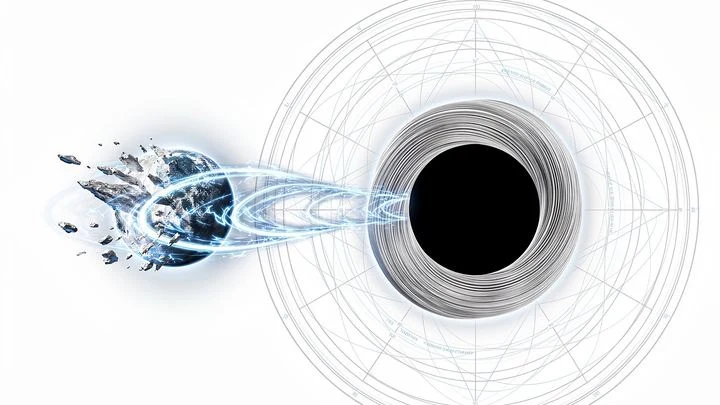
A black hole can torment a star for years, rather than rip it apart immediately. Tidal forces are when the hole's gravity stretches the star: the near side is pulled harder than the far side. Usually, getting too close rips the star apart instantly — that's a tidal disruption event.
The proton is not a solid ball but a seething cloud of quarks and gluons. Each particle carries its own bit of rotation, but if you add up all the bits, you don't get the full proton spin. Part of the rotation seems to hide in the cloud's slowest inhabitants: those carrying only a tiny share of the total motion.
In a dense ball of hundreds of thousands of stars, what astronomers call a globular cluster, radio telescopes have picked up a faint but very steady rhythm. Every 2.45 milliseconds, that's 408 ticks per second, a radio pulse arrives.
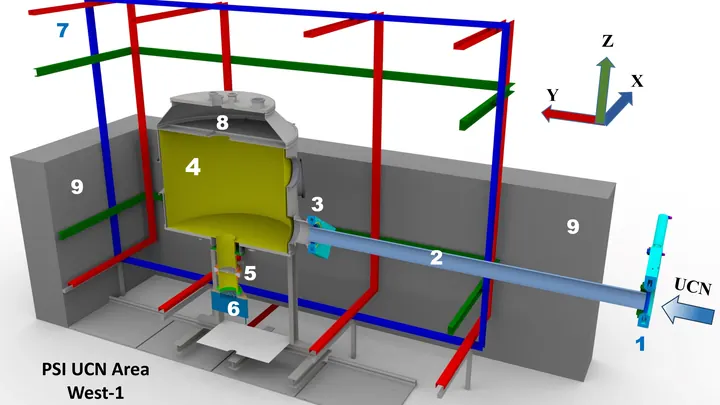
The neutron, a particle inside the atomic nucleus, can live in two worlds: ours and a mirror one. The mirror world has its own neutron twin, invisible to our instruments. If an ordinary neutron sometimes hops to the mirror world and back, some neutrons in a trap would seem to dissolve into thin air.
In 2019, gravitational-wave detectors caught a signal from the merger of distant objects. One was a black hole of 23 solar masses. The other weighed just 2.5 solar masses — and that's weird.
Usually, neutron stars don't get heavier than two solar masses: beyond that, they collapse into a black hole.
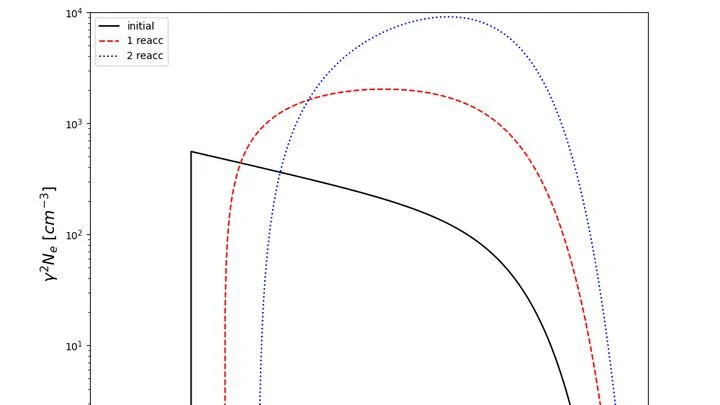
A blazar is a distant galaxy with a plasma jet shooting from its center, aimed almost directly at us. Inside this jet, particles are accelerated to near-light speeds and emit powerful radiation.
In the center of galaxy J2344 five years ago, a black hole tore apart a star, and now scorching gas bubbles there — a cosmic “stew pot”. Every 12 hours, giant X-ray bubbles rise in it, and on their ascent, super-hot splashes lasting 5–30 minutes appear.
In a dense gas cloud where a star heavier than the Sun is forming, there is a tiny source of radio waves. It works like a laser: methanol molecules amplify the radiation, and we see a bright spot. But this spot behaves strangely: its brightness jumps up and down within a matter of hours.
The pulsar in the Crab Nebula blinks like a lighthouse: every 33 milliseconds it sends out a radio pulse, and it does so with the precision of atomic clocks. But sometimes its rotation stumbles: the star suddenly speeds up slightly, as if something inside it is shifting.
In a dance with an ordinary star, astronomers have found a true heavyweight — a neutron star with 2.35 times the mass of the Sun. That's more than any other whose mass has been precisely measured. These objects are born when a star explodes as a supernova and its core collapses into a city-sized sphere.
Gamma-ray burst 230307A lit up the sky like a thunderclap: in seconds, it released more energy than the Sun will emit over billions of years. Three detectors—GECAM-B, GECAM-C, and Fermi/GBM—were looking in the right direction at that moment.