Spin-down of the accreting magnetar 4U 0114+65 ✛
Context
The work sits off to the side of neutron-star and magnetar research: neighboring papers deal with cooling magnetars, infrared observations of 4U 0142+61, magnetic fields in 4U 1700-37, jet birth around black holes, scars on stars left by destroyed planets, radio bursts from black holes, and X-ray pulsations from neutron stars. What sets this work apart is that it examines a rare case of long-term disappearance of pulsations in hard X-rays from a slowly rotating accreting pulsar and links it to the evolution of the ratio of the Alfvén radius to the corotation radius. This approach to the strong-coupling regime had not previously been applied to 4U 0114+65.
Methods
Two XMM-Newton observations separated by ten years were compared: one from 2015 (49 kiloseconds) and one from 2025 (21 kiloseconds), supplemented by eight short Swift/BAT pointings in 2025 and the long-term Swift/BAT light curve. For timing analysis, a sliding window with a Lomb-Scargle periodogram was used over 1000 points with a shift of 100 points; periods with a signal-to-noise ratio above 5 and a false-alarm probability below $10^{-5}$ were selected. Spectra from the three EPIC cameras were combined and grouped to at least 25 counts per channel, then fitted in the ISIS package with a model consisting of bulk-motion Comptonization (bmc), a blackbody soft excess, and Tbnew absorption. To search for short bursts, the semi-automatic dipspeaks algorithm based on autoencoders was used, and for clustering bursts, a Gaussian mixture model.
Results
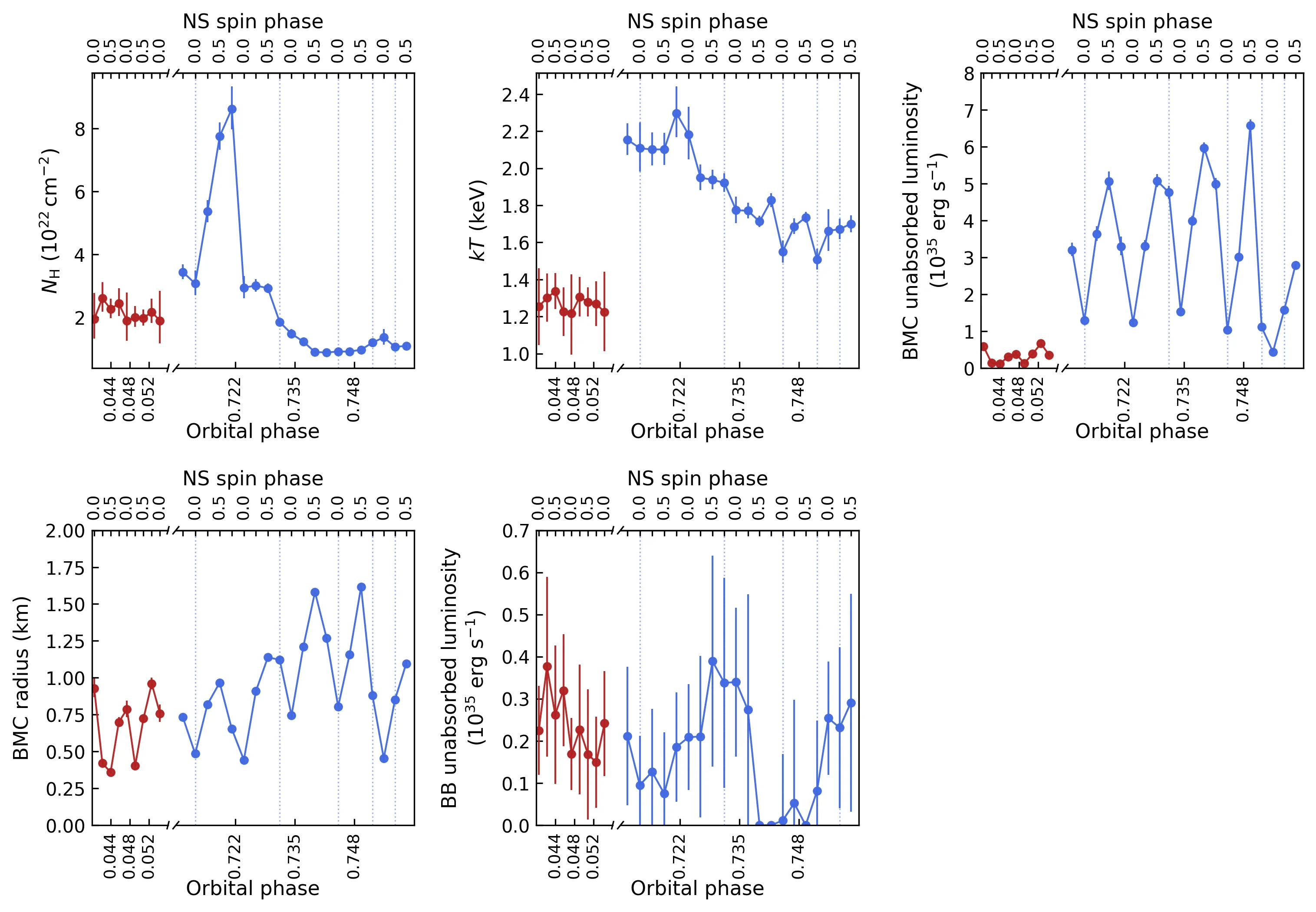
In the 2025 observation, pulsations were detected with a period of about 9.3 kiloseconds, even though they are not visible in Swift/BAT. The luminosity fell from 3.3×$10^{35}$ to 3.1×$10^{34}$ erg/s, that is, by roughly an order of magnitude, with the main contribution coming from suppression of the Compton component (its flux dropped by a factor of ~9), while the blackbody component weakened only by half. The pulsed fraction of the Compton component remained around 0.7 in both observations. The absorbing column in 2025 is higher, but an estimate of the donor star's mass-loss rate gives (5.6±0.3)×$10^{-7}$ solar masses per year versus (7.4±0.2)×$10^{-7}$ in 2015, which points to no global changes in the wind. The ratio of the Alfvén radius to the corotation radius grew from ~0.3 to ~0.5, and the spin-down rate between the last reliable Swift/BAT measurement and XMM-2 was ~$10^{-4}$ s/s, close to the theoretical maximum for the strong-coupling regime.
Implications
The work differs from neighboring studies in that it is the first to link the long-term disappearance of pulsations in hard X-rays to an approach toward the strong-coupling regime, where the toroidal magnetic field becomes comparable to the poloidal one. Neighboring papers study magnetars and pulsars in other states, but they do not consider the transition to partial centrifugal inhibition of accretion in a slow pulsar. If the interpretation is correct, this is the first observational evidence of such a transition, which broadens our understanding of the evolution of accreting neutron stars.
Future development
The topic could move toward longer monitoring of 4U 0114+65 to track the further evolution of the ratio of the Alfvén radius to the corotation radius. New observations with XMM-Newton, NuSTAR, or future X-ray missions could test whether the strong-coupling state recurs. Modeling of the magnetospheric boundary that accounts for wind inhomogeneities and testing the hypothesis of cyclic accretion are also promising.
Impact
The results will affect the interpretation of variability in accreting pulsars and models of quasi-spherical accretion. They are also important for understanding the evolution of neutron-star magnetic fields in binary systems.
Next steps
Continue monitoring 4U 0114+65 in X-rays to register the return of pulsations in hard X-rays. Carry out more detailed phase-resolved modeling of the spectra, allowing for possible inhomogeneity of the hot spot.
Key open problems
The work addresses the unsolved problem of the link between accretion rate, magnetic field, and neutron-star rotation in the quasi-spherical regime. It also touches on the question of how accreting magnetars evolve and how to distinguish them from ordinary pulsars.
The knowledge machine's view
This section is addressed to the author of the paper and their colleagues. Neighbouring works were found by meaning-based search across our archive, not by word overlap. We do not review: we show the field around the work.
What the work does
The study compares XMM-Newton observations from 2015 and 2025 of 4U 0114+65: the pulsations persist with a period of ~9.3 ks, but the luminosity has dropped by an order of magnitude due to suppression of the Compton component. The spectral shape has barely changed, and absorption increased in line with the orbital phase. The authors interpret this as the system approaching a regime of partial centrifugal suppression of accretion in the strong-coupling regime.
Where its strength is
For the first time for 4U 0114+65, a link has been shown between the long-term disappearance of pulsations in hard X-rays and an increase in the ratio of the Alfvén radius to the corotation radius, which may be observational evidence of a transition to the strong-coupling regime.
Where it could go next
- It might be interesting to compare the resulting magnetic field estimate with methods that use cyclotron lines, as in the work on the magnetic field in 4U 1700-37, to check the consistency of different approaches.based on: A Cosmic Magnet in 4U 1700-37 arXiv:2602.04622
- A nearby study concerns the infrared emission of the magnetar 4U 0142+61; perhaps similar infrared observations of 4U 0114+65 would help track changes in the accretion disk or wind during the transition to the new regime.based on: Infrared Rhythm of a Magnetar: JWST Tunes into 4U 0142+61 arXiv:2606.29653
- The idea of turbulent amplification of magnetic fields in newborn neutron stars may suggest how the toroidal field component in 4U 0114+65 could have reached a magnitude comparable to the poloidal one, which is important for the strong-coupling regime.based on: Cosmic Kneading: Turbulent Amplification of Magnetic Fields in Newborn Neutron Stars arXiv:2607.21990v1
Worth trying
- Check whether the strong-coupling regime shows up as a change in the pulse profile in the next XMM-Newton observation.
- Search for cyclotron lines in the spectrum of 4U 0114+65 to obtain an independent estimate of the magnetic field.
- Compare the long-term evolution of the period with models that include a toroidal field, using Swift/BAT data.
Why this may matter
If the interpretation is correct, this is the first observed transition of an accreting pulsar into the strong-coupling regime, which will make it possible to calibrate theoretical models of the interaction between the accretion disk and the neutron star's magnetosphere and to better understand the evolution of such systems.
Nearby works in our archive
- Infrared Rhythm of a Magnetar: JWST Tunes into 4U 0142+61similarity 0.58
- A Cooling Magnetic Starsimilarity 0.57
- The Pulse of a Black Hole: Birth of a Jet in X-ray Echosimilarity 0.56
- A Record That Can't Be Broken Because the Run-Up Is Too Shortsimilarity 0.53
- Black hole blinked with a radio flaresimilarity 0.53
- A Pulsar's Magnetic Heart Began to Beat Fastersimilarity 0.53
- A Cosmic Magnet in 4U 1700-37similarity 0.53
- Cosmic Kneading: Turbulent Amplification of Magnetic Fields in Newborn Neutron Starssimilarity 0.52
The archive is sparse around this work: the closest review is only 0.58, against a usual 0.64. It looks like few have drilled nearby.
The neutron star in 4U 0114+65 spins with a period of about 2.6 hours, making it one of the slowest known accreting pulsars. For comparison, a typical pulsar in the Crab Nebula completes a rotation in 33 milliseconds.
Stanisław Lem's novel Fiasco describes a neutron star with extreme magnetic fields that influence the surrounding matter. Although it deals with a different scenario, the idea of a 'magnet star' suppressing accretion echoes the discussed regime of partial centrifugal inhibition.
Key numbers
- spin period in 2025: 9.3 kiloseconds
- luminosity drop between 2015 and 2025: roughly a factor of 10
- pulsed fraction of the Compton component: 0.7
- ratio of the Alfvén radius to the corotation radius: 0.3 → 0.5
- spin-down rate: ~10-4 s/s