Strong coupling is a regime in quantum physics where the interaction between two systems—such as light and matter—is so intense that it overwhelms any losses or dissipation. In the context of magnons (quantized spin waves in magnetic materials) and photons, strong coupling means the two can exchange energy back and forth coherently many times before the energy leaks away. This is fundamentally different from weak coupling, where the interaction is a small perturbation and the systems mostly behave independently.
History
The concept of strong coupling has roots in cavity quantum electrodynamics, developed in the 1980s–1990s with atoms in optical cavities. The extension to magnons in magnetic materials came later, around the 2010s, with experiments coupling yttrium iron garnet spheres to microwave cavities.
How it works
The key is the ratio between the coupling strength (the rate of energy exchange) and the combined decay rates of both systems. When the coupling rate exceeds the losses, the system enters the strong coupling regime. The magnons and photons then form hybrid quasiparticles called magnon-polaritons, which have properties of both constituents. This coherent exchange can be observed as an anticrossing in the dispersion relation—a splitting of energy levels that indicates the two systems are no longer independent.
In practice
Strong coupling is essential for quantum information processing, where coherent transfer between light and spin systems is needed for quantum memories and transducers. It also enables cavity spintronics, where magnon-photon hybrids are used for signal processing and sensing.
Fun fact
In the strong coupling regime, the hybrid magnon-photon system can be used to create a 'dark mode' that is decoupled from the environment, preserving quantum information for much longer than either constituent alone.
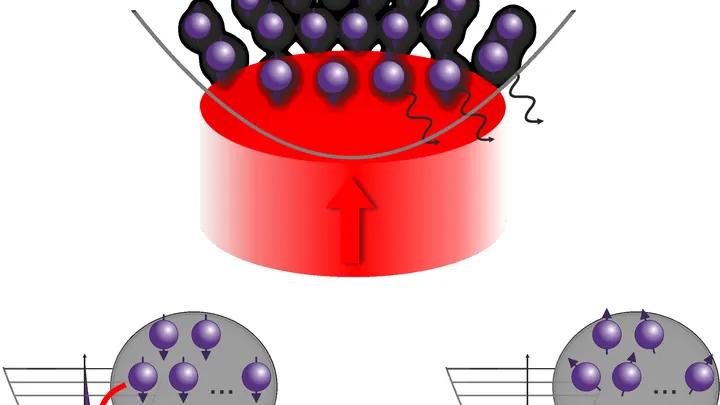
A tiny crystal of charged atoms, trapped in a trap, trembles with heat. Each ion oscillates like a ball on a spring, and these vibrations hinder using the crystal for precise quantum operations. Usually, excess energy is removed with a laser — the beam hits the ions and slows their motion, like a stream of air damping a pendulum.
A tightly twisted phone cord snaps and scatters sparks. Magnetic fields on the Sun behave the same way: they twist, break, and reconnect, powering flares. For the first time, astronomers have witnessed this process directly. One loop was twisted by 540 degrees — one full turn and then half again. That’s three times more than previously thought possible.
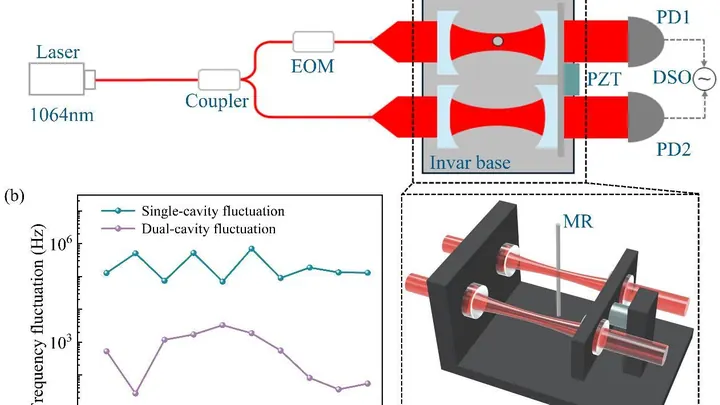
A guitar string is stretched between two mirrors. A beam of light bounces back and forth between them, and the string shudders at every touch. Sometimes the light loses energy — the string takes it and dissipates it as heat, like a fading sound. Other times, the string shifts the pitch of the light itself, changing its color but barely dimming it.
Ice, water, steam — phase transitions we all know. But what happens if you squeeze and heat an atomic nucleus itself? Theorists think protons and neutrons inside it 'melt,' releasing smaller building blocks — quarks and gluons.
A child on a swing: too strong a push and they fly off. Roughly this is how powerful light tears electrons out of an atom. It would seem that the stronger the push, the more certain the destruction. But in the quantum world it is different: when the field strength crosses a certain threshold, the atom suddenly freezes.
Light loves symmetry: in an open channel, it flows equally both ways. To steer it one way, physicists often use magnets. A new approach does without, using rotation — just the speed of a vinyl record — and interference from two atoms. Rotation changes the “pitch” of light for different directions, just as a siren’s tone shifts when a car approaches or recedes.
The Universe is a vast city. In it, dark matter is the invisible framework of buildings, and dark energy is the force stretching the streets. For a long time they were considered independent, but new research has caught them in secret communication.
The dance floor is packed: everyone moves on their own, no one holds hands. Suddenly the music gets louder and more rhythmic — neighbors start grabbing each other, forming pairs that spin in sync. That's roughly what the experiment looked like in the lab, where a cloud of lithium atoms, cooled to near absolute zero, was made to suddenly strengthen its mutual attraction.
Two tin nuclei collide at about two-thirds the speed of light. For an instant, a hot, dense cloud forms, and protons fly out in all directions. If you catch pairs of protons and measure how often they fly off in the same direction, you can work out the size of that cloud. This method is called femtoscopy: it works like a microscope for nuclear scales.
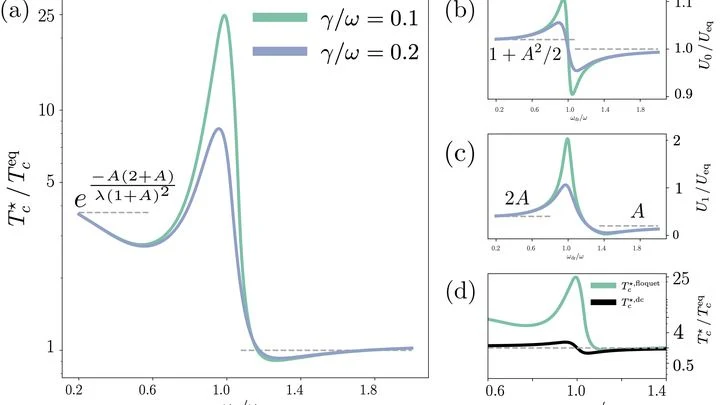
In a dark room, an infrared laser flashes, and a speck of black K3C60 powder conducts electricity without resistance for a split second. The light strikes at 10 terahertz — a thousand times faster than a microwave oven. The effect is a hundred times stronger than at other frequencies. Why this particular frequency?
In a dark room, an invisible lamp flashes. Its light is unlike anything familiar: it has no steady brightness, only rare but powerful bursts. This is bright squeezed vacuum — a state of light with no ordinary wave but strong quantum fluctuations. It is with such light that physicists bombarded xenon atoms.
An electron beam in an accelerator is like a flock of birds: it flies in a tight group, but over time it spreads out. To keep particles together, heavy magnets are usually used. Here they did without them — the beam squeezed itself.
In a superconducting resonator, light doesn't just bounce around: it embraces the qubit so tightly that their joint dance can no longer be described by old textbooks. The researchers took an indium arsenide nanowire, turned it into a superconducting qubit, and placed it inside a microwave resonator.
In a dark room, an atom and light are locked together in a mirrored box. The box is so small that the atom cannot simply release light: they constantly exchange energy, like two dancers who never let go of each other's hands.
In two mirrored rooms, set at right angles, lives a cloud of atoms. Each atom is like a singer in a choir: on its own, it may stay silent, but when neighbors start to sing, it joins in. Here, the conductor's role is played by geometry itself: one room helps the atoms emit light together, while the other gently nudges them toward that — not directly, but through a clever detour.
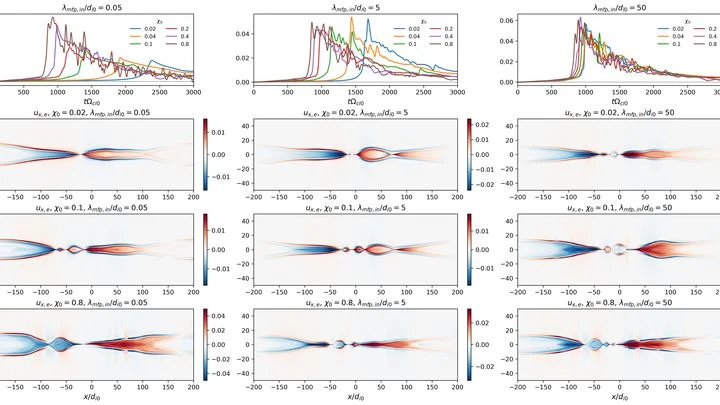
In plasma where some atoms remain neutral, magnetic field lines can rearrange at different speeds. This is like two rubber bands that are initially stuck together, then suddenly snap apart and contract, releasing energy.
A regular laser is like a choir where everyone sings their own part — the sound is loud, but with inevitable roughness. In the new quantum laser, the singers hear each other and harmonize their voices.
A flashlight in thick fog is useless: the beam scatters, and the reflected light drowns in noise. But if you tie two photons with an invisible thread, one can pass through the fog and come back, while the other stays safe. This connection is called quantum entanglement — when two particles behave as a single whole, even when far apart.
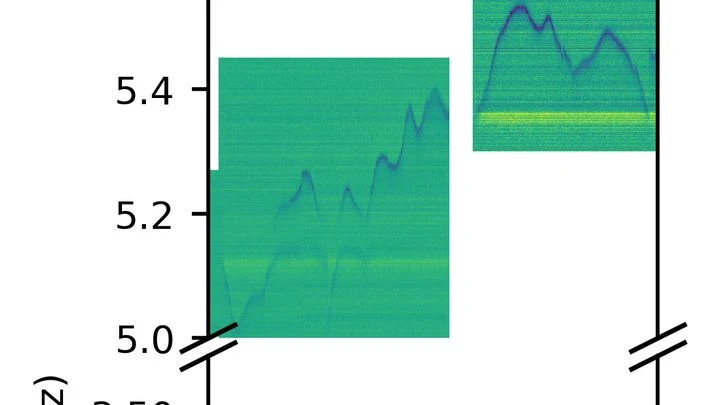
Magnetic materials can store oscillatory energy, like a tuning fork that keeps ringing after being struck. When such a material is placed in a microwave cavity, its oscillations (magnons) start interacting with light (photons).
An ordinary superconductor works only in nature's freezer — at temperatures below minus one hundred degrees. The carbon-ball material K₃C₆₀ is no exception: without cold, it resists current like a crowd in a narrow corridor. But physicists noticed something strange: if you shine a laser on it, it starts conducting without loss even in warmth.
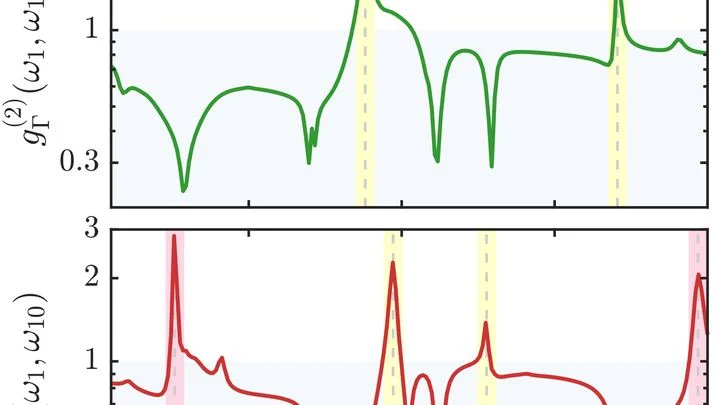
Ordinary light is a stream of independent particles: photons fly through each other without noticing their neighbors. But in superconducting circuits cooled to near absolute zero, the situation changes. There, photons travel along narrow metal tracks, and if tiny elements called Josephson junctions are embedded in these tracks, light begins to 'feel' itself.
A light pulse can be sliced into short time bins, like a train into carriages. If two photons are born together and their carriages are tightly linked, the arrival of one in a specific bin guarantees that the other arrives in the paired bin, this connection is called time-bin entanglement.
Two spinning tops are set off simultaneously in opposite directions. If one spins left, the other always spins right — no matter how far apart they fly. That's roughly how quantum entanglement works, except instead of tops, we have top quarks, the heaviest known particles.
Heat flow usually evens everything out: hot things cool down, cold things warm up, and in the end you are left with a uniform warm swamp. The same holds in the quantum world: the environment, whether a crystal lattice or a gas of photons, tends to destroy the fragile entanglement between particles.
Spontaneous emission, the very process that lights up lamps and stars, has long been considered a pesky noise in quantum physics. This cacophony of random photons ruthlessly destroys fragile quantum entanglement, like radio static drowning out a distant melody.