Density functional theory (DFT) is a quantum mechanicalmodeling method used to investigate the electronic structure of many-body systems, such as molecules, solids, and liquids. Instead of tracking every individual electron, it uses the electron density as the central variable, making calculations feasible for systems with thousands of atoms. DFT has become the standard tool in materials science, chemistry, and condensed matter physics for predicting properties like binding energies, band gaps, and reaction pathways.
History
The foundations were laid by Pierre Hohenberg and Walter Kohn in 1964, with the practical Kohn-Sham formulation introduced the following year. Walter Kohn received the Nobel Prize in Chemistry in 1998 for this work.
How it works
The theory rests on the Hohenberg-Kohn theorems, which state that the ground-state energy of a system is a unique functional of the electron density. In practice, the Kohn-Sham equations map the interacting electron problem onto a set of non-interacting particles moving in an effective potential. This potential includes the external potential, the classical Coulomb repulsion, and an exchange-correlation term that approximates quantum many-body effects. The equations are solved iteratively until the density converges to a self-consistent solution.
In practice
DFT is used to design new battery materials, predict the properties of catalysts, simulate drug interactions with proteins, and study the electronic structure of novel superconductors.
Fun fact
DFT calculations are so widespread that they account for a significant fraction of all supercomputer time used in materials science worldwide.
A layered cake of molybdenum disulfide MoS2 sits on the lab bench. It is prepared in the usual way: adhesive tape peels off the top layers to obtain a thin sample. But beneath the tape remains an invisible cavity where the atomic floors are no longer pressed together. It is there that electrons begin to behave differently than in the crystal bulk.
A laser beam strikes a thin target hidden inside layers of another material. Within billionths of a second, the material is compressed to a density of 25 grams per cubic centimeter, as if a piece of lead became more than twice as heavy without moving an inch.
A flashlight beam cuts through fog. The denser the fog, the more the light scatters and the later it reaches your eye. A similar principle works with fast radio bursts — mysterious, super-powerful pulses from distant galaxies. As their radio waves travel through space, they interact with free electrons — particles stripped from atoms.
A tuning fork struck once rings pure and long. But if you shake the fork itself while it sounds, the tone wavers and dies out quickly. Something similar happens to electrons in any piece of matter. Atoms in a lattice never stay put: thermal vibrations keep them jittering.
A molecule works like a marketplace: electron shoppers enter through two gates (contacts) and head for stalls with the most attractive goods — the chemically active spots. Previously, current was thought to spread evenly, but it turns out up to 90% of all flow rushes through these 'hot spots'. Reactive centers become superconducting highways inside the molecule.
DFTB is a high-speed train in the world of quantum chemistry: hundreds of times faster than classical DFT, yet still on electronic rails. But its engine — iterative self-consistency of charges — sometimes resembles an orchestra where each instrument starts from an arbitrary note.
Many chemical transformations resemble assembling furniture in complete darkness: you see the starting parts and the finished cabinet, but the assembly itself remains a mystery. The intermediate states, like awkward positions of the craftsman's hands, vanish too quickly to be discerned.
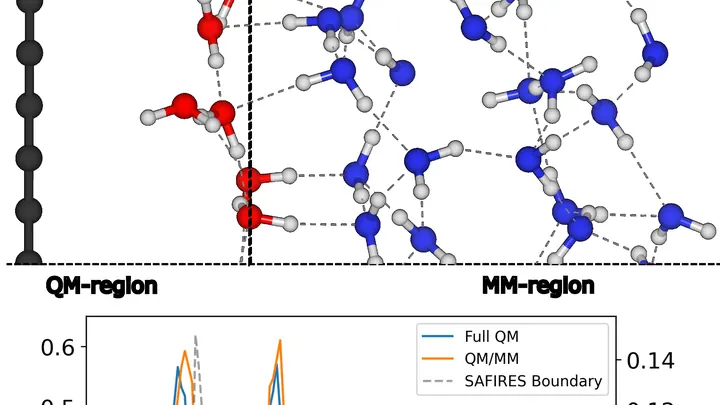
Imagine a huge swimming pool. In one corner, a chemical reaction is underway that needs to be calculated with jeweler-like precision. But the surrounding water is not just decoration: its molecules jostle, attract, and influence the reaction. How do you account for this endless dance of particles without drowning in calculations?
Inside every cell, life is bustling: tiny protein machines tirelessly haul cargo, read genes, and fix errors. But their work is far from perfect: they often 'spin their wheels,' take backward steps, or get stuck in futile cycles. It's like a city traffic jam where cars dart around aimlessly, burning fuel.
The atomic nucleus is not a billiard ball but rather a hazy cloud that constantly changes its contours. Protons and neutrons inside are in continuous motion, and the nucleus can take on many different shapes: elongated, flattened, or pear-like. To describe this quivering diversity, physicists usually picked a few most probable shapes and mixed them, like an artist mixing paints on a palette.
A baker follows a recipe for a cake, but instead of a fluffy sponge, they get a hard crust. They start running through possible causes: maybe the flour was damp, or the oven heats unevenly, or the eggs were too cold.
You taste a fruit smoothie through two different straws. One lets through only the big chunks, the other only the liquid. Individually, the sensations are misleading, but together they give you the key: here, it seems, is banana, and here, strawberry.
A substance's spectrum is its fingerprint. Usually, to record one, you place the sample in a strong magnetic field, like in an MRI scanner. But there is a way to do without a magnet altogether: detect the signal from atomic nuclei at zero field. Until now, this method suffered from poor sensitivity, and its complex spectra were hard to predict.
Imagine a city where streets are not straight but winding, with dead ends and hidden passages. A bike courier will take much longer to deliver a package than in a city with a regular grid of roads. Similarly, molecules inside living tissue: their path depends on how "tangled" the tissue structure is.
Scientists built a model that describes the movement of molecules in such a "tangled" environment.
Inside a piece of metal, electrons don't sit still: they move like water in a river. But you can't see this motion directly; it's too fast and too small. Scientists devised a workaround: they take 'frozen snapshots' of the electron liquid at different temperatures, then reconstruct how the electrons moved from those snapshots.
A crystal that inside resembles a sponge with a labyrinth of pores turns out to be capable of performing computations. The material, named DUT-8, consists of metal nodes and organic linkers forming an intricate lattice. Under the influence of different gases, this lattice slightly changes shape, like a house of cards that rearranges with a gentle breath.
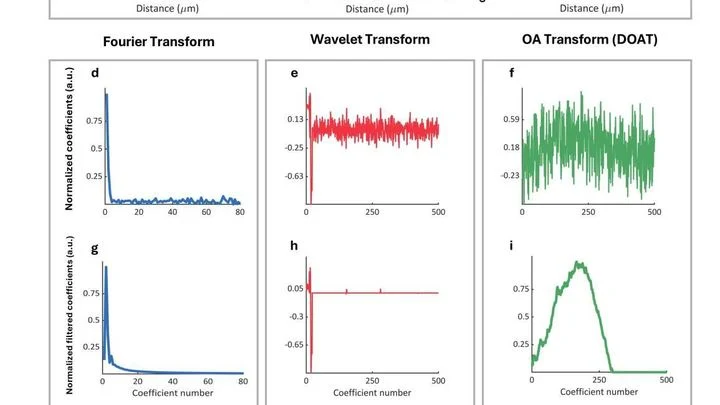
A laser beam hits the skin, and tissues respond with a barely audible ultrasonic echo. From that echo, doctors can see blood vessels and tumors without making a single incision. But before the picture appears on the screen, the signal has to be cleaned of noise, just as a cook skims the foam off a broth to make the soup clear.
On the surface of a tiny sphere, electrons line up in patterns that look like ripples on water. Physicists have long noticed that this simple picture describes the behavior of quantum systems with surprising accuracy. But why it works has remained a mystery. The authors of a new study have unraveled the mathematical mechanism behind this model.
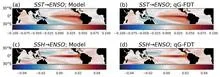
Every few years, the warm current off the coast of Peru shifts, and fishermen come home empty-handed. This is El Niño, the breath of the tropical Pacific, which affects weather from Indonesia to California. Predicting its arrival is as hard as predicting where a stone thrown into a raging river will roll.
Physicists built a chain of Rydberg atoms — atoms with electrons in enormous orbits, comparable to planetary paths. These giant atoms feel their neighbors intensely, turning the chain into a quantum analog of a string.
In every handful of fertile soil, there are bacteria that do something no factory can: they take nitrogen straight from the air and turn it into fertilizer. The secret lies in the enzyme nitrogenase, and its working core, a cluster of iron and molybdenum atoms, looks like a tiny factory floor.
Chemists have long tried to understand how this factory works from the inside.
You need to sift through millions of keys to find the one that unlocks the lock of a disease. Each key is a molecule, and the lock is a protein in our body. Checking each key manually is impossible, so chemists use computer models that predict how a molecule will behave in reality. Until recently, accurate calculations took hours or days on powerful computers. The new tool AceFF does it in seconds.