Outlier rejection is the process of identifying and removing data points that deviate significantly from the expected pattern or distribution of a dataset. In scientific contexts, outliers can arise from measurement errors, transient events, or contamination by unrelated sources. The goal is to clean the data so that subsequent analysis reflects the underlying phenomenon rather than spurious fluctuations. This is especially important in fields like astronomy, where a single anomalous reading could be mistaken for a real discovery.
How it works
The method typically involves defining a statistical criterion for what counts as 'normal'—for example, a certain number of standard deviations from the mean, or a robust fit to a model. Points that fall outside this threshold are flagged and either discarded or re-examined. In practice, the process may be iterative: after removing obvious outliers, the model is recalculated, and the threshold is reapplied to catch subtler deviations. The choice of criterion depends on the data's noise characteristics and the risk of discarding genuine signals.
In practice
Used in particle physics to filter detector noise, in astronomy to exclude cosmic rays from images, and in finance to remove erroneous trading data before risk analysis.
Fun fact
In the discovery of the Higgs boson, physicists used outlier rejection to eliminate background events, but they deliberately kept a few 'outliers' that later turned out to be the first hints of the new particle.
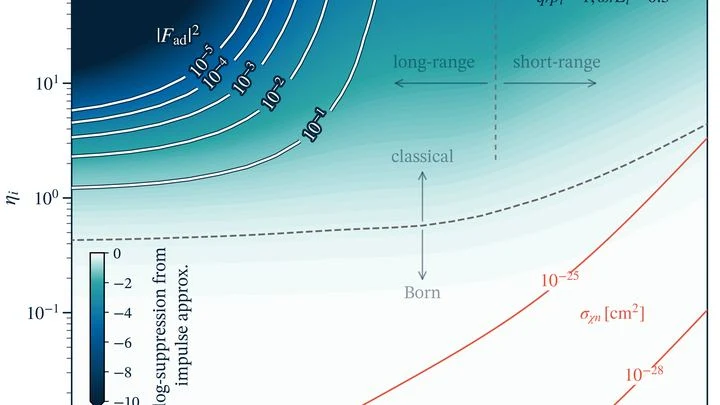
A billiard ball slams into another. Impact, and the balls scatter. But if the push is not sharp but very gentle, the balls just roll together without bouncing. An atom behaves much the same way when hit by a dark matter particle.