Matched filtering is a signal processing technique used to detect a known pattern (the 'signal') buried in noisy data. In cosmology, it is applied to search for 'matched circles' in the cosmic microwave background (CMB) — patterns that would appear if the universe had a non-trivial topology, such as a torus or a multiply-connected shape. The idea is that if the universe is finite and small enough, the same region of the early universe would be visible from different directions, leaving circles of similar temperature fluctuations on the sky.
History
The concept of matched filtering originated in radar and communications theory in the 1940s, and was adapted to cosmology in the 1990s by researchers like Neil Cornish and colleagues to test cosmic topology.
How it works
The method works by correlating the data with a template of the expected signal. If the template matches a feature in the data, the correlation produces a peak; if not, the result is just noise. For matched circles, the algorithm searches for pairs of circles on the CMB sky with similar temperature patterns, using a filter that maximizes the signal-to-noise ratio. This requires careful handling of the noise properties of the CMB maps.
In practice
Beyond cosmology, matched filtering is used in gravitational wave detection (e.g., LIGO) to identify the faint chirp of merging black holes, and in radar and sonar systems.
Fun fact
The first direct detection of gravitational waves in 2015 relied on matched filtering, where the predicted waveform of a black hole merger was matched against the noisy detector data to find the signal.
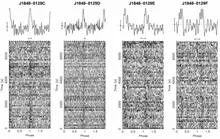
At night in fog, a searchlight works worse than in daylight: tiny droplets scatter the beam, and distant objects drown in the murky haze. Much the same way, radio waves from pulsars get lost in the interstellar medium when there are many free electrons between us and the star.
Cosmology is like an orchestra where different sections suddenly start playing out of sync. Measurements of the universe's expansion rate (the Hubble constant) from the early and late universe give different numbers.
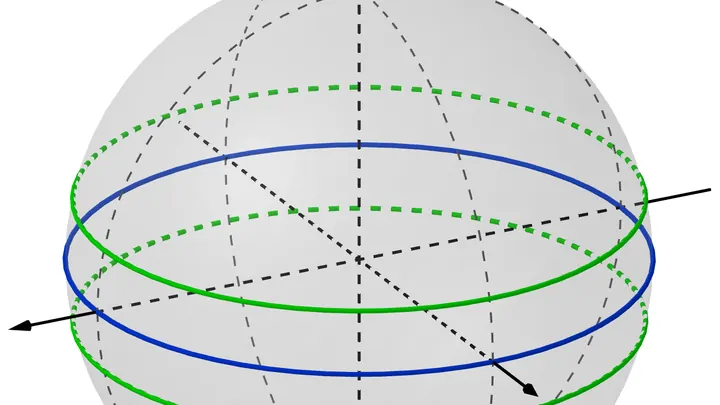
From childhood, we're used to thinking of space as infinite and isotropic. But Einstein and Lemaître were already asking: could the Universe be closed in on itself, like a Möbius strip or a 3-torus?
Gravitational waves are the trembling of spacetime itself. Usually we only catch their overall hum, but each wave also has a direction of oscillation – polarization. Old maps were built only from signal loudness, which led to errors. It's like trying to see the bottom of a pond through sun glare.
Ancient light, traveling 14 billion years, reaches us from all directions. At first glance, it looks perfectly smooth, but if you look closely, tiny fluctuations appear, like ripples on a still pond. Those ripples aren't random noise; they're an encoded history of the universe.
A huge pond, with ripples spreading from two heavy stones circling each other. The stones draw closer, the ripples become more frequent and stronger, and soon the stones will collide. Gravitational waves are like those ripples, but not on water — in the very fabric of spacetime.
Fibers in composites, paper, or biological tissues are often hidden from view, but their orientation determines the strength and properties of the material. Previously, to see fiber directions, you had to take many images at different angles and assemble a three-dimensional picture, like slicing a loaf of bread into thin pieces. For thin samples, this approach doesn't work: you can't slice what isn't thick enough.
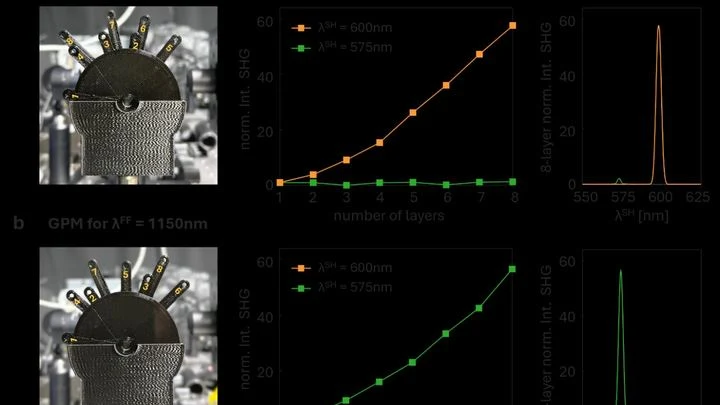
When two light beams meet in a crystal, they can generate a third beam with a different frequency. For this process to be efficient, the waves need to stay in step, like two people walking side by side without breaking stride. Previously, two old tricks were used: either picking a crystal with the right properties, or slicing it into thin layers.
Dark matter makes up 85% of the matter in the Universe, yet remains invisible. It only reveals itself through gravity. We can catch it by its cosmic 'hum' — a faint vibration that permeates space. A single detector is powerless here: the signal is too quiet.
Physicists turn many sensors into a quantum ensemble.
Imagine a border river that separates two countries. On one bank live one group of people, on the other, another. The boundary between them is not always obvious: in some places the river is wide and calm, in others narrow and turbulent. But it is exactly where the current changes abruptly that the border becomes most noticeable.