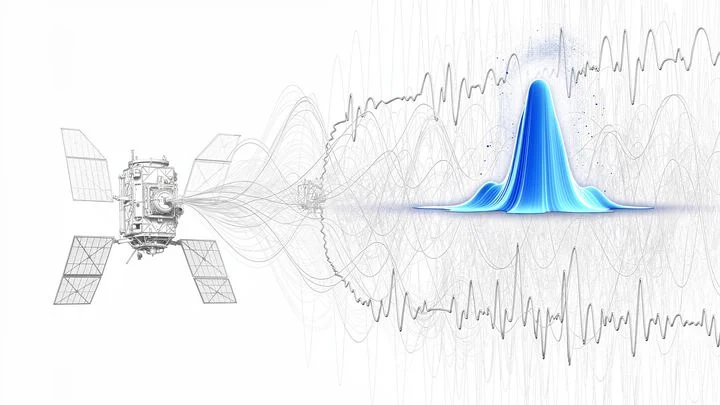
Anomaly detection is the identification of rare items, events, or observations that raise suspicions by differing significantly from the majority of the data.
Anomaly detection is the process of identifying data points, events, or observations that deviate significantly from what is considered normal or expected. In physics and astronomy, it is a powerful tool for discovering new phenomena, because unexpected signals often point to novel physics, instrumental glitches, or rare natural events. For example, in gravitational-wave astronomy, anomaly detection helps separate genuine cosmic signals from noise, while in particle physics, it can flag unusual events that might indicate a new particle or force.
History
The concept of anomaly detection has roots in statistics and quality control, dating back to the early 20th century, but its modern form emerged with the rise of machine learning in the 1990s and 2000s. In physics, it gained prominence with the search for new particles at colliders and in the analysis of astronomical surveys.
How it works
The approach typically involves building a model of 'normal' behavior from a large dataset, then measuring how far new data points fall from this model. Methods range from simple statisticalthresholds (e.g., flagging points more than a few standard deviations from the mean) to sophisticated machine learning algorithms that learn complex patterns. In time-series data, like detector outputs, anomaly detection often uses autoencoders or recurrent networks to reconstruct expected signals; a large reconstructionerror indicates an anomaly. The key is to distinguish true physical anomalies from mundane noise or technical artifacts.
In practice
Anomaly detection is used in gravitational-wave observatories like LIGO to identify potential signals in real time, in particle physics experiments to search for beyond-Standard-Model events, and in medical imaging to spot unusual patterns that might indicate disease.
Fun fact
In the search for extraterrestrial intelligence, anomaly detection is used to scan radio telescope data for signals that stand out from natural astrophysical sources, such as pulsars or quasars.
In active galactic nuclei, supermassive black holes are surrounded by a dense ring of dust that acts like a curtain: it hides everything happening at the center. If a star ventures too close to the black hole, tidal forces tear it apart, and the resulting flare is usually visible in optical and X-ray light.
Toss a handful of sand onto a table — the grains scatter equally in all directions. But if a magnet is hidden under the table and the sand is iron, the trajectories get trickier: an invisible structure overlays the chaos. That's roughly how molecular motion works inside a living cell.
Two hundred million stars. In the heart of the Galaxy, where the future survey by the Nancy Grace Roman telescope will aim, about 250 times during its mission the light of one of them will flicker at an invisible touch.
Assembling the puzzle of the Universe, astronomers are used to every new detail fitting perfectly into the already completed picture. But sometimes there are pieces that seem cut from another jigsaw. Twenty thousand active galactic nuclei, and eleven percent of them the neural network confidently rejects as alien.
A spotlight blazes straight into your eyes, and a few steps away a tiny firefly flickers. That's roughly what it's like hunting for an Earth-like planet around a neighboring star: the planet is a hundred million to ten billion times fainter than its star, and in the sky they almost merge into a single point.
The gamma sky, captured by the Fermi telescope, is a grand symphony of thousands of sources. Here, the rhythmic pulsations of pulsars, the powerful chords of active galactic nuclei, but most of all — unidentified objects, whose part remains a mystery.
Picking out a single faulty microchip from a million, without any clue what the fault looks like, is a classic needle-in-a-haystack problem. A classical computer would test each chip one by one.
Battery aging is like metal fatigue: a crack grows inside long before the part breaks. Usually, you only learn about the problem when capacity drops below 80%—but by then, the damage is irreversible.
Astronomers occasionally spot interstellar objects — rocky chunks or comets from other star systems. Most look ordinary, but some puzzle us with their shape, speed, or shine. To stop guessing, scientists applied the Loeb scale: from 0 (plain rock) to 5 (technosignature — an artificial signal from space).
Eyes follow a dot that smoothly traces a complex curve on the screen. For most people, the gaze stays close to it, but for some, it seems to slip or lag behind. Previously, such peculiarities drowned in average numbers: if you add everyone up and divide, the difference almost disappears.
Instead of looking at averages, the scientists decided to examine each person individually.
The trace of a short-lived particle is like a signature left in the detector. The particle is born and decays in an instant, but from its trace you can reconstruct its character — whether it's compact like a stone or fluffy like a snowball. That's exactly what this work is about: the authors propose a new way to read such signatures.
They noticed that each particle has an angle that links its mass and lifetime.
At Hungary's Institute for Nuclear Research, ATOMKI, physicists noticed something odd: in the decays of excited atomic nuclei, pairs of electrons and positrons sometimes fly apart at an unusual angle. It's as if an invisible mediator particle briefly appears and disappears between them.
Detecting a faint signal against a noise background is like trying to hear a distant bell in a storm. Ordinary amplification only makes the din more deafening. Quantum error correction solves the problem in an unexpected way.
The galaxy is like a city at night: most windows shine steadily, but sometimes a skyscraper lights up all its lights and then goes dark. Just like that, according to a new hypothesis about planets around alien stars (exoplanet), we might first notice another civilization — by a short but blinding flash that could mark its demise.