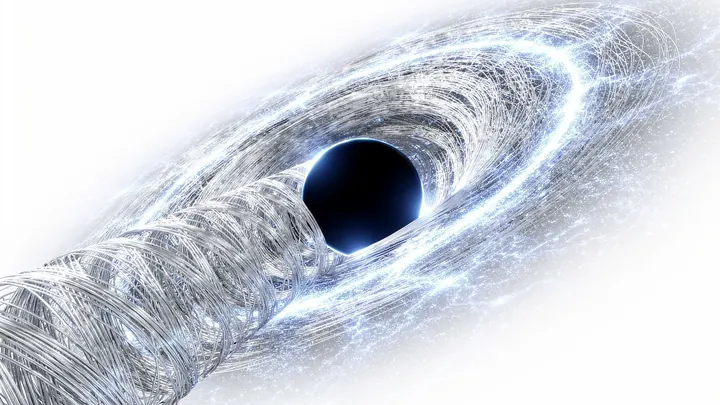
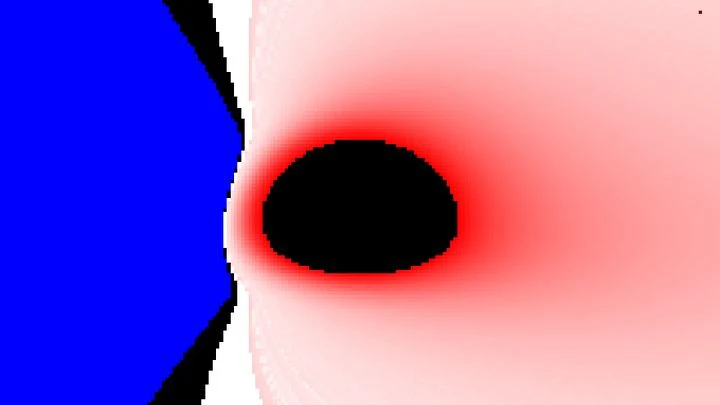
The shadow of a black hole is the dark region on the background of hot gas or light, corresponding to the photon capture sphere and the event horizon. In the simplest case, it is almost circular, with a size set by the black hole's mass and spin. However, the shadow's shape and brightness can be altered by the presence of strong magnetic fields, which bend and polarize light, or by hypothetical extra dimensions, which would modify the spacetime geometry near the horizon. Observable distortions in the shadow are thus a potential probe of physics beyond the standard model and of the extreme conditions near a black hole.
History
The concept of the black hole shadow was first discussed in the 1970s by James Bardeen and others, but the term and its detailed predictions were developed later, notably by Heino Falcke and collaborators in the 2000s. The first direct image of a black hole shadow was published by the Event Horizon Telescope in 2019.
How it works
Light rays passing near a black hole are deflected by gravity; those that come too close are captured, creating the shadow. Magnetic fields in the surrounding plasma can change the path of light through the Faraday effect and by altering the emission pattern, producing asymmetries or bright 'photon rings'. Extra dimensions, if they exist, would change the gravitational field at short distances, slightly shifting the shadow's size or shape compared to the general-relativistic prediction. Comparing high-resolution images (like those from the Event Horizon Telescope) with theoretical models allows physicists to infer the presence of these effects.
In practice
Shadow observations are used to test general relativity and alternative theories of gravity, and to measure black hole mass and spin. They also serve as a tool to search for dark matter or extra dimensions, as suggested in the article 'Минимальный размер тени чёрной дыры'.
Fun fact
The shadow of a black hole is about 2.6 times larger than the event horizon itself, because gravitational lensing magnifies the apparent size of the dark region.
Speed of light in vacuum, a fundamental constant of nature. — speed of light= 299792458metre per second
G
constant
Newtonian constant of gravitation, determining the strength of gravity. — gravitational constant= 6.67430e-11cubic metre per kilogram per second squared
A million orbits: the same score. Nine dark matter halos: nine orchestras without a conductor. All musicians play from the same notes, but in each hall the music sounds different: sometimes in tune, sometimes out of sync. Likewise, satellite galaxies falling into a host halo follow orbits that depend not only on mass but also on the shape of the invisible stage.
Current in an ordinary metal flows like a crowd of people down a straight street: each electron is on its own, and if you turn on a magnetic field, the whole crowd shifts slightly sideways. This shift is called the Hall effect.
Light from the hottest stage of the universe has been traveling toward us for nearly 14 billion years. This is the cosmic microwave background — a faint glow filling the entire sky.
Cosmologists are facing a curious situation: two reliable tools draw slightly different maps of the same universe. One tool is the map of ancient light (the cosmic microwave background), and the other is the map of galaxy distribution. They broadly agree, but in details they diverge.
In the first moments after the Big Bang, the universe expanded at an incredible rate — a phase known as inflation. Even the vacuum was restless back then: quantum jitters shook the fields like wind rustling through a wheat field.
At the center of many galaxies lurks a black hole, wrapped in an invisible cloud — the halo of dark matter. This is not just a featureless mass: its density changes from the edge to the center, and the degree of this "compression" is called compactness.
The Universe is a giant concert hall, where instead of walls and balconies, invisible clouds of dark matter float. This architectural ensemble is not static: it refracts and scatters the 'music' rushing through it — gravitational waves from merging black holes.
At the center of a black hole, classical theory paints a point where density and spacetime curvature shoot to infinity — like an infinitely sharp needle. But quantum corrections, tracing back to the work of Karl Schwarzschild, add a tiny “pillow”: space cannot collapse to zero.
The hot broth of the early universe cooled unevenly. At some point, bubbles of a new phase began to pop within it, like steam bubbles in boiling water. But these bubbles weren't made of steam; they were made of a new state of matter in which particles of the dark sector clumped into larger lumps. That's how dark matter could have been born.
In quantum field theory, there is a strict law: a signal cannot outrun light. This is causality — the foundation on which the order of events rests. But near black holes, this foundation begins to crack, especially if the hole is not quite ordinary.
A black hole is a place where gravity is so strong that even light cannot escape. But around it there is a glowing ring of gas, and in the center a dark void known as the shadow. The size of this shadow depends on how spacetime is curved.
A black hole is not just a dark spot in the sky. Its shadow falls on the glowing backdrop of infalling matter and carries the imprint of spacetime geometry itself. If gravity works even slightly differently than we think, the shadow will give it away.
In a new study, physicists traced light rays around a rotating black hole in so-called Rastall gravity.
Light passes through a crumpled film — and comes out slightly altered. In much the same way, gravitational waves born in the early universe feel the lumpy distribution of galaxies and dark matter.
Imagine a translator working in a noisy hall. The hum of voices, the clatter of dishes, fragments of other people’s conversations: it seems they should constantly make mistakes. But by the end of the day, their notes match perfectly with what they would have written in the quiet of an office. This is roughly how the quantum rule known as the axial anomaly behaves.
Drop a pebble into a pond, and ripples spread across the water. A black hole 'sounds' much the same when matter falls into it or when its spacetime gets a gentle jolt. These fading oscillations are called quasinormal modes, like the tolling of a bell that gradually fades away.
The oldest light in the universe has been traveling toward us for nearly 14 billion years. It was born when the cosmos first became transparent, and since then its plane of oscillation has been rotating ever so slightly. The cause is an invisible ocean permeating all of space: the dark energy field that makes the universe expand faster and faster.
Light passing by a black hole swirls like water down a bathtub drain. The most intriguing part is the thin ring where rays can orbit forever, neither falling in nor escaping. This is the photon sphere — an invisible boundary that paints the hole's shadow on the sky.
An inflating balloon starts out slowly, then suddenly expands faster and faster, as if someone is pumping it up from inside. That's roughly how our universe behaves: galaxies are receding with acceleration. The culprit behind this acceleration is called dark energy.
A stellar river winds around the center of a distant galaxy like a glowing ribbon on an invisible frame. That frame is the dark halo: a vast cloud of invisible dark matter whose gravity holds stars and gas in place. If the halo is squashed like a pumpkin or stretched like a melon, the stellar stream will bend differently.
Every isolated quantum system inevitably moves toward thermal equilibrium — a state where all details of the past are erased. It’s like an orchestra: instead of a symphony, it starts playing white noise — random but statistically predictable notes.
A black hole is like a perfect vault: everything that falls in disappears without a trace. But in the 1970s, Jacob Bekenstein and Stephen Hawking discovered that the horizon carries an indelible "sticker" — entropy (a measure of hidden information about swallowed matter).
A figure skater glides across the ice, gradually approaching the center of the rink. A slight twist of the torso, and the smooth spiral breaks, the trajectory becomes unpredictable. Something similar happens when a small black hole with its own rotation (spin) falls toward a giant black hole.
Light usually behaves like a pedestrian on a two-way street: the path from a streetlamp to a camera matches the reverse path. But near a rotating black hole with broken spatial symmetry, this street becomes one-way. Swap the light source and observer, and the hole's shadow changes shape: from an oval resembling a rugby ball, it turns into a teardrop.
Light passing by a massive body bends around it, like a stream of cars swerving around a deep pothole in the road. The steeper the pothole's slopes, the more the trajectories curve, and the fewer straight paths remain to the observer. That's how a black hole's shadow is born: a region from which light can no longer escape.
A black hole is not just a void but a massive object that warps the space around it. If it finds itself in a cloud of invisible dark matter, matter that emits no light but makes itself known through gravity, its behavior changes.
In galaxy clusters, invisible dark matter serves as the framework holding star systems together. Its shape is betrayed by a faint glow — stars ripped from galaxies by tidal forces. This stellar 'broth' fills the cluster like a liquid taking the shape of its container: it envelops the clumps of dark matter, creating a precise cast of their outlines.
A crystal does not grow as a single whole but like a city of neighborhoods — grains. In each neighborhood, atoms are arranged in their own way, and the boundaries between them are like streets.
At the center of our Galaxy lies a supermassive black hole, with stars orbiting around it. Their motion resembles a cosmic dance: some race along elongated orbits, others follow nearly circular paths. If invisible dark matter exists near the black hole, it slightly distorts these orbits, like an unseen hand nudging a star off course.
A wormhole is a tunnel through space, connecting distant regions of the Universe. Its shadow against a bright gas background was long thought to be as round as that of a black hole. But for a rotating wormhole (one you could actually traverse), the shape of the shadow might be surprising: the edge becomes jagged, like a gear.
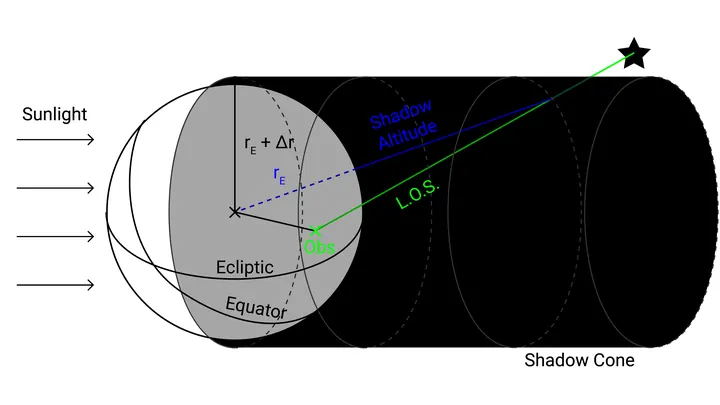
At night, the sky is never completely black. Even far from cities, the upper atmosphere glows faintly: sunlight makes hydrogen atoms emit a reddish glow that astronomers call geocoronal emission. For a telescope, it's like a fogged-up window: it adds extra light and hinders seeing distant galaxies.
Since Vera Rubin first convincingly showed that galaxies are surrounded by invisible matter, the quest to understand the nature of dark matter has remained one of physics' greatest challenges.
Supermassive bodies warp space, turning into a lens that bends light from distant objects. Such spacetime curvature allows astronomers to see the invisible. Recently, this method helped detect a hidden clump with the mass of a million Suns.
A century ago, magnetic observatories recorded only the slow breathing of Earth's core. Today, their data have become hunting grounds for particle physics. At the Eskdalemuir Observatory in northern England, fluctuations of the magnetic field are recorded every hundredth of a second.