Dark matter is an invisible form of matter that does not emit light but exerts gravitational influence, explaining galactic rotation and cosmic structure.
Imagine you're looking at a carousel spinning too fast, but you don't see all the people riding it. That means there's someone invisible whose mass makes the carousel spin faster. Dark matter is something like an invisible mass in space: we don't see it directly, but from the way stars and galaxies move, we understand that it exists and there's a lot of it.
History
In 1933, Fritz Zwicky applied the virial theorem to the Coma Cluster and calculated that much more mass than visible was required to hold the galaxies; he coined the term 'dark matter'. In the 1970s, Vera Rubin and Kent Ford, using a spectrograph to measure Doppler shifts, constructed rotation curves of spiral galaxies and showed that at the outskirts, velocities remain constant, which contradicts Newton's law of gravitation given the visible mass distribution — a huge invisible halo was required. Subsequent observations of gravitational lensing (e.g., the 'Bullet Cluster' — a collision of clusters) and the cosmic microwave background confirmed the existence of dark matter as the dominant non-baryonic component. Theoretical predictions within supersymmetry actively stimulated searches for WIMP particles in underground detectors.
How it works
Dark matter interacts with ordinary matter through gravity, which is described by Newton's law of universal gravitation and Einstein's equations. Galaxy rotation curves are explained by assuming that mass is concentrated in an extended halo whose density falls off as ρ ~ r^{-2}. Gravitational lensing, predicted by general relativity, allows mapping the distribution of dark matter, for example, by the distortion of shapes of distant galaxies. The cosmological theory of structure formation is based on primordial density fluctuations; dark matter, being cold (CDM), clumps earlier than ordinary matter, creating gravitational 'wells' into which baryonic matter subsequently falls. The anisotropy of the cosmic microwave background encodes the density ratios of the universe's components. Non-relativistic equations of motion (Newton's law) are used to describe dynamics in halos. A key problem is the lack of detection of hypothetical particles on Earth.
Fun fact
There is five times more dark matter in the Universe than ordinary matter, which makes up stars, planets, and you and me. So we are just the bright tip of a huge invisible iceberg!
An old stellar ball that has gathered hundreds of thousands of suns has been circling the edge of a dwarf galaxy for billions of years. By all calculations, it should have long ago plunged into the center like a heavy stone into jelly. But the ball holds its ground, and this fact has been nagging astrophysicists for several decades.
In an underground laboratory in South Dakota, the LUX-ZEPLIN detector, filled with liquid xenon, waits for rare collisions. Usually, dark matter particles pass through it without a trace, but one day a xenon nucleus was displaced with an energy of 248 keV.
In an underground laboratory beneath Sanford Mountain in South Dakota, a tank holding ten tons of liquid xenon waits for a dark matter particle to fly through it. Over 60 days of observation, the LZ detector registered a single nuclear recoil with an energy of 248 keV.
In a tank holding three tons of liquid xenon, buried deep underground, something stirred one day. Not the xenon itself, but one of its atomic nuclei: it received a kick with an energy of 248 thousand electronvolts and recoiled like a billiard ball struck by an invisible cue ball.
A light ray passing near a massive body bends around it, like a runner rounding the corner of a stadium. For a neutron star, this deflection angle is usually assumed to be the same as for a point mass. But if the star is wrapped in an invisible halo of dark matter, the picture changes: light passing through the halo is deflected less than the total mass would predict.
The neutron is a particle that usually sits in the atomic nucleus and doesn't disappear. But some theories suggest that occasionally it might transform into its invisible twin — a particle that ordinary detectors can't catch.
In the shaft leading to the Large Hadron Collider, an unusual tenant may soon move in: a hundred-meter vertical tube where clouds of strontium atoms will be dropped. Each cloud is cooled to near absolute zero, so the atoms move slowly and in sync, like dancers in slow motion.
No one has ever seen dark matter, but it should pass through detectors like wind through leaves. Sometimes, very rarely, a dark matter particle bumps into an atomic nucleus, and then the detector must catch that jolt. The trouble is that light dark matter particles can hardly move heavy nuclei: it's like trying to knock down a bowling pin by throwing a feather at it.
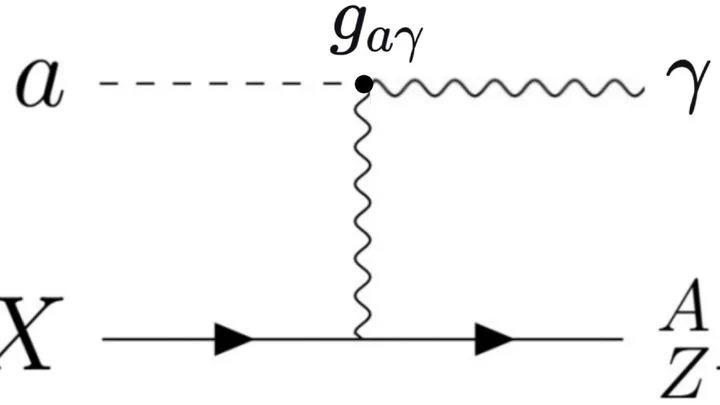
Inside the Sun, reactions can produce light, almost undetectable particles called axions. One such reaction yields axions with an energy of 5.49 MeV, as if each one carried the energy of a tennis ball moving at 100 km/h. These particles pass freely through Earth, but occasionally they might collide with a xenon atom.
In the southern sky, behind a dense veil of dust, hides a source of gamma rays — the most energetic light in the Universe. It shines so brightly that it can be seen even through this veil, but the object itself remains invisible. Astronomers pointed the ALMA radio telescope at the neighboring gas clouds and saw a pattern that gave the invisible object away.
Dark matter doesn't emit or reflect light, but its presence is revealed through gravitational effects. To catch even a single particle, physicists build detectors that are like very quiet rooms: inside lie crystals that flash when a particle hits them. But the flash is faint, and if light is lost along the way, the signal can be missed.
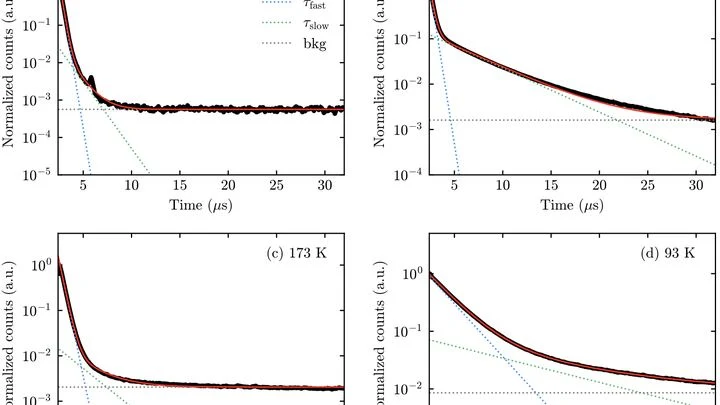
A sodium iodide crystal doped with thallium is like photographic film for invisible particles. When a gamma ray or a hypothetical dark matter particle hits it, it flashes with faint light. Two silicon photomultipliers pressed against the crystal's ends catch the flash from both sides.
Think of a merry-go-round: the farther you sit from the center, the faster you're carried around. For a long time, astronomers assumed galaxies work the same way — stars at the edges should orbit more slowly than those near the center. But back in the 1970s, it turned out that in many spiral galaxies, the speed of stars barely drops with distance from the center.
In the first moments after the Big Bang, matter and antimatter should have been created in equal amounts. But today, everything around us is ordinary matter, and antimatter is almost nowhere to be found. Where did it all go? The standard answer: a tiny imbalance in favor of matter wiped out almost all antimatter.
A galaxy is like a city: bright lights and dense buildings at the center, sparse lights and emptiness toward the outskirts. But if you watch how gas rotates in a galaxy's disk, you see that its speed barely drops at the edges. As if invisible neighborhoods keep the motion going. Astronomers have found a way to map this invisible city.
A magnet weighing just a few grains of sand hovers in midair with no support. It doesn't touch the walls, doesn't rub against bearings — it just hangs in a magnetic trap like a speck of dust in a sunbeam. Researchers have turned this tiny object into an ultra-sensitive compass: the device detects changes in the magnetic field of 23 femtotesla.
The universe is constantly sending us signals, but many are too faint to notice. Relic neutrinos, particles left over from the Big Bang, pass through Earth by the billions every second, yet catching even one is a feat on the edge of possibility. We need a detector that can sense energy a thousand times smaller than what it takes to move a speck of dust.
Imagine a huge stadium packed with people dressed in black. You're standing outside, trying to figure out what's happening inside, even though you can't see a single person. But if two people bump into each other and exchange bright T-shirts, you'd spot a flash of color.
In the first moments after the Big Bang, the universe resembled a boiling cauldron. According to one hypothesis, dark matter, the invisible substance that holds galaxies together, could have been born there.
Somewhere in the center of a galaxy, a black hole is spinning. It doesn't hang in a void — around it swirls an invisible swarm of dark matter particles. Until now, this swarm was described for non-rotating holes, but in reality, holes always rotate.
Every pulsating object has a moment when its rhythm falters. For boson stars, hypothetical clumps of ultralight particles, that moment turns out to be the point where mass stops growing. The authors calculated the lowest radial mode (the fundamental 'breathing' tone) for a whole family of such stars, including models with self-interaction.
A neutron star is the ultra-dense remnant of a supernova: the mass of the Sun packed into a sphere the size of a city. For billions of years, it travels through space, gathering around itself invisible matter, dark matter, which emits no light but pulls with gravity.
The five-hundred-meter FAST radio telescope picked up a signal at the 21-centimeter wavelength — the telltale glow of cold hydrogen. The signal came from a cloud named Cloud-9. It hangs in space near the galaxy M94, but it contains not a single star.
An invisible scaffold holds galaxies together, keeping them from flying apart. This is dark matter — matter that doesn't shine and barely interacts with ordinary stuff. Astrophysicists have long debated what it's made of.
The night sky looks like a random scattering of stars. But zoom out to enormous distances, and the chaos disappears. Galaxies gather into long filaments and flat walls, with colossal voids gaping between them — cosmic voids. This structure is called the cosmic web.
The cosmological standard model is like a recipe for a cake where everything is strictly measured: dark matter is like flour without a single lump (zero pressure), and dark energy is like the perfect leavening agent (equation of state exactly minus one). But what if the flour is a bit damp and the leavening agent has lost its oomph?
A red giant in a globular cluster is a star in retirement. It has burned up the hydrogen in its core and now lives off fusion in a thin shell around a helium ash core.
The quantum world is like a kitchen where particles suddenly appear out of "nothing." But you need a chef — a classical field acting as an external source. Glauber's theorem, long known in optics, has now been generalized: it shows exactly how the field "cooks up" particles, be they photons or gravitons.
The early Universe resembles a boiling cauldron, where particles and antiparticles are born and die in equal numbers. But today, all around us is only matter — stars, planets, ourselves. How did a tiny excess of one part in a billion emerge from the initial equality? One answer hides in the oscillations of a heavy field, like a rock that the tide alternately submerges and exposes.
A hunter sets snares in the woods. They know the animal's habits but not whether it will ever show up. In much the same way, physicists set up detectors in hopes of catching particles of dark matter — the invisible substance thought to make up most of the Universe's mass.
A new study offers hunters an unusual tool: not a trap, but a measuring tape.
Buried in Antarctic ice, there's a detector the size of a cubic kilometer. It doesn't catch light but ghostly particles — neutrinos. Yet sometimes, a different beast might flash through: a pair of muons born together and flying apart in a wide fan. No known particle of ordinary matter can paint that pattern.
Dark matter is the invisible scaffolding of the universe. It's there, we know from the motion of stars and galaxies, but what this scaffolding is made of remains unknown. One guess is ultra-light particles similar to axions. They barely interact with ordinary matter, yet occasionally they do get involved.
A black hole isn't just a cosmic vacuum cleaner. If it rotates, it can amplify waves around it, much like a mountain echo repeats sound. For ultralight dark matter (particles billions of times lighter than an electron), this effect, called superradiance, can create a huge cloud.
A black hole is not an empty funnel. Invisible matter can accumulate around it, and then the familiar boundaries shift.
A group of theorists found a simple condition: if the mass of this surrounding material grows smoothly and satisfies the inequality 1 − 2m' − rm'' > 0, then the event horizon remains well-defined and the hole stays stable.
In the dark outskirts of our Galaxy, far from bright star clusters, millions of black holes lurk. They are invisible: they don't shine and don't noticeably accrete matter. Conventional search methods, designed for dense stellar fields, are useless here. A different approach is needed.
Astronomers have proposed using the very fabric of space as a detector.
In the first moments after the Big Bang, the universe underwent a rapid expansion — inflation. Space stretched faster than light, and quantum jitters of the vacuum turned into real particles. This is how dark matter, the invisible substance that holds galaxies together, could have been born.
A globular cluster, a dense swarm of hundreds of thousands of stars, plows through a galaxy like a bullet through water. In ordinary dark matter (the invisible mass that holds galaxies together), it should quickly lose speed due to dynamical friction.
A whirlpool gulps down water, but splashes most of it back out. That's roughly how a black hole behaves when too much matter falls onto it. In a new study, astrophysicists ran 32 computer simulations to understand how a black hole's parameters — mass, spin, and "appetite"—control these cosmic fountains.
A cosmic object spins, but its shadow isn't round. Astrophysicists examined a black hole in an unusual version of gravity — the so-called brane world (where our universe is a three-dimensional surface in a space of higher dimensions).