In 1958, Rudolf Mössbauer, then a graduate student, noticed anomalously strong resonant absorption of gamma rays in iridium-191 upon cooling the sample. This contradicted expectations, since thermal vibrations and recoil usually destroy resonance. It turned out that in a crystal lattice, with a certain probability, the nucleus emits without recoil, being 'anchored' in the matrix. The effect became the basis of Mössbauer spectroscopy — a method with fantastic energy resolution.
History
Discovered by Rudolf Mössbauer in 1958 while investigating resonant scattering of gamma rays in the isotope iridium-191. By cooling the source and absorber to liquid nitrogen temperature, he observed an increase in absorption intensity, which was not predicted by classical theory. Mössbauer interpreted this as a quantum effect: at sufficiently low temperatures, there is a finite probability of emitting a gamma quantum without energy loss to nuclear recoil, because the solid-state lattice absorbs the momentum as a whole. For this discovery, he was awarded the Nobel Prize in Physics in 1961.
How it works
Mössbauer spectroscopy allows measuring hyperfine interactions of the nucleus with its surroundings (isomer shift, quadrupole splitting, magnetic hyperfine field) with a relative accuracy down to 10⁻¹⁵. It is applicable to a limited number of isotopes (about 100), most famously ⁵⁷Fe, which requires temperatures around room temperature. It was used in the famous Pound–Rebka experiment to test gravitational redshift. Limitations: requires a solid sample, often cryogenic temperatures, and a small set of convenient isotopes.
In practice
Used in ultra-precise vibration sensors, testing relativity theory, and materials spectroscopy.
Fun fact
Mössbauer received the Nobel Prize for the discovery just three years later, being the youngest laureate at the time (excluding Lawrence Bragg).
A sponge slowly watered from a watering can gets soaked all the way through. But if you dump the same bucket of water on it all at once, the middle gets wet while the edges stay almost dry. That's roughly how a material with nonlinear absorption behaves: the more intense the flux, the more it gets stuck at the point of impact.
A beam of light enters frosted glass and fades — nothing unusual. But physicists have long known how to make light pass through without losing a single photon. This trick is called electromagnetically induced transparency: two light waves cancel each other at the right point, and absorption disappears. Now a similar feat has been pulled off with atoms.
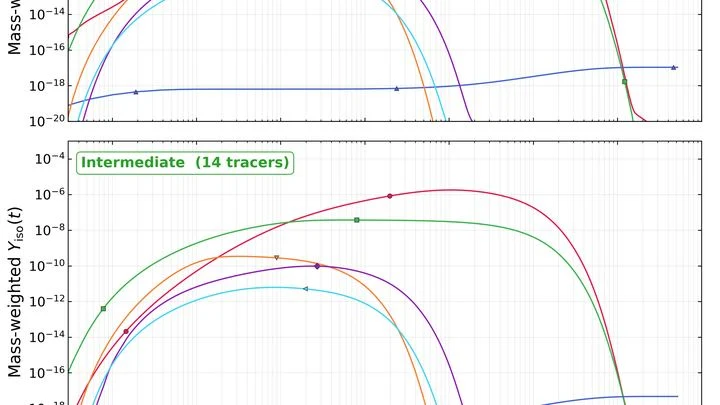
A collision of two neutron stars is a cosmic forge where the heaviest elements of the periodic table are hammered out in seconds. In 2017, detectors picked up gravitational waves from such a merger, and telescopes saw a flash — a kilonova.
A powerful laser strikes a diamond like a sledgehammer, with matter itself serving as the anvil. The impact lasts only an instant but generates pressures a million times greater than atmospheric. Physicists have long dreamed of peering into that moment to see how atoms rearrange under the onslaught.
The X-ray beam here is like a camera flash.
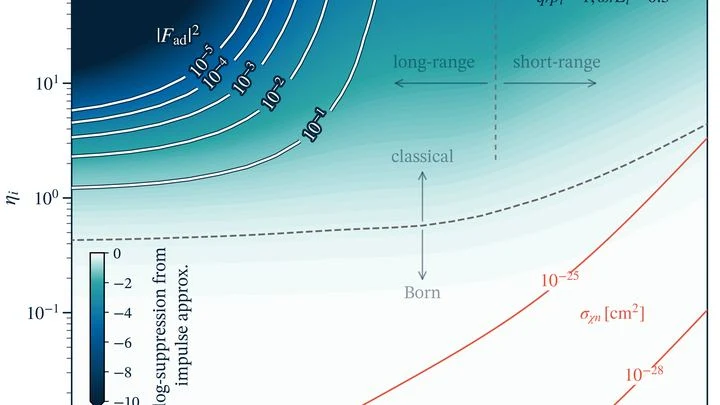
A billiard ball slams into another. Impact, and the balls scatter. But if the push is not sharp but very gentle, the balls just roll together without bouncing. An atom behaves much the same way when hit by a dark matter particle.
In the orchestra of atoms, each instrument has its own score. But sometimes two musicians start playing in unison, and the sound amplifies many times over. In the quantum world, this 'harmony' is called a Feshbach resonance. It allows you to control atomic interactions with jeweler-like precision.
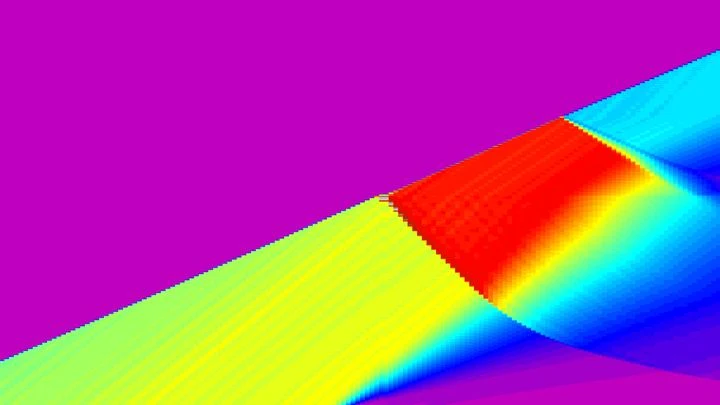
A gamma-ray burst is a brief but extremely powerful flash of light, born from the merger of neutron stars or the collapse of a massive star. Inside such a flash, plasma flows race at enormous speeds and collide with each other.
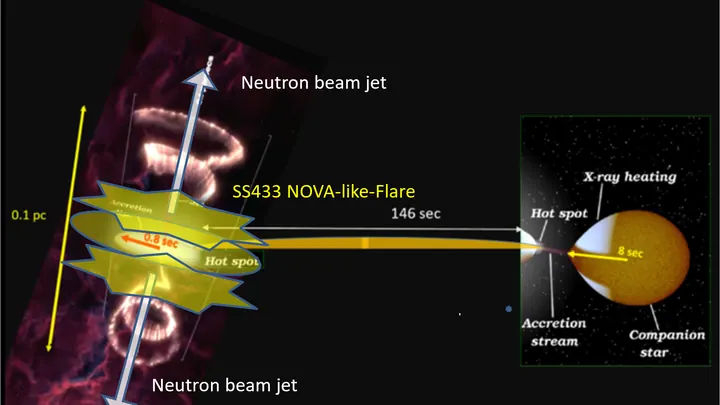
The binary system SS433 is known for its black hole stripping matter from a neighboring star. Some of the gas falls into the hole, while the rest is ejected in two narrow jets that wobble like a spinning top. These jets are visible in radio and X-rays.
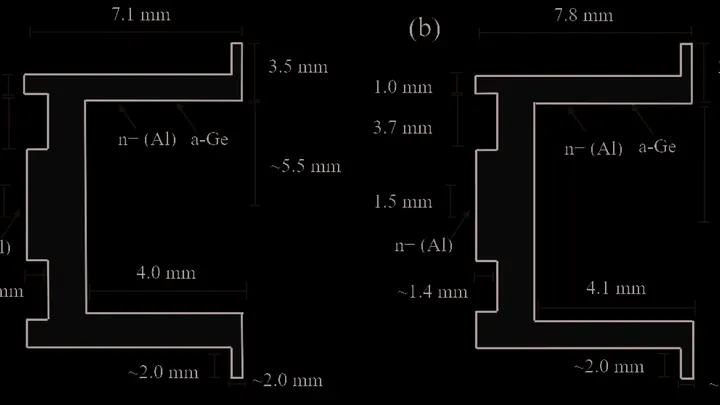
A germanium crystal the size of a fist sits in liquid nitrogen at minus 196 degrees Celsius. When a gamma quantum hits it, a cloud of charges is born inside. The detector must collect every charge without losing a single one — otherwise, the picture blurs.
In a particle accelerator, electrons race around a ring at nearly the speed of light. When such an electron collides with a photon, a particle of light, the photon bounces off like a ball hitting a moving truck and flies away with much greater energy.
A muon is like an electron, but about 200 times heavier. When it stops in a piece of silicon, it gets pulled into the atomic nucleus like a nail to a magnet. The nucleus gains extra energy and starts to "boil": various particles fly out — protons, deuterons, tritons, and alpha particles.
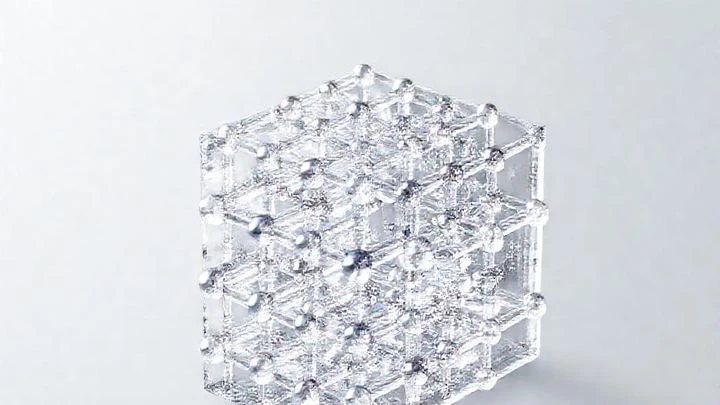
Throw pebbles along a tight row of posts: they ricochet into a dense spray. Throw at an angle, and they scatter. Gamma rays in a crystal do the same: they spawn particle cascades that spread out unless the crystal’s atomic rows are perfectly aligned. Align them within a hair’s width, and the cascade sharpens into a tight beam. A small crystal then outperforms a large one.
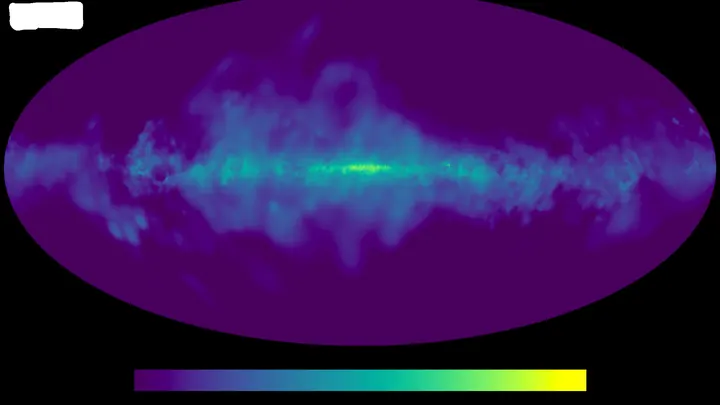
At the center of the Milky Way, a giant stellar cauldron boils. Massive stars are born and die there: each death is a supernova explosion, hurling clouds of charged particles into space.
A thin film of thorium dioxide, just 10 nanometers thick, is deposited on a steel disk. A laser pulse strikes it, but instead of the expected glow, the detector catches a stream of electrons.