Dark matter indirect detection is a strategy for finding dark matter not by catching the particles themselves, but by looking for the secondary signals they produce when they interact with ordinary matter or with each other. Since dark matter is invisible and passes through everything, direct detection experiments (which wait for a dark matter particle to bump into an atomic nucleus) are extremely difficult. Indirect detection instead searches for the byproducts of dark matter annihilation or decay — such as gamma rays, neutrinos, or even the heating of dense regions — which could be observed by telescopes and other instruments. The idea is that if dark matter particles occasionally collide and annihilate, they would produce a distinctive spectrum of radiation that we could spot coming from regions where dark matter is expected to be dense, like the centers of galaxies or the Sun.
History
The concept of indirect detection emerged in the 1980s, with early work by theorists like Lawrence Krauss and Frank Wilczek, who suggested that dark matter annihilation in the Sun could produce detectable neutrinos. The field gained momentum in the 2000s with the launch of gamma-ray telescopes like Fermi-LAT.
How it works
The mechanism relies on the fact that dark matter, despite being 'dark', is not completely inert. In many theoretical models, dark matter particles can annihilate with each other, producing standard-model particles like quarks, leptons, or photons. These products then decay or radiate, creating gamma rays or other cosmic messengers. The Earth itself can act as a detector: if dark matter particles pass through it, they might scatter and become trapped in the Earth's core, where they accumulate and annihilate, producing a faint neutrino signal. Similarly, the Sun could capture dark matter and emit neutrinos from its core. Another approach looks for the gravitational or thermal effects of dark matter on its surroundings, such as the way it might heat up dense regions or leave an imprint on the cosmic microwave background.
In practice
Indirect detection is used in astrophysical observations, such as searching for gamma-ray excesses from the galactic center or dwarf galaxies, and in neutrino telescopes like IceCube, which look for neutrinos from dark matter annihilation in the Sun or Earth.
Fun fact
The Earth's shadow can act as a natural filter for dark matter, as the planet blocks a portion of the incoming dark matter flux, creating a detectable asymmetry in the signal.
Imagine a huge stadium packed with people dressed in black. You're standing outside, trying to figure out what's happening inside, even though you can't see a single person. But if two people bump into each other and exchange bright T-shirts, you'd spot a flash of color.
Solar neutrinos are tiny particles born in the Sun's core by the trillions every second. They pass through Earth almost without noticing it, and for a long time they were considered absolutely stable. But perhaps they too can "age"—decaying imperceptibly, vanishing on their way to us.
264 kilometres per second — that's how fast the Solar System hurtles through the cloud of dark matter. Its existence was given away by galaxies: they spun too fast to be held by visible mass, and Vera Rubin was first to suspect a hidden scaffolding.
At nine in the morning, the DarkSide-50 detector, 1400 meters beneath Gran Sasso, records a weak ionization pulse. By eleven at night, the frequency of such events drops noticeably. This is not an electronics glitch or a seasonal background variation.
Dark matter leaves no trace in ordinary detectors: it passes through them like wind through gauze. To spot it, you need instruments that can feel a mosquito's punch in a storm. Quantum sensors with a threshold of a fraction of an electronvolt (a thousand times less than the energy of visible light) are just that.
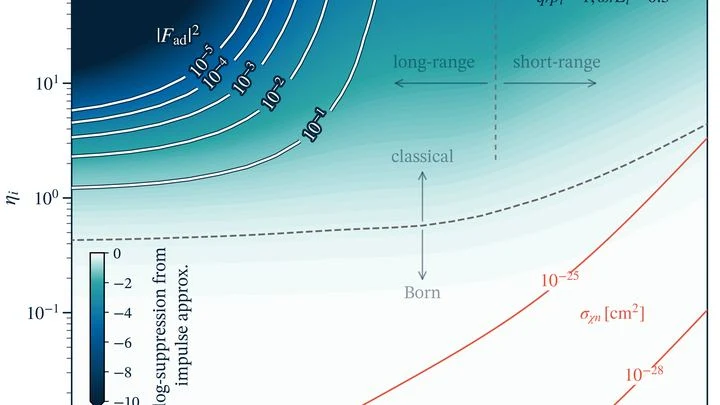
A billiard ball slams into another. Impact, and the balls scatter. But if the push is not sharp but very gentle, the balls just roll together without bouncing. An atom behaves much the same way when hit by a dark matter particle.
An ocean permeates all of space, yet remains invisible to us. This ocean is dark matter, and the waves on its surface are particles called axions. They are so light and elusive that they pass through Earth without noticing it. But if these waves crash against a shore made of a special material, they might leave a trace — a tiny electric current.
The Universe is pervaded by an invisible substance — ultralight dark matter, which doesn't collide with ordinary matter but can tremble like a taut string. Its oscillations alter the world's most fundamental properties: the electron charge, the speed of light — as if the tuning of a single cosmic note slightly drifts.
A lighthouse spins in dense fog. Its beam cuts through the gloom, but the fog itself remains invisible. That's roughly how astronomers search for dark matter: it doesn't emit light, yet it can affect the signals that reach us.
Drop two pebbles into a pond at the same time — the ripples will spread evenly and in sync. The same happens in a quantum interferometer: a particle is split into two waves that travel along different paths and then meet. Ideally, their crests align.
A detector filled with superfluid helium-4 is like a perfectly still lake. The liquid doesn't slosh or bubble: it's frozen in a single quantum state. An invisible guest, a dark matter particle, flies through it. It doesn't shine or leave a track. But sometimes it nudges a helium nucleus.
A neutron star is the dead core of a massive star, crushed to the size of a city. A teaspoon of its material weighs as much as a mountain. Dark matter particles fly through such a dense medium almost unimpeded, but occasionally they do hit neutrons and get stuck, like bullets bogging down in deep sand.
Dark matter is an invisible substance that keeps galaxies from flying apart. If its particles occasionally decay near the Sun, they shoot out streams of fast particles, like invisible hammers striking light. Each impact turns a particle of sunlight into a gamma ray — a super-powerful flash that telescopes can spot.
Dark matter is the invisible glue that keeps galaxies from falling apart. Back in the 1930s, Fritz Zwicky suspected its existence, and in the 1970s Vera Rubin proved that without it, stars would fly apart.
The LCLS-II X-ray laser in California fires short, powerful flashes, like a strobe light at a disco. Between flashes, there are dark pauses lasting 26.9 nanoseconds (billionths of a second).
In the 1930s, Fritz Zwicky, observing the Coma cluster, noticed anomalously high galaxy velocities: their motion pointed to a huge hidden mass gravitationally binding the system.