Cómo las aves ven el campo magnético de la Tierra exprés
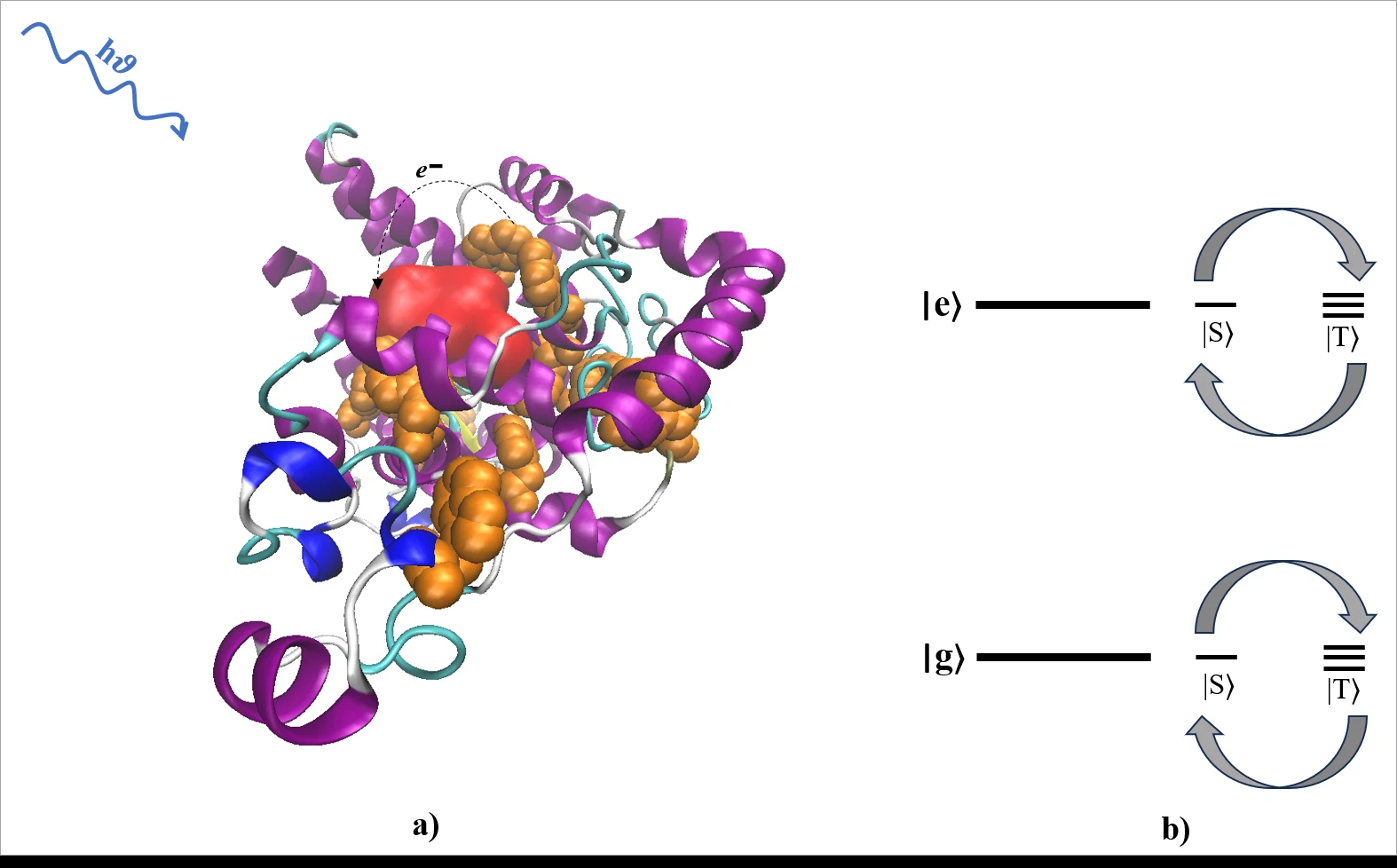
Las aves migran utilizando el campo magnético. En sus ojos hay una proteína llamada criptocromo. Esta capta la luz solar, especialmente la azul, e inicia una reacción. La absorción de luz da lugar a un par de partículas que reaccionan sensiblemente al campo magnético.
Bajo la influencia del campo, estas partículas cambian su posición mutua, lo que provoca una débil corriente eléctrica en la proteína. Esta corriente se transmite al cerebro y se percibe como una sensación visual, como si sobre el mundo se superpusiera una red transparente de líneas magnéticas. Sorprendentemente, la brújula solo funciona con luz azul diurna; al anochecer, el sistema se apaga y por la noche las aves se orientan por las estrellas.
Comprender este mecanismo no solo revela el secreto de la navegación, sino que también promete nuevas tecnologías. La proteína está compuesta de materia orgánica común, incluyendo carbono, por lo que los científicos esperan crear biosensores más compactos y sensibles que sus equivalentes electrónicos.
Resumen original
tal como lo escribieron los autores, en inglés arXiv:2510.13840
Photoreduction of cryptochrome protein in the retina is a well-known mechanism of navigation of birds through the geomagnetic field, yet the biosignal nature of the mechanism remains unclear. The absorption of blue light by the flavin adenine dinucleotide (FAD) chromophore can alter the distribution of electrons in cryptochrome and create radical pairs with separated charges. In this study, the spin dynamics of electrons in the radical pair including its spin-orbit coupling were investigated by quantum mechanical modeling. Spin-orbit coupling is negligible relative to other terms and has no significant role in the dynamics. However, it engages the spatial states of the radical pair and make possible to study spatial related observables. Several interactions were considered in the presence of an external magnetic field, and the resulting electric dipole moment in cryptochrome was computed as the quantity emerging from this coupling. The computations show the induced electric dipole moment clearly depend on the characteristics of the applied magnetic field even after considering dissipative effects. In fact, our findings indicate that the radical pair in cryptochrome protein is a magnetic biosensor, in the sense that in the presence of the geomagnetic field, variations in spin states can influence its electric dipole moment, which may be interpreted via the bird as an orientation signal. The results can be used in the advancement of bio-inspired technologies which replicate animal magnetic sensitivity.
Esta misma proteína también está en los ojos humanos, pero en nosotros solo ajusta el reloj biológico y no percibimos el campo magnético.