Dos sondas se sumergirán en la cola de un cometa interestelar exprés
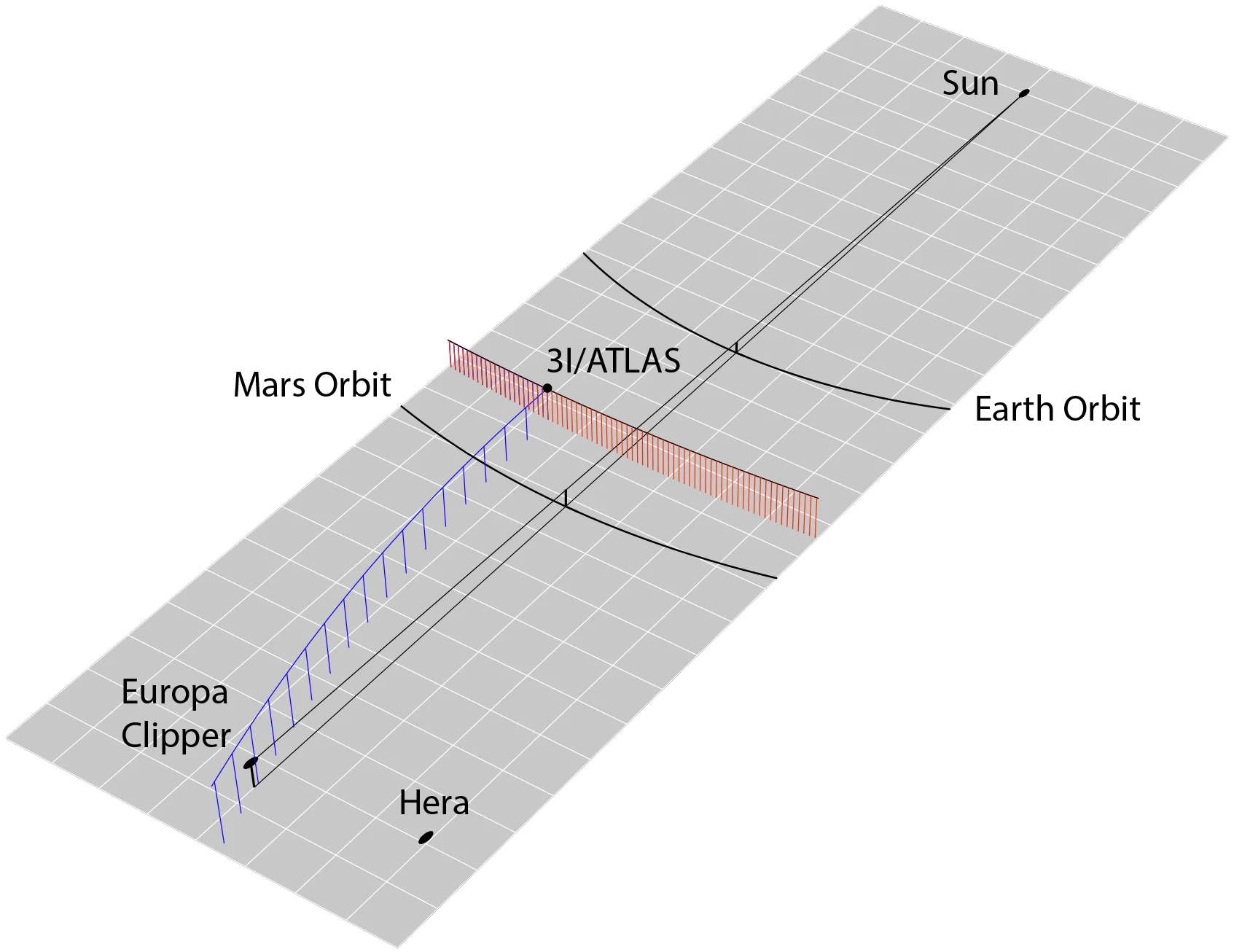
La cola del cometa 3I/ATLAS, extendida por millones de kilómetros, está compuesta de gas enrarecido y diminutas partículas de polvo. A finales de octubre de 2025, dos sondas terrestres se sumergirán en ella: Europa Clipper y Hera. Ninguna fue diseñada para encontrarse con un cometa: Clipper viaja hacia una luna de Júpiter, Hera hacia un asteroide. Pero sus trayectorias se cruzaron casualmente con la cola.
Los instrumentos a bordo captarán partículas de polvo y hidrógeno, y medirán cómo cambia el flujo de partículas cargadas del Sol.
El análisis de su composición revelará si otros mundos se parecen al nuestro. Es como tomar una muestra de un océano desconocido. Estos datos transformarán las vagas conjeturas sobre otros sistemas planetarios en química medible.
Resumen original
tal como lo escribieron los autores, en inglés arXiv:2510.13222
During October - November 2025, interstellar comet 3I/ATLAS, will pass upstream of the Europa Clipper and Hera spacecraft. Here, we identify two potential opportunities for in-situ observations of 3I's ion tail by immersion, facilitated by the close alignment between the comet's hyperbolic trajectory with the ecliptic plane. During the period 30 October - 6 November 2025, it is predicted that Europa Clipper will potentially be immersed within the ion tail of 3I/ATLAS, providing the opportunity to detect the signatures of an interstellar comet's ion tail. Characteristic changes to the solar wind are also expected to be observed; a magnetic draping structure associated with the comet may be identifiable. It is further predicted that spacecraft Hera will possibly be immersed within the ion tail of 3I/ATLAS during the period 25 October - 1 November 2025.
El cometa 3I/ATLAS fue descubierto en 2025: es apenas el cuarto objeto interestelar detectado por los humanos, después del asteroide Oumuamua.