Mundos con océanos eternos de magma exprés
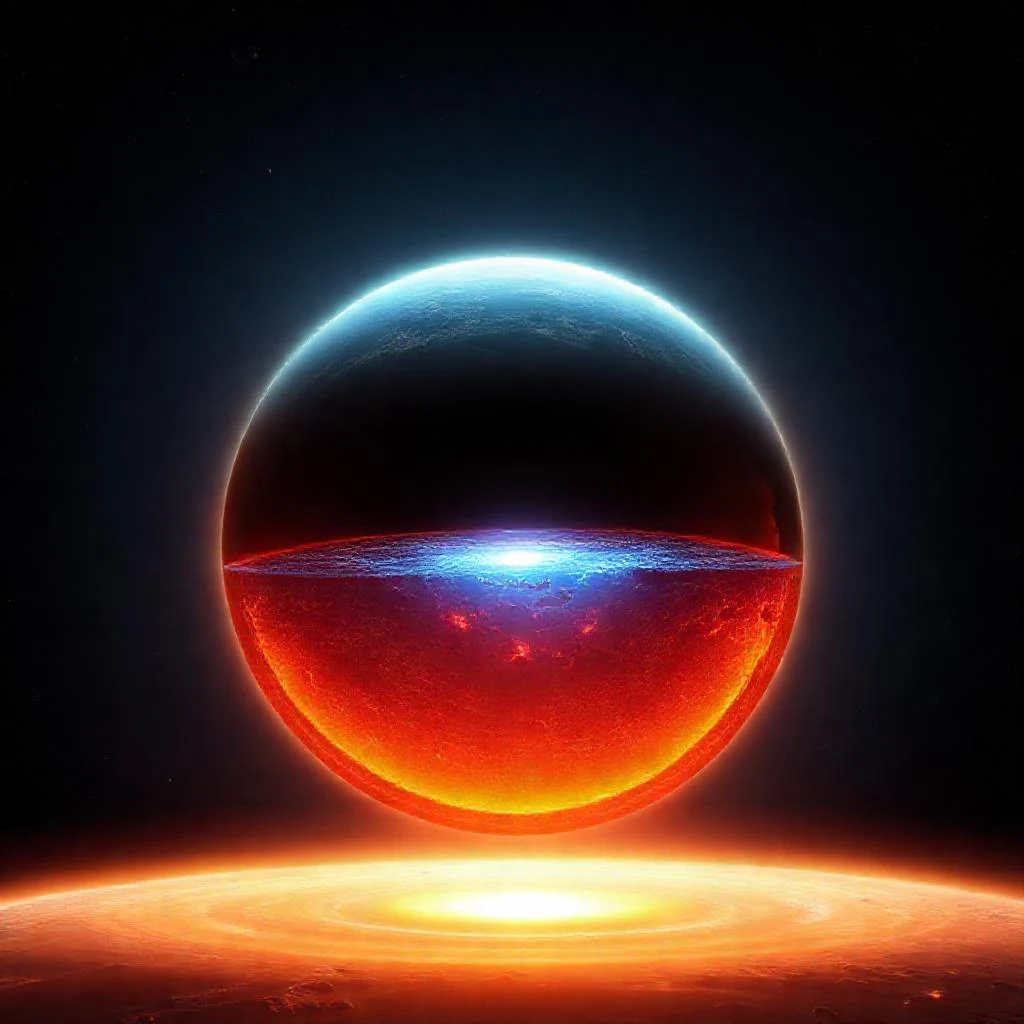
La estrella calienta su planeta como un horno calienta una olla. Para la mayoría de los subneptunos (mundos más grandes que la Tierra pero más pequeños que Neptuno), el calor es suficiente para que bajo el cielo de hidrógeno hierva eternamente un océano de roca fundida. Un modelo computacional mostró que el 98% de estos planetas descubiertos permanecen fundidos en su interior, si realmente se asemejan a enanas gaseosas con una atmósfera ligera de hidrógeno.
Si en el interior del planeta abunda el oxígeno y en el exterior el carbono, la atmósfera se vuelve más pesada y se enfría más rápido. Pero para la mayoría de los mundos, el calor interno no se ha extinguido. Esto cambia las ideas: antes se pensaba que estos cuerpos se solidifican en miles de millones de años, pero resulta que sus entrañas aún arden.
Resumen original
tal como lo escribieron los autores, en inglés arXiv:2512.05816
Sub-Neptunes are the most common type of detected exoplanet, yet their observed masses and radii are degenerate with several interior structures. One possibility is that sub-Neptunes have silicate/iron interiors and H$$_2$$-dominated atmospheres ($$\mu$$<3.8 g mol$$^{-1}$$), i.e., they are 'gas dwarfs'. If gas dwarfs have molten interiors, interactions between their magma oceans and atmospheres will produce distinct observational signatures. These signatures may break the degeneracy in interior structure, while providing insight into their interior processes, history, and population trends. We expect all such planets are born molten, but under what conditions do they remain molten today? We use the coupled interior-climate evolution model, PROTEUS, to estimate the 'solidification shoreline': the instellation flux boundary (as a function of stellar $$T_{\rm eff}$$) that separates molten gas dwarfs from solidified ones. Our results show that 98% of detected sub-Neptunes occupy a region of parameter space consistent with their having permanent magma oceans, if they are gas dwarfs. While mantle $$f{\rm O}_2$$ and bulk volatile C/H ratio both influence magma ocean cooling, planets with oxidising mantles and carbon-rich atmospheres are likely to have high mean-molecular weight atmospheres ($$\mu$$>3.8 g mol$$^{-1}$$) and are thus outside the scope of this study. Therefore, most detected sub-Neptunes, if they are gas dwarfs, have permanent magma oceans. This result motivates further research into the interactions between molten interiors and overlying atmospheres, and campaigns to identify unambiguous signatures of these interactions.
Los subneptunos son el tipo de planeta más común en nuestra galaxia, aunque no existen en el sistema solar.