Un telescopio lunar verá las sombras de agujeros negros lejanos exprés
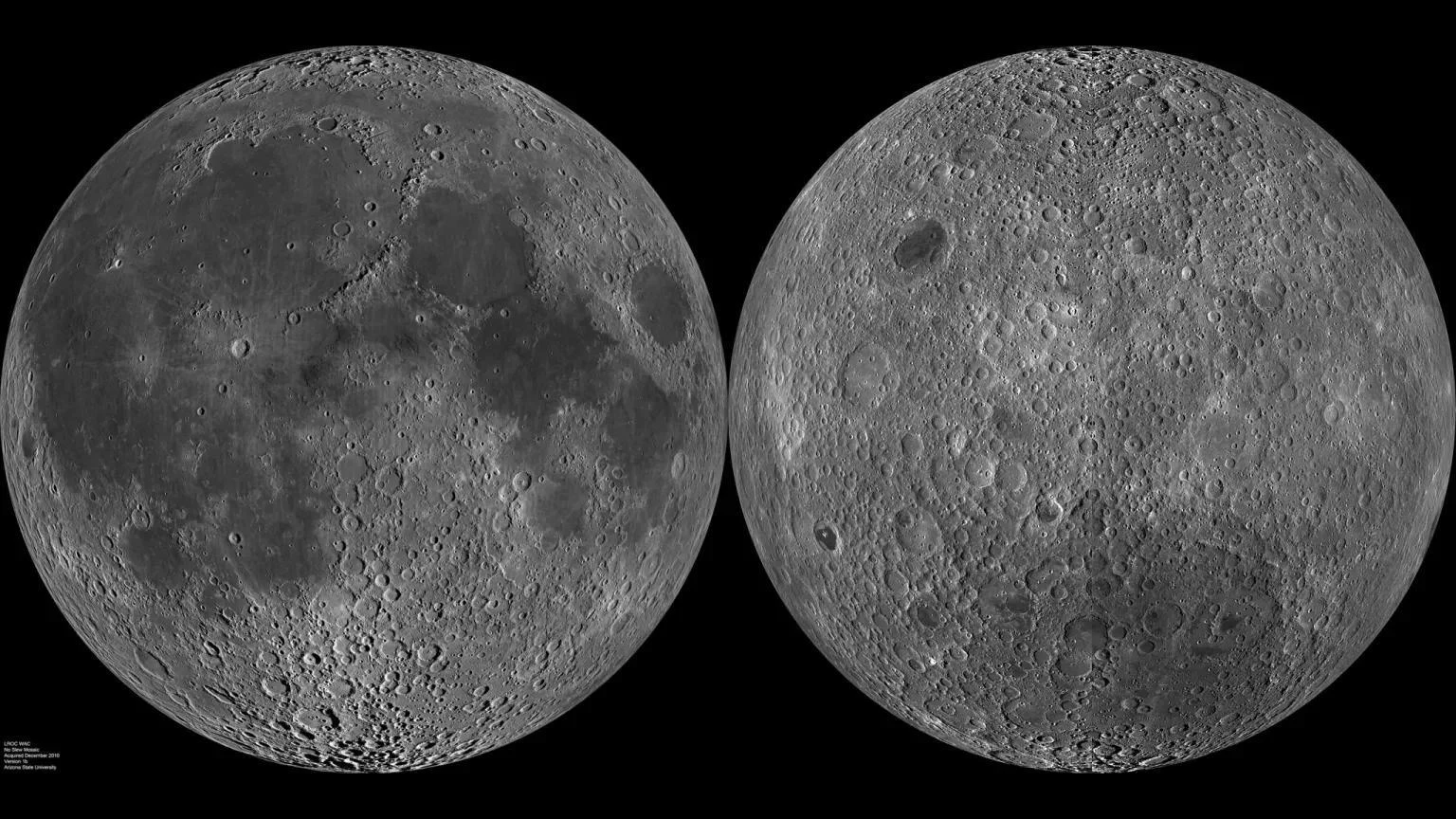
Cuanto más separadas estén las antenas, más finos serán los detalles que captan. Al combinar sus señales, los astrónomos convierten varios instrumentos en un solo telescopio del tamaño de la distancia entre ellos. Añadiendo a las antenas terrestres una lunar, obtenemos un ojo virtual de 384 000 km de diámetro. Es como mirar al cosmos con los ojos de un gigante cuyas pupilas están separadas por la distancia de la Tierra a la Luna.
La principal sorpresa es el anillo de fotones. Es un finísimo aro de luz generado por la extrema curvatura del espacio-tiempo. Para distinguirlo, se necesitarán además antenas flotando en el vacío entre la Tierra y la Luna. Entonces las sombras de los agujeros negros se volverán más nítidas y pondremos a prueba las leyes de la gravedad allí donde funcionan al límite.
Resumen original
tal como lo escribieron los autores, en inglés arXiv:2601.02812v2
The 1.3 mm ground-based very long baseline interferometry (VLBI) array Event Horizon Telescope (EHT), is limited by Earth's diameter, restricting its black hole shadow imaging to only M87* and Sgr A*. Extending baselines to the Moon would achieve ~0.7 uas angular resolution at 230 GHz, enabling shadow detection for a much larger sample of supermassive black holes (SMBHs). The concept is motivated by space VLBI missions and lunar exploration, including the ongoing Lunar Orbit VLBI EXperiment (LOVEX) aboard QueQiao-2 (Chang'E-7) and the planned International Lunar Research Station (ILRS). We assess shadow detectability for 31 SMBHs with predicted large angular sizes, exploring different telescope location and antenna size. Assuming a telescope at the lunar antipode, we simulate the Moon-Earth (u,v) coverage and show that sources with direction near the Moon's orbital plane yield projected baselines spanning from short to long, enabling sampling of the first visibility null - a key shadow signature. Using a geometric ring model, we identify six shadow-detectable candidates for Moon-Earth VLBI. Among these, M104, NGC 5077, and NGC 1052 are detectable with a 5 m lunar-based telescope; PGC 049940 requires 10 m; NGC 524 requires 20 m; and NGC 5252 requires 40 m. Furthermore, if space telescopes fill the baseline coverage gaps between Moon and Earth, the n=2 photon ring region is detectable for Sgr A*, M87* with a 10 m lunar-based telescope, and 12 candidates are detectable for the n=1 photon ring region using a lunar-based telescope of up to 40 m. These results provide a clear scientific and technical motivation for lunar-based telescopes in future black hole shadow studies.
La resolución angular de este sistema —0,7 microsegundos de arco— es comparable a poder distinguir una naranja dejada en la superficie de la Luna desde la Tierra.
Como en 'Interstellar', pero más preciso: el telescopio lunar promete mostrar las sombras de agujeros negros lejanos con una nitidez de película.