Aire planetario: receta de una estrella exprés
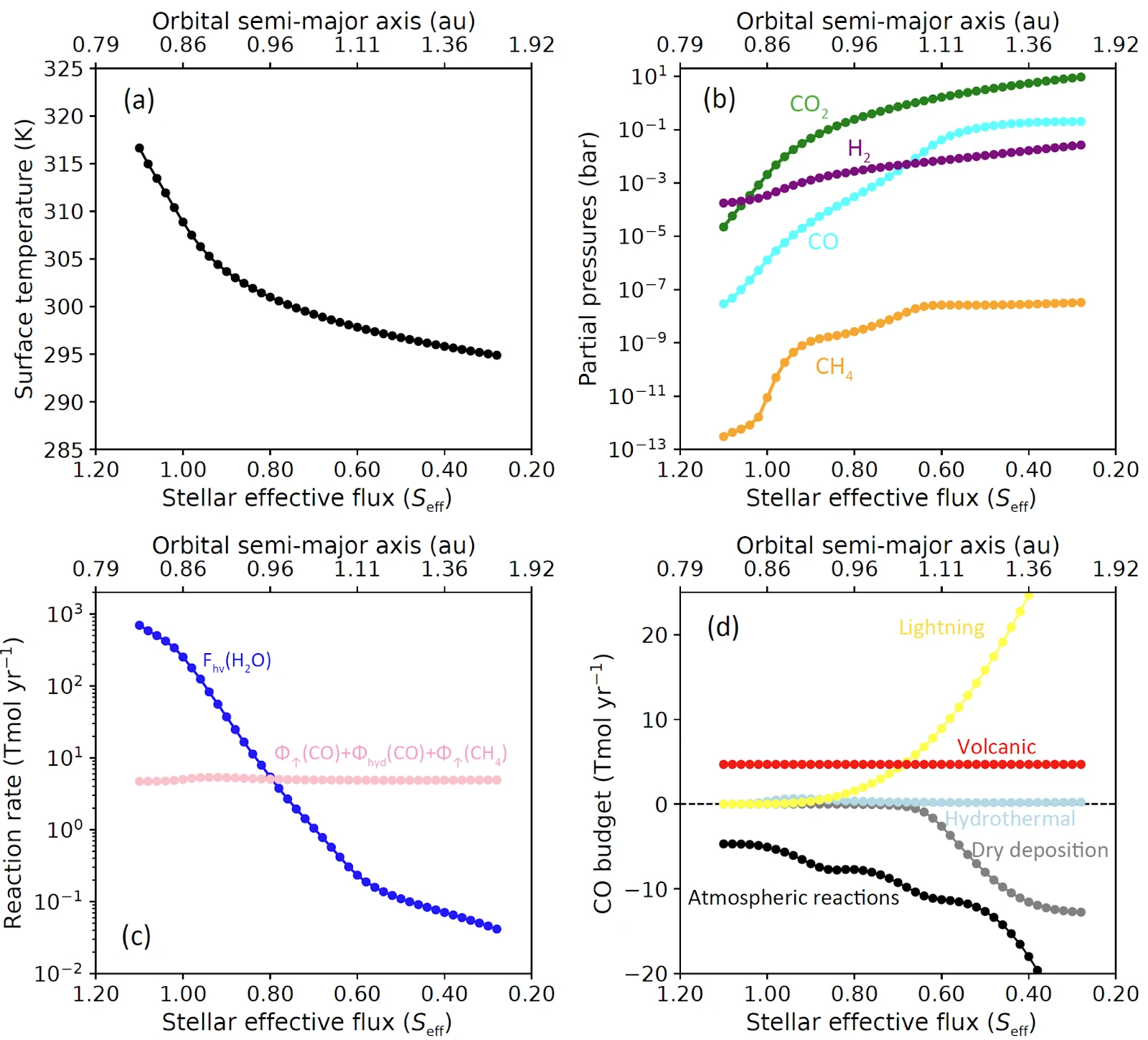
Un planeta rocoso alrededor de otra estrella es como un plato en el horno. La estrella fija la temperatura: cuanto más lejos, más frío. Del régimen de calor y del tipo de estrella (como el Sol o más tenue) depende la mezcla de gases con carbono en el aire: dióxido de carbono, monóxido de carbono, metano.
El formaldehído — ladrillo para azúcares y aminoácidos — se 'hornea' mejor cerca de estrellas calientes, justo antes del colapso. Telescopios como «James Webb» analizarán la luz de mundos lejanos y encontrarán lugares donde la receta de la vida casi se ha armado.
Resumen original
tal como lo escribieron los autores, en inglés arXiv:2601.05480v1
The abundances of atmospheric carbon species--carbon dioxide (CO2), carbon monoxide (CO), and methane (CH4)--exert fundamental controls on the climate, redox state, and prebiotic environment of terrestrial planets. As exoplanet atmospheric characterization advances, it is essential to understand how these species are regulated on habitable terrestrial planets across a wide range of stellar and planetary conditions. Here, we develop an integrated numerical model that couples atmospheric chemistry, climate, and the long-term carbon cycle to investigate the atmospheric compositions of lifeless, Earth-like planets orbiting Sun-like (F-, G-, and K-type) stars. Our simulations demonstrate that CO2, CO, and CH4 generally increase with orbital distance, and that planets near the outer edge of the habitable zone may undergo CO runaway--a photochemical instability driven by severe depletion of OH radicals. The threshold for CO runaway depends strongly on stellar spectral type and is most easily triggered around cooler, lower-mass stars. In contrast, the atmospheric production of formaldehyde (H2CO)--a key precursor for prebiotic organic chemistry--peaks around planets orbiting more massive, UV-luminous stars and is maximized at orbital distances just interior to the CO-runaway threshold. These results establish a quantitative framework linking observable system properties--stellar type and orbital distance--and the atmospheric carbon chemistry of lifeless Earth-like planets, providing new context for interpreting future spectroscopic observations and for evaluating the potential of such planets to sustain prebiotic chemistry.
En planetas sin vida, el monóxido de carbono puede acumularse a niveles cientos de veces superiores a los terrestres, y todo por las características de la luz de la estrella.