Química revela un planeta en formación exprés
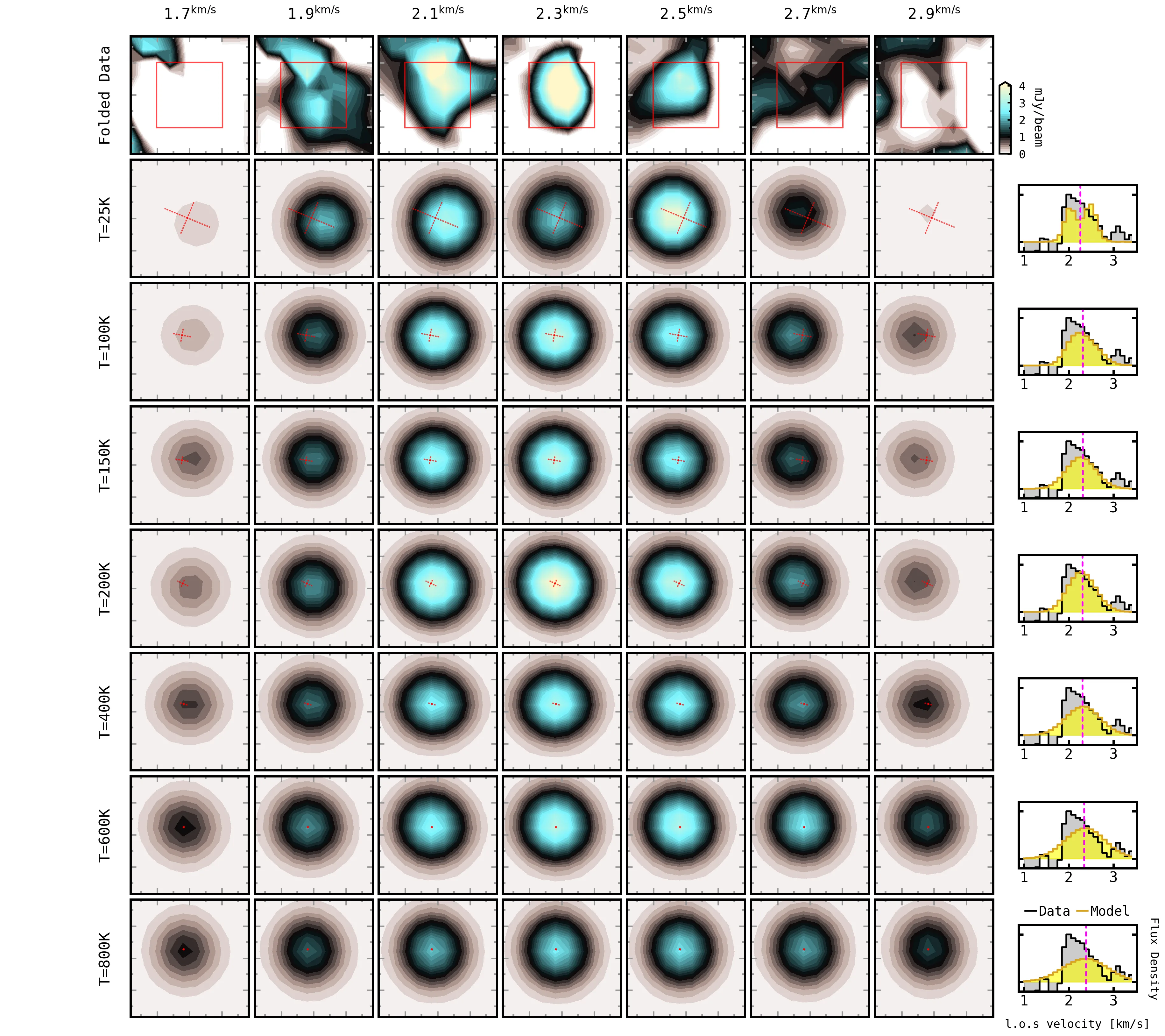
Alrededor de la estrella HD 163296, a 330 años luz de nosotros, gira un denso anillo de gas y polvo. En él, los astrónomos han distinguido una pequeña pero brillante mancha de moléculas de ácido cianhídrico y etinilo. Se encuentra a 88 unidades astronómicas de la estrella, más lejos que Plutón del Sol.
El calor del planeta en formación, oculto en esa mancha, derrite el polvo helado. Las moléculas congeladas se evaporan y comienzan a brillar, como el vapor sobre una olla caliente. Así, la química revela un planeta invisible.
La mancha coincide con el lugar donde antes se habían detectado perturbaciones en el movimiento del gas, la huella del planeta P94. Ahora también tiene un retrato químico. Las estimaciones de masa son inferiores a 1.8 masas de Júpiter, y la temperatura del gas en sus alrededores supera los 150 kelvin, como un congelador, pero al revés.
Resumen original
tal como lo escribieron los autores, en inglés arXiv:2601.10631
Atacama Large Millimeter/submillimeter Array observations suggest that the disc of HD 163296 is being actively shaped by embedded, yet unseen protoplanets, as indicated by numerous gas and dust substructures consistent with planet-disc interaction models. We report the first detection of simple organic molecules, HCN and C2H, tracing a candidate circumplanetary disc (CPD) in the HD 163296 system, located at an orbital radius of $$R=88\pm7$$ au and azimuth $$\phi=46\pm3^\circ$$ (or $$R=0.75''$$, $$\rm{{PA}}=350^\circ$$ in projected sky coordinates), and originating near the midplane of the circumstellar disc. The signature is localised but spectrally resolved, and it overlaps with a previously reported planet candidate, P94, identified through kinematic perturbations traced by CO lines. We propose a scenario in which the observed chemical anomalies arise from increased heating driven by the forming planet and ongoing accretion through its CPD, facilitating the thermal desorption of species that would otherwise remain frozen out in the disc midplane, and potentially triggering the activation barriers of chemical reactions that lead to enhanced molecular production. Based on a first-order dynamical analysis of the HCN spectrum from the CPD--isolated with a 7$$\sigma$$ significance--we infer an upper limit on the planet mass of 1.8 $$M_{\rm Jup}$$, consistent with predictions from CO kinematics and constraints from direct imaging studies. By comparing the CPD sizes derived from our models with theoretical expectations where the CPD radius corresponds to roughly one-third of the planet's Hill radius, we favor CPD gas temperatures $$T > 150$$ K, planet masses $$M_{\rm p} < 1.0$$ $$M_{\rm Jup}$$, and CPD radii $$R_{\rm CPD} < 2$$ au.
El radio del disco alrededor del planeta es de solo 2 unidades astronómicas, como la órbita de Marte, pero de gas y polvo.
En la serie 'The Expanse', el cinturón de asteroides está repleto de moléculas orgánicas que se extraen para las colonias, algo parecido a lo que vemos en el disco de HD 163296.