Cómo una galaxia enana sacudió la Vía Láctea exprés
La galaxia enana de Sagitario se estrelló contra el disco de la Vía Láctea y lo atravesó repetidamente, como una piedra lanzada a un estanque tranquilo. Cada impacto dejaba ondulaciones: ondas y curvaturas en el campo estelar. Antaño, Sagitario estaba llena de masa invisible (materia oscura), pero las colisiones le arrancaron gas y estrellas, dejándola como un tenue rastro.
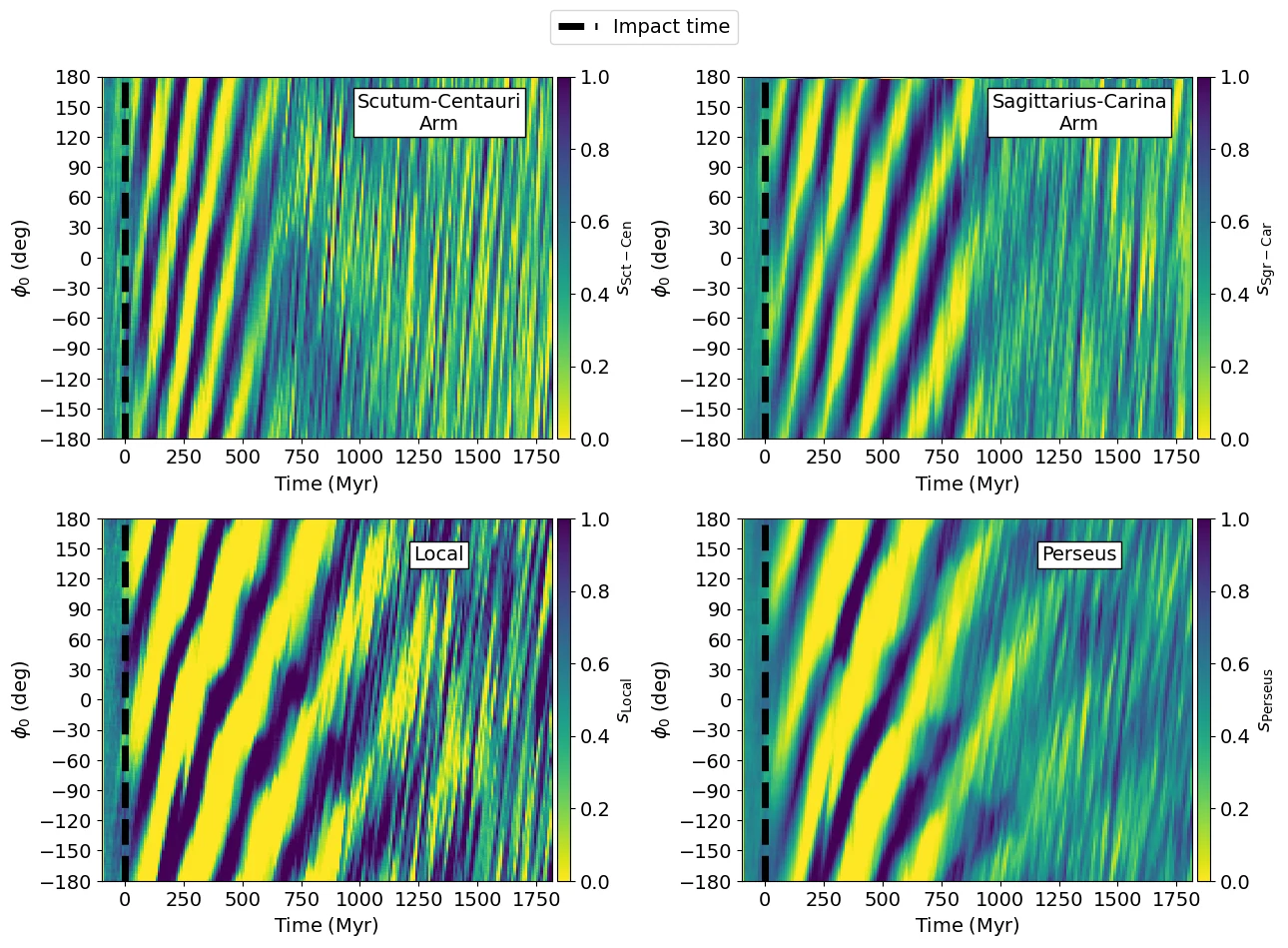
Los astrónomos simularon el último gran impacto, hace unos mil millones de años, para comprobar si pudo generar los brazos espirales, la curvatura del disco y las sutiles oscilaciones en las velocidades estelares. Las mediciones de movimientos mediante espectroscopía confirmaron que el impacto explica los brazos y la curvatura, pero los patrones ondulatorios más complejos no se reproducen por completo. Esto significa que nuestra Galaxia también recuerda otros empujones: de la densa barra central o de otras galaxias enanas satélite.
Lo más sorprendente: Sagitario casi ha desaparecido, pero su materia oscura probablemente sigue impregnando la Vía Láctea, influyendo invisiblemente en el movimiento de las estrellas. Así, reuniendo pistas cósmicas, los científicos reconstruyen el turbulento pasado de la Galaxia.
Resumen original
tal como lo escribieron los autores, en inglés arXiv:2602.05296
Prior to its infall, the Sagittarius (Sgr) dwarf galaxy was a major satellite with a mass of $$M_{\rm sgr}\sim 10^{11}$$ M$$_\odot$$. For the past $$5-6~\mathrm{Gyr}$$ , it has been heavily stripped by the Milky Way (MW), losing most of its mass while crossing the MW disc multiple times. Recent models of Milky Way disc perturbations $$-$$ including the spiral arms, the stellar bar, the Gaia phase spiral, and stellar and gaseous disc corrugations $$-$$ have identified these crossings as possible formation triggers, but have generally treated each perturbation in isolation. Here, we adopt a holistic perspective and ask whether a single disc-crossing impulse can simultaneously account for these features as observed today. We focus on simulations of single disc-crossing events by a Sgr-like perturber, and present a forensic analysis of the role of the powerful impulse in forming spiral arms, disc corrugations, the phase spiral and the `$$L_{z}-\bar{V}_{R}$$ wave', determined from a star's angular momentum and radial velocity, respectively. We find that a single disc crossing can reproduce reasonably well (e.g. structure, amplitude, phase) the observed local disc corrugation, and the Outer, Local and Sagittarius-Carina arm segments, implying that the last significant impulse due to a transit took place $$700-1200~\mathrm{Myr}$$ ago. Moreover, the $$L_{z}-\bar{V}_{R}$$ wave and phase spiral appear within the simulations over the same epoch and their general structure is reasonably well replicated, but not in detail. We conclude that Sgr's last significant crossing roughly a Gyr ago could be the primary cause of large-scale MW disc perturbations, but it cannot fully account for the $$L_{z}-\bar{V}_{R}$$ wave. Consequently, other triggers, possibly the Galactic bar or interactions with other satellites, must be considered in order to fully explain the current dynamical state of the MW's disc.
La galaxia enana de Sagitario aún es visible en el cielo como una tenue franja de estrellas, estirada por la gravedad de la Vía Láctea.