Superllamaradas estelares: calientan planetas y sintetizan aminoácidos exprés
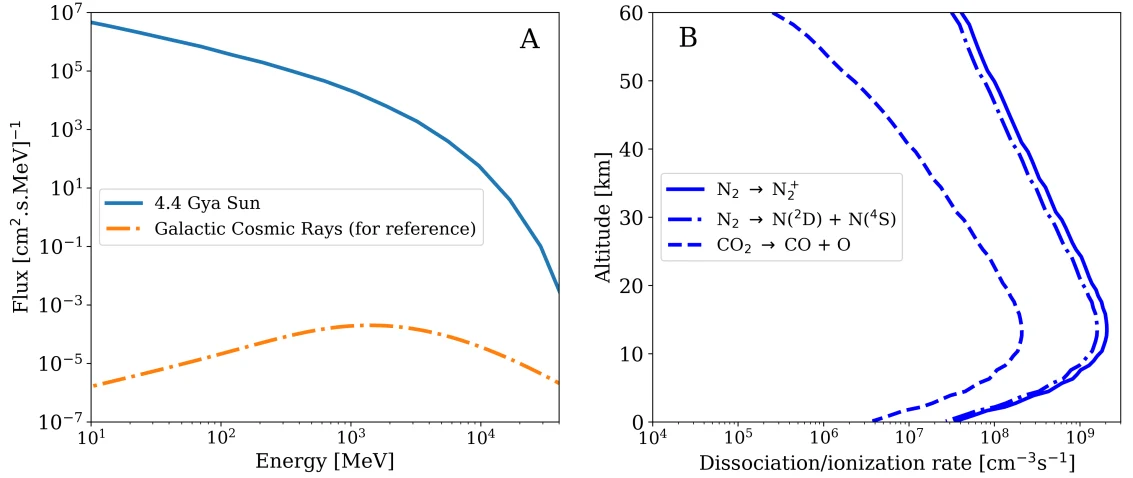
El joven Sol brillaba un 30% menos, pero los océanos no se congelaron. La clave: las superllamaradas que bombardeaban la atmósfera con flujos de partículas energéticas. Un experimento de laboratorio lo reprodujo: una mezcla de nitrógeno y dióxido de carbono bajo el impacto de partículas produjo óxido nitroso y glicina, un bloque de construcción de proteínas. La atmósfera es aquí la olla, y las partículas estelares el chef, preparando con gases simples un 'caldo' para el clima y la vida. Cada potente llamarada podía producir hasta 20 mil millones de kilogramos de óxido nitroso al año, suficiente para crear una densa 'tapa' para la olla planetaria.
El óxido nitroso es un gas de efecto invernadero 300 veces más fuerte que el CO2. Retenía el calor del débil Sol, evitando que la Tierra se congelara. Este mismo mecanismo amplía la zona habitable para exoplanetas rocosos donde el calor normal es insuficiente. De paso, nacen aminoácidos, los ladrillos de la vida. Así, la tormenta cósmica, normalmente vista como amenaza, posiblemente inició la química de la vida en la Tierra.
Resumen original
tal como lo escribieron los autores, en inglés arXiv:2603.18206
The emergence of habitable conditions on the early Earth and on rocky exoplanets requires persistent energy sources that can drive both prebiotic chemistry and climate warming under magnetically active young G to M stars. To quantify the contribution of stellar energetic particle (StEP) events associated with superflares to the atmospheric chemistry of young planets with primitive atmospheres, we carried out a suite of laboratory proton irradiation experiments on mildly reduced gas mixtures. We present first proton irradiation experiments of $$N_{\mathrm{2}}$$/$$CO_{\mathrm{2}}$$ rich gas mixtures that yield abundant nitrous oxide ($$N_{\mathrm{2}}O$$) at mixing ratios up to 1000 ppmv, together with amino acid precursors including glycine, corresponding to global production rates of order $$2\times10^{10}$$ kg/yr on the early Earth. Our photochemical modeling of StEP driven proton irradiation reproduces the experimentally inferred $$N_{\mathrm{2}}O$$ production rates and provides self-consistent atmospheric $$N_{\mathrm{2}}O$$ profiles. We then use these profiles of $$N_{\mathrm{2}}O$$ as input to a 3D global climate model to evaluate the radiative and climatic impact of StEP generated $$N_{\mathrm{2}}O$$ in primitive atmospheres representative of the early Earth and young rocky exoplanets. Our results show that frequent StEP events can help alleviate the faint young Sun paradox on the early Earth and can maintain temperate surface conditions on young rocky exoplanets beyond the outer edges of habitable zone, while simultaneously enhancing the buildup of prebiotic molecules. Together, these processes may constitute a robust pathway toward early planetary habitability.
Cada potente superllamarada en una estrella joven podía producir hasta 20 mil millones de kilogramos de óxido nitroso al año, suficiente para calentar la atmósfera de todo un planeta.
La idea de calentar un planeta con gases de efecto invernadero es familiar en la trilogía 'Marte Rojo' de Kim Stanley Robinson. Solo que allí son ingenieros humanos, y aquí, la propia estrella.