El universo canta: resonancia entre materia oscura y ordinaria exprés
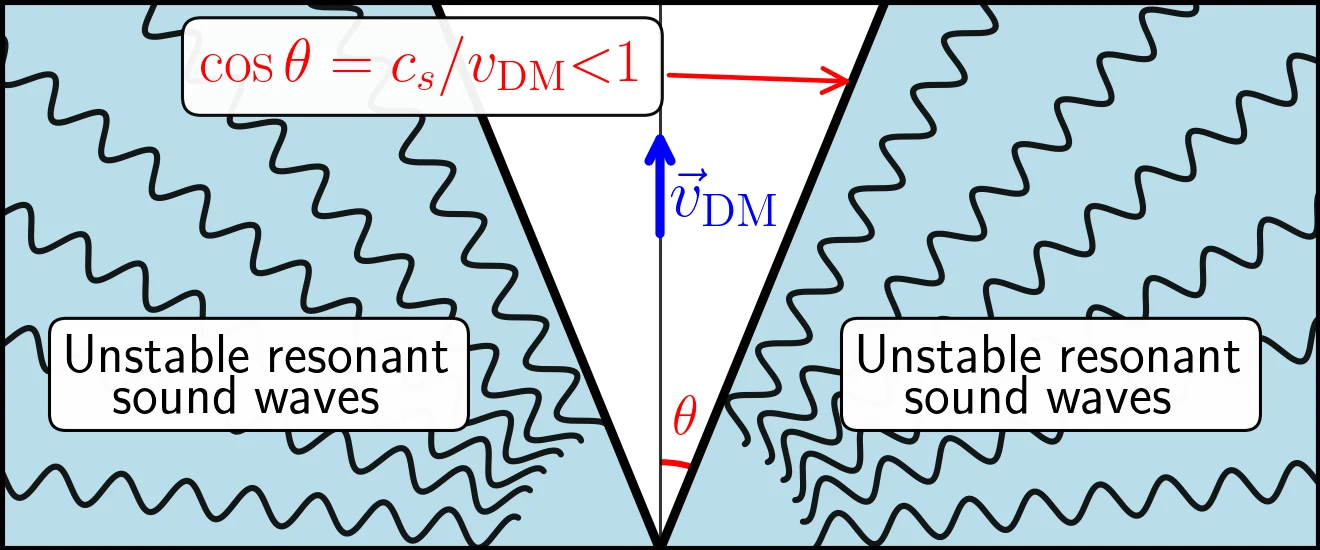
Después del Big Bang, la materia oscura y la materia ordinaria (principalmente hidrógeno) se separaron en velocidad. Su atracción gravitacional actúa como un arco deslizándose sobre una cuerda: cuando las frecuencias coinciden, surge una resonancia y las ondas sonoras en la materia ordinaria comienzan a crecer rápidamente.
Este dúo cósmico resuena por todas partes y ocurre de forma vertiginosa: desde unos pocos años hasta decenas de millones de años, un suspiro comparado con la vida de las galaxias. El descubrimiento, basado en los trabajos de Fritz Zwicky y Vera Rubin, explica misterios: por qué los brazos espirales no se desintegran y por qué el gas en los cúmulos es más caliente. Gracias a la expansión del universo, descubierta por Edwin Hubble, la materia oscura está en perpetuo movimiento, y su resonancia se percibe a todas las escalas: desde los discos protoplanetarios, donde calienta los planetas en formación, hasta los cúmulos de galaxias.
Resumen original
tal como lo escribieron los autores, en inglés arXiv:2604.22665
Dark matter and baryons acquire a relative velocity after decoupling in the early Universe. Baryons are gravitationally unstable only above their Jeans scale, while cold dark matter (CDM) is unstable on all scales. We show for the first time that their relative drift triggers a resonant gravitational instability that drives sound waves in baryons. When the projected DM drift is subsonic, the stable oscillatory branch of baryons resonates with the Doppler-shifted DM mode, producing exponentially growing perturbations whose growth rates exceed the intrinsic CDM growth rate. The instability peaks below the baryon Jeans scale and, in baryon-dominated environments, opens a window of complete stability between the Jeans scale and the resonance. Supersonic drift suppresses growth, as previously noted. The resonant coupling also transfers momentum between the species, creating a non-viscous, collisionless drag. We derive an accurate analytical approximation for the growth rate at resonance and show that the associated timescales range from years to tens of millions of years across diverse environments -- planets, protoplanetary disks, stars, molecular clouds, galaxies, and galaxy clusters -- typically much shorter than their ages. In an expanding FLRW universe, the instability enhances baryon density perturbations at different redshifts for appropriately oriented modes while suppressing the growth of those aligned with the DM stream. The universe thus sings across all scales, and this resonant mechanism provides the means to listen: it offers a novel probe of dark matter through its seismic imprint on astrophysical objects and may explain long-standing puzzles such as the persistence of spiral arms and the heating of the intracluster medium in galaxy clusters.
La resonancia de la materia oscura puede influir en la formación de planetas, calentando los discos protoplanetarios alrededor de estrellas jóvenes.
La imagen de un «universo que canta» resuena con la ciencia ficción, por ejemplo, con la novela de Arthur C. Clarke «Cánticos de la lejana Tierra».