Implante poroso con fármaco: cómo el flujo sanguíneo controla la dosificación exprés
Un implante poroso cargado con fármaco funciona como una esponja que va cediendo lentamente la sustancia al líquido que lo rodea. Pero si el líquido fluye rápido, arrastra el fármaco de manera distinta que en un entorno tranquilo. Los autores calcularon por ordenador cómo las distintas velocidades de flujo y las propiedades de la estructura porosa afectan a la liberación del fármaco.
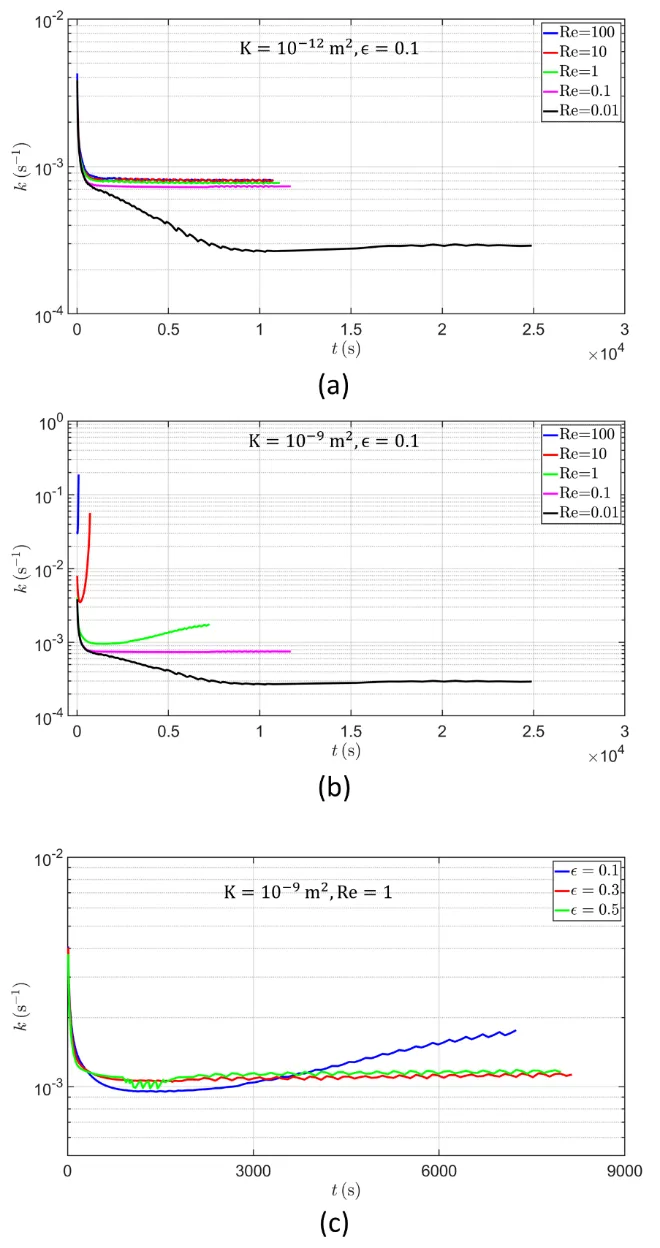
Resulta que, a altas velocidades de flujo (números de Reynolds grandes), la velocidad de liberación del fármaco puede no disminuir, sino aumentar hacia el final de la vida útil del implante. Esto es inusual: normalmente el fármaco se libera rápido al principio y luego cada vez más lento. Este efecto permite alargar la administración del fármaco y adaptarla a las necesidades del organismo.
Resumen original
tal como lo escribieron los autores, en inglés arXiv:2604.23191
Drug-Filled Porous Implants (DFPIs) are an innovative solution for delivering drugs in a controlled and sustained manner to target sites. To optimize their performance across various physiological conditions, it is essential to understand how fluid flow and porous media properties influence the drug release process. In this work, we numerically investigate a wide range of flow conditions and their effects on drug release from DFPI. The DFPI is modeled as a homogeneous, saturated porous medium, with flow through the porous structure modeled using the Forchheimer-extended Darcy law. Drug diffusion within the DFPI and its transport through the surrounding channel are simulated using a diluted species transport approach. The results reveal the impact of flow conditions and porous media characteristics on the drug release profile of the implant and drug availability within the channel. The variations in drug release behavior are analyzed by modeling the release as an apparent first-order process with a time-dependent rate constant. Notably, the results highlight specific conditions under which the rate constant increases during the later stages of drug release from the DFPI, particularly at high Reynolds numbers, while also ensuring a prolonged operational time period of the implant. These findings suggest the potential for developing intelligent DFPI designs capable of delivering drugs in a manner more attuned to the specific needs of the application.
El número de Reynolds es la relación entre las fuerzas de inercia y las fuerzas viscosas en un flujo. Para el agua en una tubería, determina si el flujo es laminar o turbulento.