Puntos calientes de diminutos agujeros negros exprés
Un diminuto agujero negro atraviesa una nube de gas. No la absorbe, sino que la calienta, como una plancha dejada sobre un paño húmedo. De él emana radiación y a su alrededor se forma un punto caliente: una región donde la temperatura es cientos de veces mayor que la del espacio circundante.
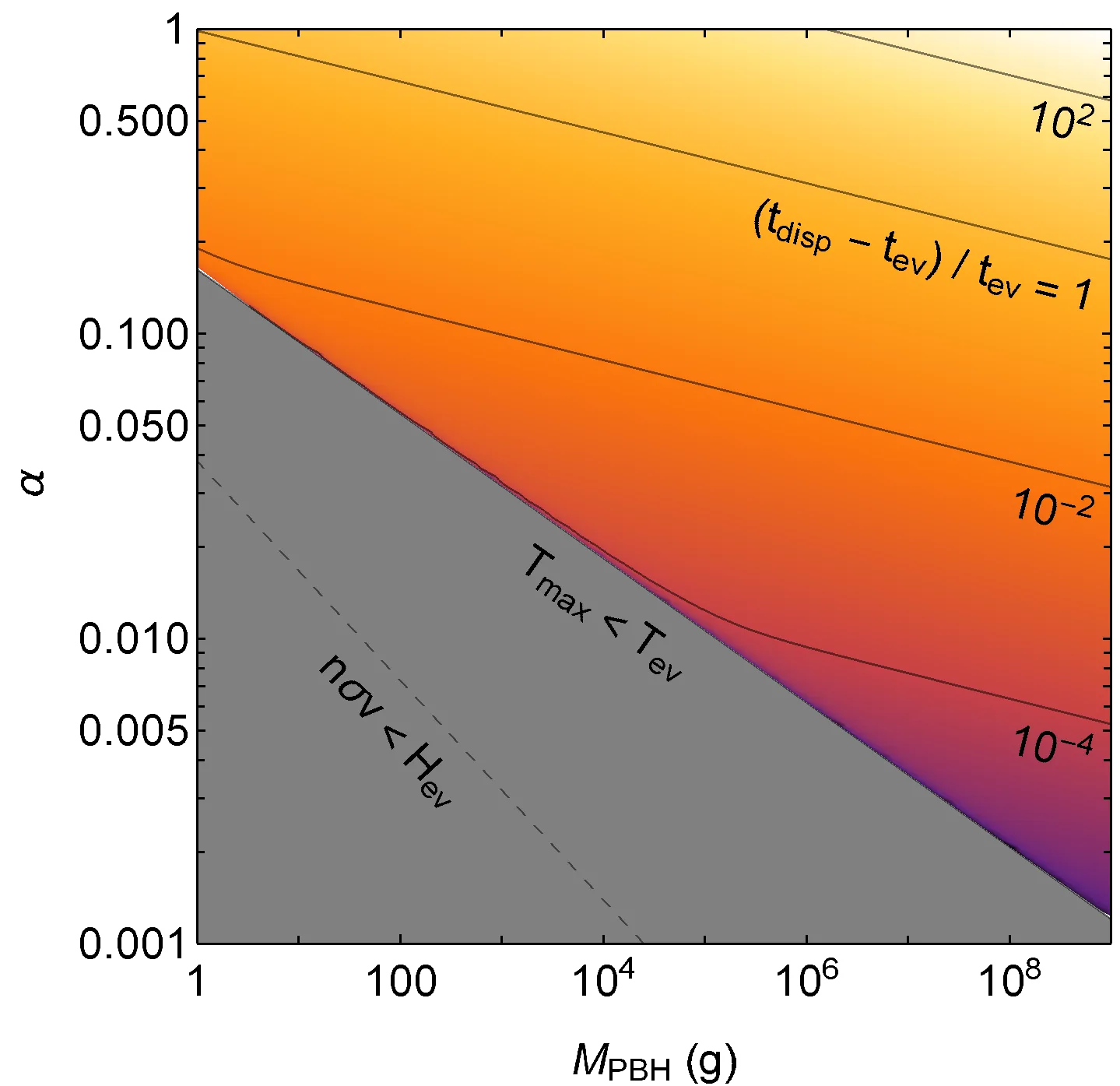
Antes se creía que esos puntos vivían casi para siempre, enfriándose lentamente y según la misma ley. Pero en el nuevo trabajo se tuvo en cuenta que el universo se expande. La expansión actúa como un ventilador: se lleva el calor más rápido de lo que este se propaga por sí mismo. El punto caliente primero pierde temperatura bruscamente y luego se enfría según una ley más pronunciada, no como en un mundo estático.
Al final, todos los puntos calientes desaparecen en un tiempo finito. Esta es una conclusión importante: si tales puntos realmente existieron en el universo temprano, sus huellas podrían haber llegado hasta nuestros días solo bajo condiciones especiales. Ahora queda claro que hay que buscarlos de otra manera: no como faros eternos, sino como destellos breves que se apagaron hace mucho.
Resumen original
tal como lo escribieron los autores, en inglés arXiv:2605.08336
Light primordial black holes heat the surrounding plasma via Hawking radiation, forming localized hotspots whose temperature may far exceed that of the cosmological background. Previous studies of hotspot formation and cooling have treated the subsequent energy transport in flat spacetime, thereby neglecting the expansion of the Universe. We formulate the diffusion equation governing the hotspot evolution, in an expanding universe, and clarify the regime in which the formalism is valid. We find that hotspot formation is robust against cosmological expansion. We show that the critical distance scale, where Hubble expansion overtakes diffusion, coincides with the decoupling radius introduced in earlier work, and the temperature profile $$T\propto r^{-7/11}$$ essentially remains unchanged. However, the cooling stage is substantially modified. We find that the plateau temperature of a cooling hotspot initially undergoes a rapid drop and then follows $$T_{\rm plt} \propto t^{-11/15}$$, steeper than the flat-spacetime scaling $$t^{-7/15}$$. This scaling cannot be obtained by simply redshifting the flat-spacetime solution, because expansion also suppresses diffusive transport. As a consequence, all hotspots disappear within a finite time, as opposed to the flat-spacetime prediction of everlasting hotspots in part of the parameter space.
La temperatura de un punto caliente puede superar en miles de veces la del gas circundante, como si de pronto agua hirviendo apareciera en agua helada.