El telescopio Webb encontró un molino cósmico de polvo exprés
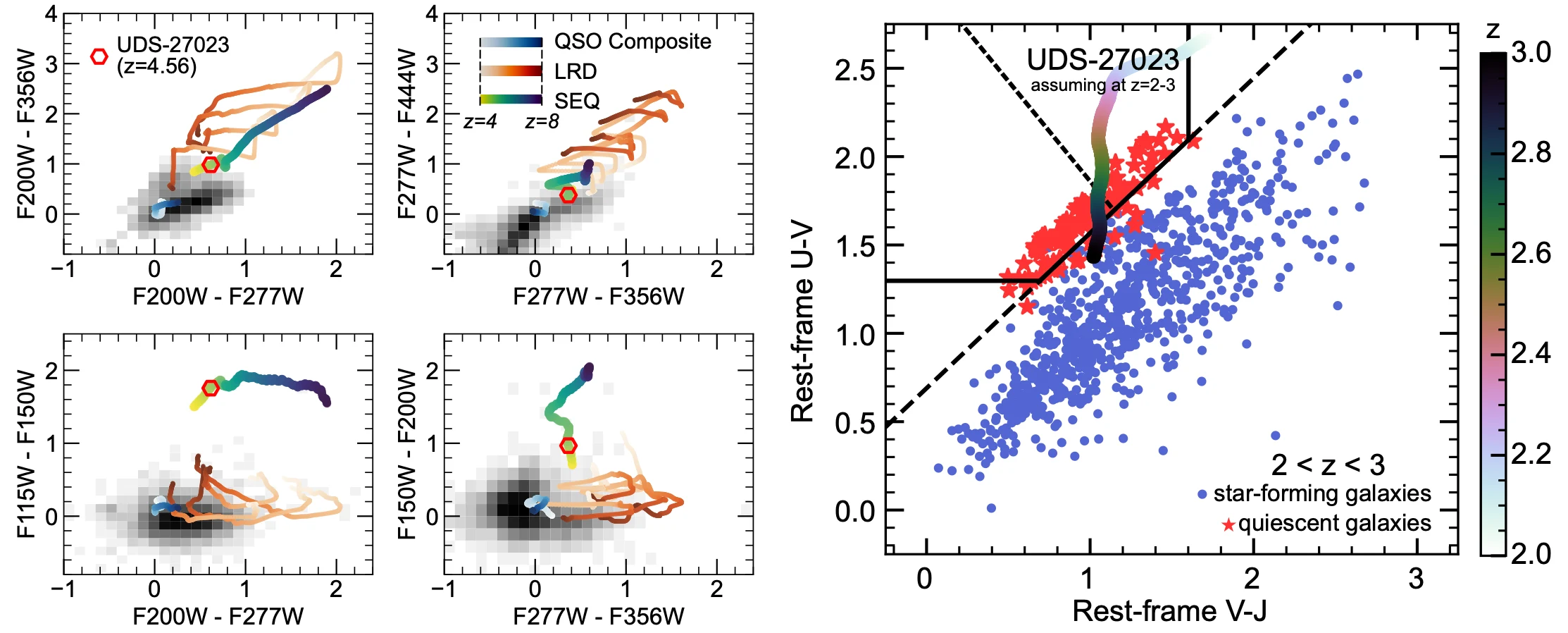
Con ayuda del telescopio James Webb, los astrónomos se asomaron a un antiguo cuásar — el deslumbrante corazón de una galaxia, donde un agujero negro gigante succiona materia. Resultó que no solo destruye, sino que también crea: sus potentes chorros y ondas de choque actúan como un auténtico molino cósmico. Trituran las partículas de polvo cósmico hasta convertirlas en un polvo finísimo — igual que la arena común, solo que molida a tamaños microscópicos.
Y aquí viene un giro inesperado: el telescopio no detectó una característica espectral distintiva que revela el polvo de carbono, el cual es casi omnipresente. Parece que este molino está ajustado de forma selectiva: solo procesa silicatos, ignorando el carbono.
Resumen original
tal como lo escribieron los autores, en inglés arXiv:2606.02685
The rapid accumulation of massive dust reservoirs in the early Universe remains a major challenge in astrophysics. While core-collapse supernovae can inject large dust grains ($$a \gtrsim 0.1\,\mu{\rm m}$$) on short timescales, explaining the total dust budgets in the early Universe likely requires efficient grain growth in the interstellar medium (ISM). Such growth depends critically on an abundant population of small grains, which maximize the surface area available for accretion and may be generated by rapid dust-processing or dust-formation channels. Here, we report the discovery of a QSO UDS-27023 at $$z=4.556\pm0.003$$, identified using JWST/NIRSpec spectroscopy. By quantitatively comparing the spectra to QSO composite templates, we find that UDS-27023 displays an exceptionally steep far-UV extinction curve ($$A_{1500}/A_V \approx 8$$) but notably lacks the 2175 Angstrom bump, indicating a dominance of small silicate dust grains. We interpret this phenomenology as evidence for active small-grain production and processing in the QSO environment. Mechanical shattering of pre-existing large grains by QSO-driven shocks and outflows provides one natural pathway, while in-situ condensation of silicate grains inside dense QSO-driven winds may offer an additional route. Such a population of steep-extinction QSOs (SEQs) may therefore reveal a short-lived phase in which luminous AGN generate, process, and redistribute small grains, potentially facilitating rapid ISM grain growth and enriching the circumgalactic medium.
La luz de este cuásar viajó 12.500 millones de años antes de alcanzar el telescopio. Lo vemos tal como era apenas 1.300 millones de años después del Big Bang.