El baile del polvo y la luz alrededor de una estrella joven exprés
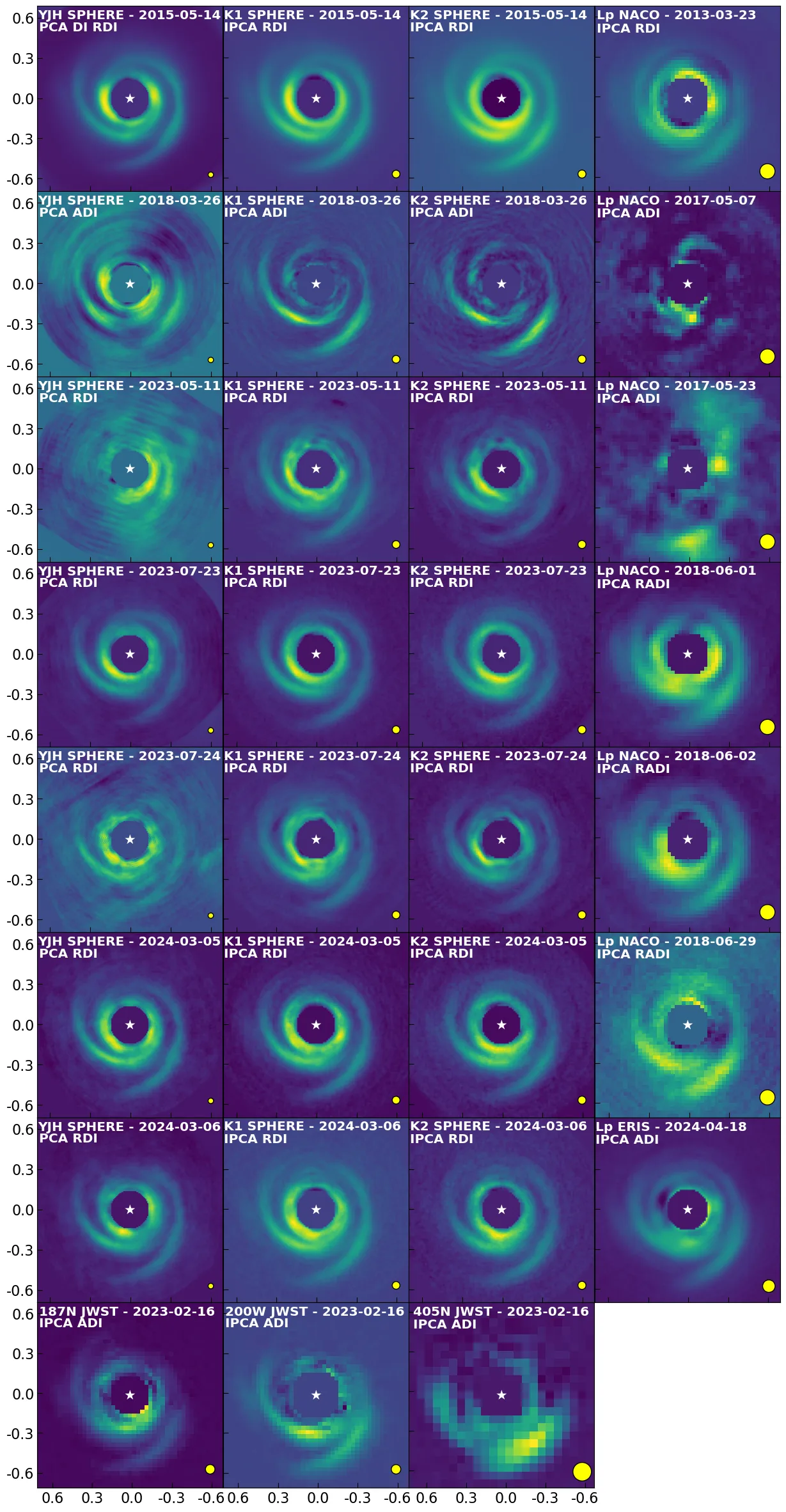
A 460 años luz de nosotros, alrededor de la estrella HD 135344B, orbita un denso disco de gas y polvo. Se parece a un gigantesco disco de vinilo al que alguien ha roto: en el disco se abre una brecha, y a través de ella, como un puente delgado, se extiende un filamento de polvo. Junto a este filamento, en luz dispersa, se aprecia una curvatura: un doblez del brazo espiral, como si lo hubieran sujetado un instante y luego soltado.
Los astrónomos han reunido imágenes de cuatro instrumentos — VLT/NACO, VLT/SPHERE, VLT/ERIS y JWST/NIRCam — durante diez años. Han aplicado algoritmos que eliminan las interferencias de la brillante luz de la estrella sin distorsionar las estructuras extensas. Resulta que la curvatura se mueve junto con la espiral a una velocidad de 0,81 ± 0,05 grados por año. Esto casi coincide con mediciones anteriores: 0,85 ± 0,05 grados por año.
Este movimiento se explica naturalmente si en la brecha se esconde un planeta gigante. Su velocidad orbital a una distancia de 69 ± 4 unidades astronómicas (el doble de lejos que Neptuno del Sol) coincide con el desplazamiento observado de la curvatura. Una imagen reciente en la que parecía verse el propio planeta resultó ser solo un defecto del procesamiento: un fantasma nacido del algoritmo. Pero la curvatura, la espiral, la brecha y el filamento de polvo forman un patrón único que dibuja una mano invisible.
Resumen original
tal como lo escribieron los autores, en inglés arXiv:2606.10624
The HD 135344B (SAO 206462) disk exhibits strong signposts of planet formation. ALMA images in the sub-mm revealed a gap-crossing dust filament whose position coincides with a twist detected in the scattered-light spiral structure. Analysis of the spirals in polarized light also hints at a spiral-driving protoplanet in the sub-mm gap. We aim to study the spirals dynamics, as well as the twist, over a 10-year baseline, in different bands. We also seek to assess the authenticity of a recently claimed candidate protoplanet. We use high-fidelity post-processing algorithms such as IPCA to minimize the biases induced by ADI on extended sources and analyze archival VLT/NACO, VLT/SPHERE, VLT/ERIS and JWST/NIRCam datasets to obtain the spiral traces and measure their orbital motion in multiple scattered light bands. We measure an average spiral orbital motion of 0.81$$\pm$$0.05 deg/yr, in agreement with the literature value of about 0.85$$\pm$$0.05 deg/yr at all wavelengths. With simple modeling of the twist morphology, we confirm that it is co-moving with the spiral in which it is embedded. While the position angle of the twist coincides with the dust filament, it is located at a smaller angular separation from the star, which we attribute to the fact that the spiral trace moves away from the central star with increasing wavelength. We find that a recently claimed protoplanet candidate can be explained as a post-processing artifact. Our confirmation that the motion of the scattered light twist is consistent with the orbital velocity of a planet at 69$$\pm$$4 au over a 10-year baseline suggests that the spirals, the gap, the dust filament, and the twist, could indeed be attributed to the same hypothetical protoplanet embedded within the spiral. A perplexing trend for a wavelength-dependence of the angular distance of the spiral traces to the central star remains to be explained.
Una unidad astronómica es la distancia de la Tierra al Sol. El planeta invisible en el disco de HD 135344B está 69 veces más lejos de su estrella de lo que la Tierra está del Sol, es decir, casi en el borde del sistema solar si lo trasladáramos a nuestro vecindario.
En la novela 'Cita con Rama' de Arthur C. Clarke, los humanos exploran un objeto misterioso que oculta sus secretos tras una pared. Aquí ocurre algo similar: el planeta permanece invisible, pero su presencia se revela por la huella gravitatoria en el polvo y la luz.