Torio-229: batería cuántica atómica exprés
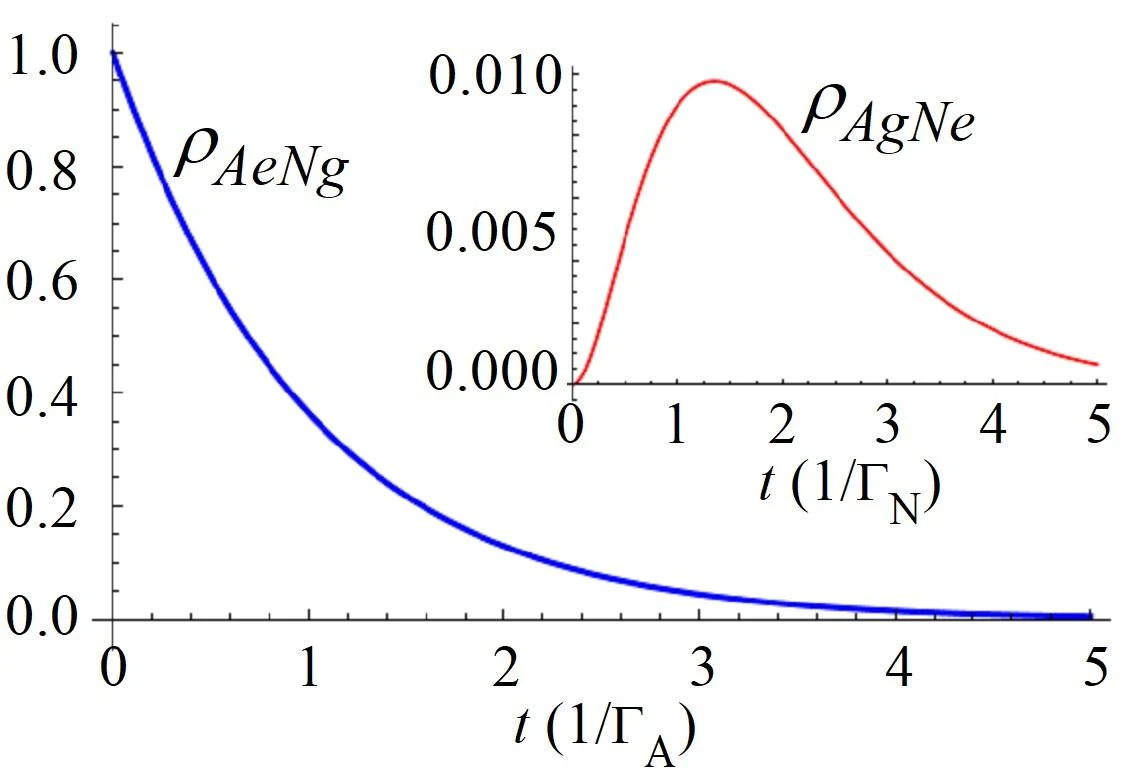
Dos péndulos en un mismo hilo intercambian movimiento: si empujas uno, el segundo comienza a oscilar, y un instante después el primero recibe un empujón de vuelta. En el átomo de torio-229, la energía fluye casi sin pérdidas entre la capa electrónica y el núcleo.
Este ritmo se observa en una trampa para átomos: el análisis de la luz (espectroscopía) y la medición del brillo (fotometría) muestran las oscilaciones de la capa. El láser la carga y la energía se sumerge en el núcleo: obtenemos una batería nuclear sin cables, con recarga lumínica. Todo se basa en las leyes del Modelo estándar, que describe la materia. Niels Bohr desentrañó la estructura en capas del átomo, y Ernest Rutherford descubrió el núcleo masivo.
Normalmente los núcleos requieren radiación gamma dura. Pero el torio-229 es único: su núcleo se excita con ultravioleta suave de apenas 8,4 electronvoltios, un nivel típico de electrones, no nuclear. Esa energía es un millón de veces menor que la nuclear habitual, y por eso ya podemos construir esta batería.
Resumen original
tal como lo escribieron los autores, en inglés arXiv:2607.00607
The electron shell of the Thorium ion with the $$M$$1(8.4~eV) transition between levels and the doublet of the $$^{229}$$Th nucleus ground state with the similar transition represent two qubits spatially inserted one within the other. In the case of relative proximity of the energies of these transitions, weakly damped energy oscillations can be excited between qubits, namely, multiple coherent energy transfer from the electron shell to the nucleus and vice versa. This process in the $$^{229}$$Th ions does not require resonant (within the width of the levels) coincidence of the transition energies due to the relatively high interaction energy of the electron and nuclear currents. The electron shell ``breathes'', periodically decreasing and increasing in size. The effect can be observed in an ion trap by the intensity of light scattered by thorium-229 ions. This extends the energy range for the $$^{229m}$$Th$$(3/2^+,8.4$$~eV) isomer excitation via an electron bridge. Furthermore, the system under consideration is transformed into a nuclear quantum battery when exposed to coherent laser radiation. To ``charge'' the battery, i.e. to excite $$^{229m}$$Th, one can use developed methods for charging quantum batteries, in particular, coherent excitation of the electron shell followed by coherent transfer of excitation energy to the nucleus (the coherent electron bridge). This opens the way for the design of the $$^{229}$$Th nuclear quantum battery at the current level of technological development.
El núcleo del torio-229 se puede 'cargar' no con rayos gamma, sino con luz ultravioleta común: su energía de excitación es de solo 8,4 electronvoltios, como el salto de un electrón en un átomo, no como una reacción nuclear.