Cómo medir la Vía Láctea con estrellas polvorientas exprés
Las gigantes rojas en el centro de la Vía Láctea se asemejan a faros lejanos que se encienden y se apagan. Su luz atraviesa el denso polvo, pero los métodos habituales para medir distancias fallan aquí: las estrellas son demasiado brillantes e inestables, y el polvo distorsiona la imagen.
Los astrónomos encontraron un camino alternativo. Tomaron estrellas cuya distancia ya se conocía por otros datos y enseñaron a un modelo informático a relacionar esa distancia con el color de la estrella en rayos infrarrojos. El modelo, similar a una calculadora inteligente, ahora estima la distancia a partir de varios "matices" del brillo infrarrojo. El error resultó pequeño: alrededor del 6% en los datos de prueba.
Con la nueva herramienta, los astrónomos midieron distancias a más de 36 000 gigantes rojas, desde 0,5 hasta 20 mil años luz. Es como si hubiéramos obtenido un mapa detallado de las profundidades del océano donde antes solo había mediciones aisladas.
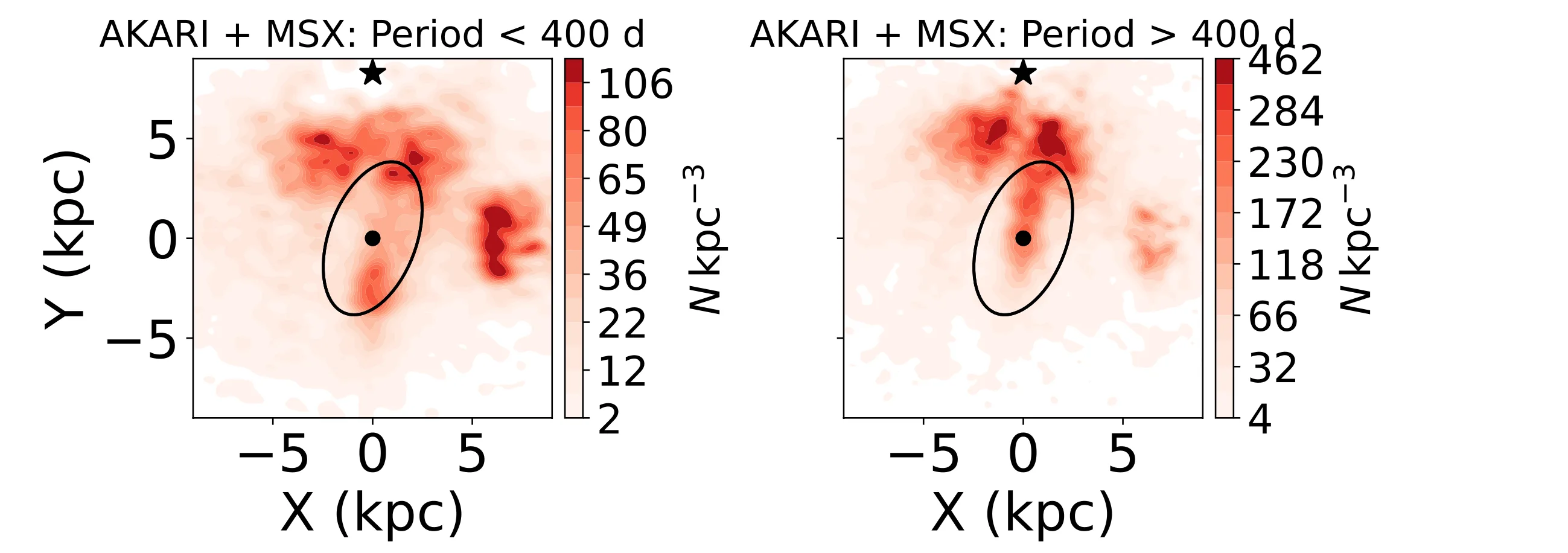
Especial interés despertaron las estrellas variables de tipo Mira. Las que pulsan más lentamente se agruparon en el centro de la Galaxia, siguiendo la forma de la barra alargada, la barra de nuestra Galaxia. Las pulsantes rápidas se dispersaron por el disco. La diferencia en el "crecimiento" de estas capas estelares sugiere cómo se formó la Vía Láctea.
Resumen original
tal como lo escribieron los autores, en inglés arXiv:2608.10577v1
The structure and evolution of the Milky Way (MW) can be traced with distance estimates to the evolved stellar populations in the inner galactic region. However, direct astrometric distances remain unavailable or highly uncertain for the majority of these sources due to instrumental limitations, large angular diameters, and complex variability. In this work, we develop a supervised machine-learning model to estimate statistical distances to oxygen-rich asymptotic giant branch (AGB) stars selected from the AKARI mid-infrared survey. We build an XGBoost regression model that maps multi-band IR photometry to distance using a training set of AGB stars with previously derived SED-based distances achieving a mean absolute percentage error (MAPE) of 6% on an independent test set. Distance estimates for over 36,000 AGB sources are obtained within a 36% total error margin, greatly expanding distance coverage (0.5-20 kpc) for dust-obscured AGB populations in the Galactic plane. We find good agreement with reported distances for Galactic Mira variables and independent period-luminosity relations. Utilizing the expanded distance set, we further investigate the spatial distribution of Mira variables in the Galactic bulge and disk. Longer-period Miras preferentially trace the bulge's barred morphology compared to their shorter-period counterparts that populate the disk. We also find roughly constant, but differing, relative scale heights for the bulge and disk, with the bulge vertical dispersion about 30% larger. These findings show that IR photometry-derived statistical distances can recover large-scale Galactic structures and establish long-period Mira variables as efficient tracers of stellar populations in heavily obscured regions of the MW.
El telescopio infrarrojo AKARI, cuyos datos utilizaron los astrónomos, fue lanzado por Japón en 2006 y funcionó en órbita durante más de cinco años, aunque el combustible se agotó antes.