Light-induced superconductivity is a phenomenon where exposing certain materials to intense, brief pulses of light can temporarily make them superconduct — conduct electricity with zero resistance — at temperatures far above their normal transition point. This is not the same as conventional superconductivity, which requires cooling materials to extremely low temperatures; here, light energy briefly reorganizes the material's electrons into a paired state that flows without loss. The effect is particularly striking in materials like fullerenes (carbon spheres) and cuprates, where light can trigger superconductivity at or near room temperature, albeit only for picoseconds.
Historia
The concept gained prominence in the 2010s, with experiments by Andrea Cavalleri's group at the Max Planck Institute for the Structure and Dynamics of Matter demonstrating light-induced superconductivity in cuprates and fullerenes. The specific mechanism for fullerenes was proposed and tested around 2023–2024.
Cómo funciona
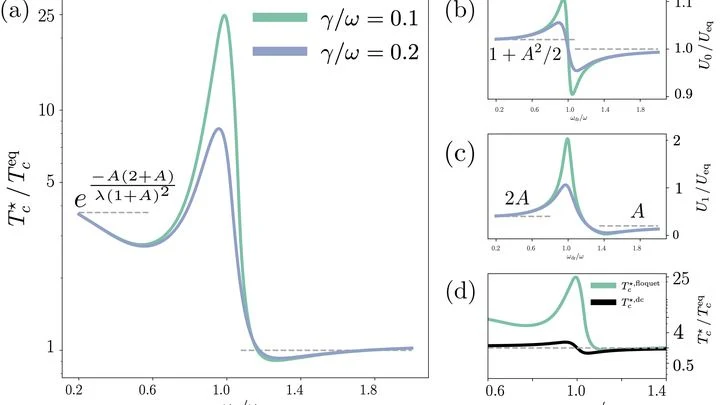
In a superconductor, electrons form Cooper pairs that move coherently without scattering. Normally, this pairing is mediated by lattice vibrations (phonons) and only occurs at low temperatures. Light pulses can transiently excite the material's lattice or electronic structure, creating a new configuration where pairing is much stronger. For example, in fullerenes, mid-infrared light pulses can distort the molecular lattice, enhancing the coupling between electrons and phonons enough to allow pairing at higher temperatures. The effect is fleeting — the superconducting state decays within a few picoseconds — but it reveals pathways to room-temperature superconductivity that are inaccessible through static conditions.
En la práctica
While the effect is too short-lived for direct technological use, it informs the search for materials that could sustain superconductivity at room temperature, potentially revolutionizing power transmission and magnetic levitation.
Dato curioso
In some experiments, light pulses have induced superconductivity in fullerenes at temperatures as high as 100 K, which is about 40 K above their normal superconducting transition temperature.
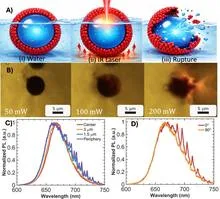
Una diminuta cápsula, parecida a una burbuja de jabón pero con una cubierta de cristales luminosos, se comporta como un láser. Mientras su pared está intacta, la luz viaja en círculo, se amplifica y sale en un haz estrecho y brillante. En cuanto la pared revienta, el haz se convierte en una mancha tenue.
La luz de muchos emisores diminutos —átomos o "puntos cuánticos" artificiales— normalmente se dispersa en todas direcciones, como una multitud donde cada uno grita por su cuenta. Pero si se les hace "cantar en coro", el destello se vuelve muchas veces más brillante.
Un superconductor normal solo funciona en el congelador de la naturaleza: a temperaturas por debajo de los cien grados bajo cero. El material de bolas de carbono K₃C₆₀ no es una excepción: sin frío, opone resistencia a la corriente, como una multitud en un pasillo estrecho.