Comment une galaxie naine a secoué la Voie lactée express
La galaxie du Sagittaire a percuté le disque de la Voie lactée et l'a traversé à de nombreuses reprises, comme une pierre jetée dans un étang calme. Chaque impact a laissé des ondulations : des vagues et des courbures dans le champ stellaire. Autrefois, le Sagittaire regorgeait de masse invisible (matière noire), mais les collisions lui ont arraché gaz et étoiles, le réduisant à une traînée pâle.
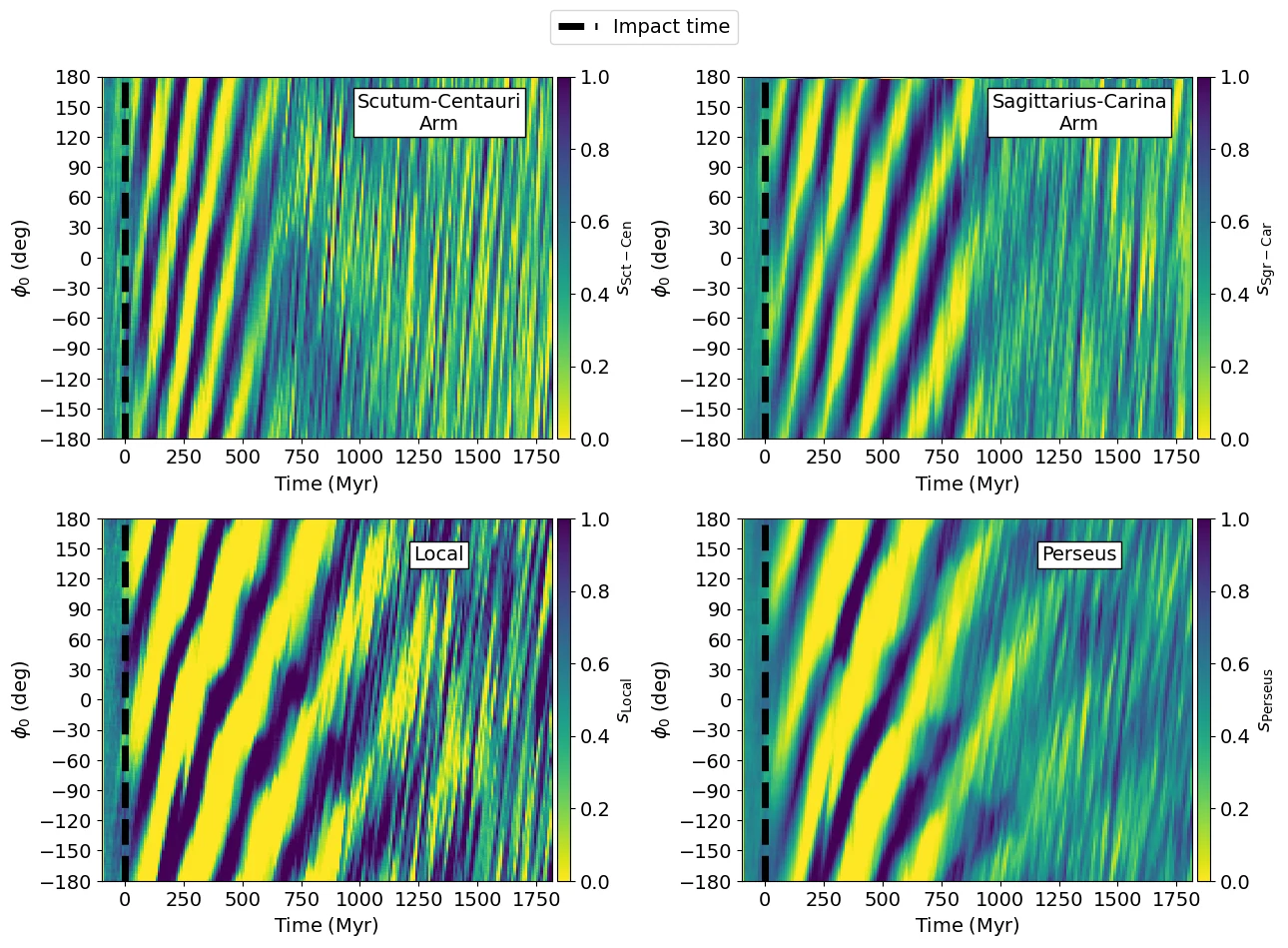
Les astronomes ont modélisé le dernier impact violent, survenu il y a environ un milliard d'années, pour vérifier s'il pouvait avoir engendré les bras spiraux, la courbure du disque et de subtiles oscillations dans les vitesses des étoiles. Les mesures des mouvements par spectroscopie ont confirmé : l'impact explique les bras et la courbure, mais les motifs ondulatoires plus complexes ne sont pas entièrement reproduits. Cela signifie que notre Galaxie garde aussi la mémoire d'autres chocs : ceux de la barre dense en son centre ou d'autres galaxies naines satellites.
Le plus surprenant : le Sagittaire lui-même a presque disparu, mais sa matière noire, probablement, imprègne encore la Voie lactée, influençant invisiblement le mouvement des étoiles. Ainsi, en rassemblant les indices cosmiques, les scientifiques reconstituent le passé tumultueux de la Galaxie.
Résumé original
tel que rédigé par les auteurs, en anglais arXiv:2602.05296
Prior to its infall, the Sagittarius (Sgr) dwarf galaxy was a major satellite with a mass of $$M_{\rm sgr}\sim 10^{11}$$ M$$_\odot$$. For the past $$5-6~\mathrm{Gyr}$$ , it has been heavily stripped by the Milky Way (MW), losing most of its mass while crossing the MW disc multiple times. Recent models of Milky Way disc perturbations $$-$$ including the spiral arms, the stellar bar, the Gaia phase spiral, and stellar and gaseous disc corrugations $$-$$ have identified these crossings as possible formation triggers, but have generally treated each perturbation in isolation. Here, we adopt a holistic perspective and ask whether a single disc-crossing impulse can simultaneously account for these features as observed today. We focus on simulations of single disc-crossing events by a Sgr-like perturber, and present a forensic analysis of the role of the powerful impulse in forming spiral arms, disc corrugations, the phase spiral and the `$$L_{z}-\bar{V}_{R}$$ wave', determined from a star's angular momentum and radial velocity, respectively. We find that a single disc crossing can reproduce reasonably well (e.g. structure, amplitude, phase) the observed local disc corrugation, and the Outer, Local and Sagittarius-Carina arm segments, implying that the last significant impulse due to a transit took place $$700-1200~\mathrm{Myr}$$ ago. Moreover, the $$L_{z}-\bar{V}_{R}$$ wave and phase spiral appear within the simulations over the same epoch and their general structure is reasonably well replicated, but not in detail. We conclude that Sgr's last significant crossing roughly a Gyr ago could be the primary cause of large-scale MW disc perturbations, but it cannot fully account for the $$L_{z}-\bar{V}_{R}$$ wave. Consequently, other triggers, possibly the Galactic bar or interactions with other satellites, must be considered in order to fully explain the current dynamical state of the MW's disc.
La galaxie naine du Sagittaire est encore visible dans le ciel comme une faible traînée d'étoiles, étirée par la gravité de la Voie lactée.