La galaxie souffle un vent brûlant express
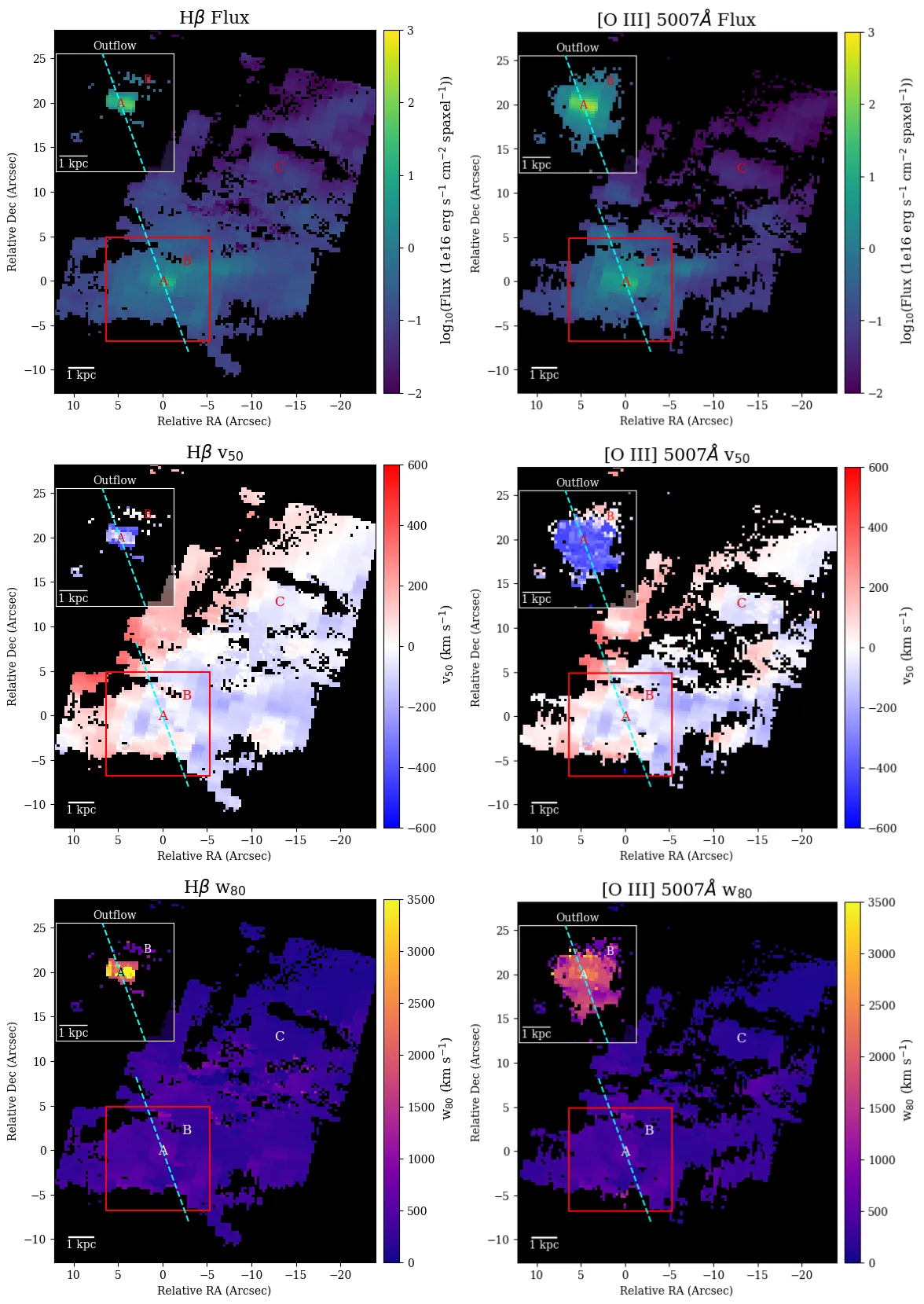
Au centre de l'amas de galaxies de la constellation de Persée se trouve la galaxie NGC 1275. De son noyau s'échappe un vent de gaz surchauffé – les astronomes l'ont pour la première fois observé en détail.
Ce vent est visible grâce à la lueur de l'hydrogène et de l'oxygène. Il atteint des vitesses allant jusqu'à 570 kilomètres par seconde – plus rapide qu'une balle. Chaque année, la galaxie éjecte environ 2,7 masses solaires. Pendant ce temps, la même quantité de gaz froid tombe vers le centre. Ainsi, la galaxie s'équilibre d'elle-même : autant de matière entre, autant en sort.
À côté du vent, un jet fonctionne également – un flux étroit de particules jaillissant des environs du trou noir. Là où le jet passe, le gaz brille différemment. Mais le vent comme le jet n'agissent que dans un rayon de deux mille années-lumière du centre. Au-delà, leur influence s'estompe.
Ainsi, la galaxie de l'amas de Persée montre comment le trou noir et le gaz qui l'entoure mènent un dialogue sans fin : l'un souffle, l'autre tombe.
Résumé original
tel que rédigé par les auteurs, en anglais arXiv:2608.08331v1
We present new Keck Cosmic Web Imager observations of the central few kiloparsecs of NGC 1275, the brightest cluster galaxy of the Perseus Cluster. These integral field spectroscopic data reveal a warm-ionized outflow traced by H$$\beta$$ and the [O III] doublet extending out to $$\sim2.5$$ kpc from the nucleus. The warm-ionized outflow has an [O III]-derived $$v_{50}$$ of up to $$\sim570$$ km/s, $$w_{80}$$ of up to $$3780$$ km/s, and H$$\beta$$-derived outflowing mass of $$(2.7 \pm 0.3)\times 10^6$$ M$$_\odot$$. Our H$$\beta$$-derived warm-ionized outflowing mass rate of 2.7$$\pm$$0.7 M$$_\odot$$ yr$$^{-1}$$ is comparable to the estimated cold molecular disk accretion rate of 1$$-$$10 M$$_\odot$$ yr$$^{-1}$$, which could be a sign of self-regulation between the pc-scale cold gas feeding the active galactic nucleus (AGN) and the warm wind accelerated out to kpc scales. In the host galaxy, we detect an enhancement in the [O III] / H$$\beta$$ ratio in the direction of the receding jet, which may imply jet interaction with the host interstellar medium. The outflow component also shows a clear enhancement of [O III] / H$$\beta$$ that positively correlates with $$w_{80}$$ and $$v_{50}$$, indicative of AGN influence and/or fast shocks. Both the outflow and host galaxy [O III] / H$$\beta$$ ratio decrease with increasing distance from the center, showing that the influence of the AGN is confined to the central $$\sim2$$ kpc. These results are the first resolved measurements of a kpc-scale ionized wind in NGC 1275 and provide a view into how both jets and winds contribute to the feedback cycles in complex cool core cluster systems.
La vitesse du vent émanant du noyau de NGC 1275 atteint 570 km/s – en une heure, un tel flux couvrirait la distance de la Terre à la Lune.