Уэбб увидел химическую погоду на коричневых карликах экспресс
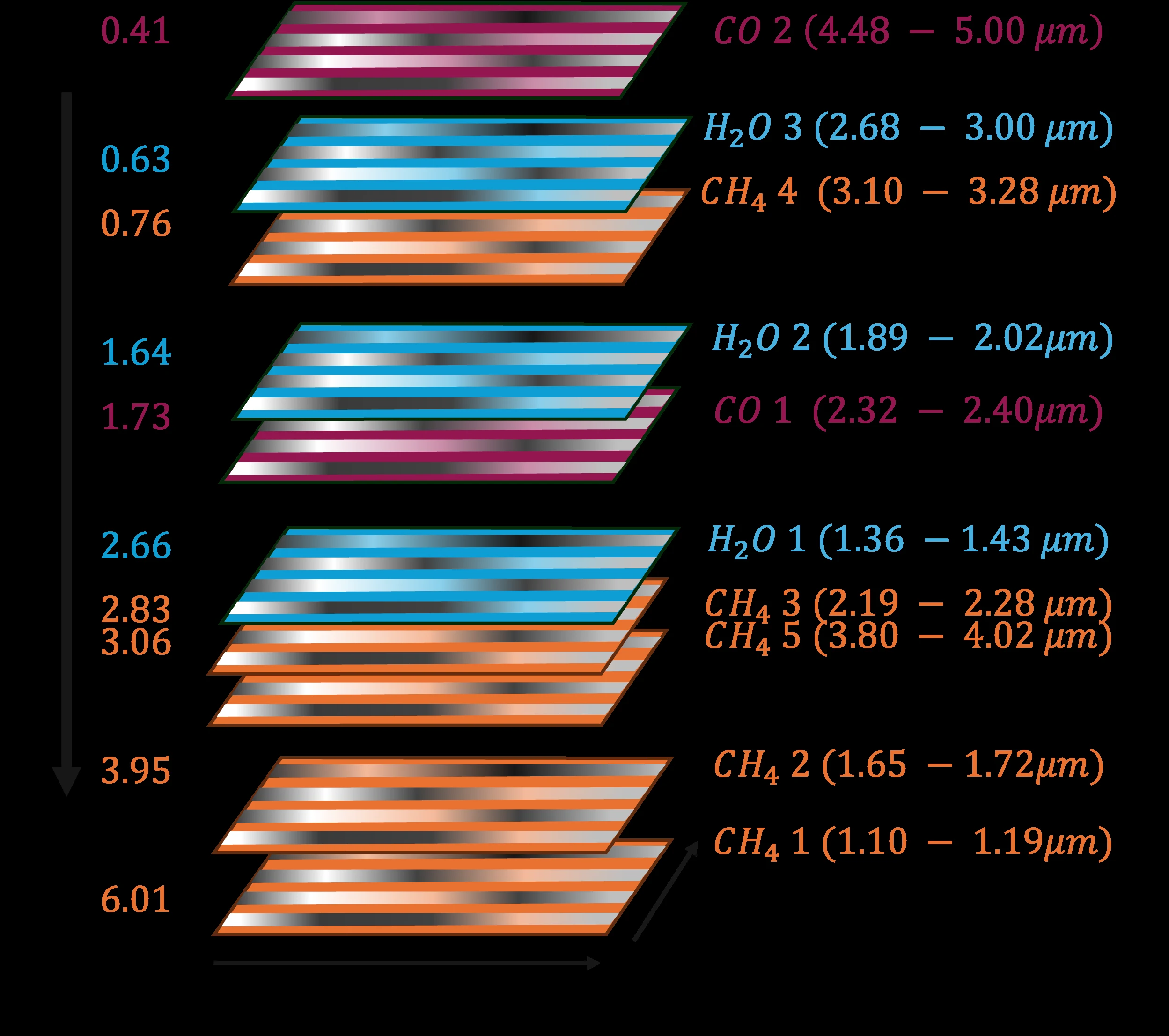
Коричневые карлики — тяжелее планет, но легче звёзд. Их атмосфера похожа на бурлящую кастрюлю: облака из раскалённого песка и капель железа то поднимаются, то опускаются. Телескоп Уэбб долго следил за парой WISE 1049AB и, разлагая их свет на цвета, заметил загадку: у более тёплого карлика свет от метана и угарного газа пульсирует гораздо сильнее, чем от воды, хотя все три исходят с одной глубины. Облака не при чём — в недрах идут бурные химические реакции. Как в кастрюле, где одни специи при нагреве всплывают быстрее других, эти реакции то ускорялись, то замирали, наводя рябь в свечении.
Вдобавок по атмосфере бегут исполинские волны — точь-в-точь как те, что создают погоду на Земле, только без океанов и суши. Эта химическая пляска может стать ключом к прогнозу климата на далёких планетах.
Оригинальная аннотация
как её написали авторы, на английском arXiv:2511.15667
We present a new analysis of the spectroscopic variability of WISE~J104915.57$$-$$531906.1AB (WISE~1049AB, L7.5+T0.5), observed using the NIRSpec instrument onboard the James Webb Space Telescope (GO 2965 - PI: Biller). We explored the variability of the dominant molecular bands present in their 0.6--5.3~$$\mu$$m spectra (H$$_2$$O, CH$$_4$$, CO), finding that the B component exhibits a higher maximum deviation than the A component in all the wavelength ranges tested. The light curves reveal wavelength-(atmospheric depth) and possibly chemistry-dependent variability. In particular, for the A component, the variability in the light curves at the wavelengths traced by the CH$$_4$$ and CO molecular absorption features is higher than that of H$$_2$$O, even when both trace similar pressure levels. We concluded that clouds alone are unlikely to explain the increased variability of CO and CH$$_4$$ with respect to H$$_2$$O, suggesting that an additional physical mechanism is needed to explain the observed variability. This mechanism is probably due to thermochemical instabilities. Finally, we provide a visual representation of the 3D atmospheric map reconstructed for both components using the molecular band contributions at different pressure levels and the fit of planetary-scale waves.
Похожие химические волны, вероятно, бушуют и в атмосфере Юпитера — мы просто не можем их увидеть напрямую.