Магнитный конструктор: неожиданная гибкость атомных слоев экспресс
Новый магнитный материал устроен как стопка блинов: в каждом слое все атомные «стрелки» направлены одинаково, но соседний слой намагничен в противоположную сторону. Узор из треугольников — решетка кагоме — искажен из-за того, что часть атомов заменили на германиевые гантельки. Редкоземельные атомы проявляют магнитный порядок лишь при температурах около -264°C, для чего используют жидкий гелий. Рентгеновская дифракция (метод, развитый Брэггом) и спектроскопия позволили разглядеть эту структуру.
Расчеты показали неожиданную гибкость: развернуть весь слой целиком энергетически крайне затратно, а повернуть одну цепочку атомов внутри слоя — легко. Такой порядок резко снижает энтропию — меру беспорядка. Это открывает возможность контролируемого создания магнитных узоров для будущих квантовых устройств.
Оригинальная аннотация
как её написали авторы, на английском arXiv:2511.17398
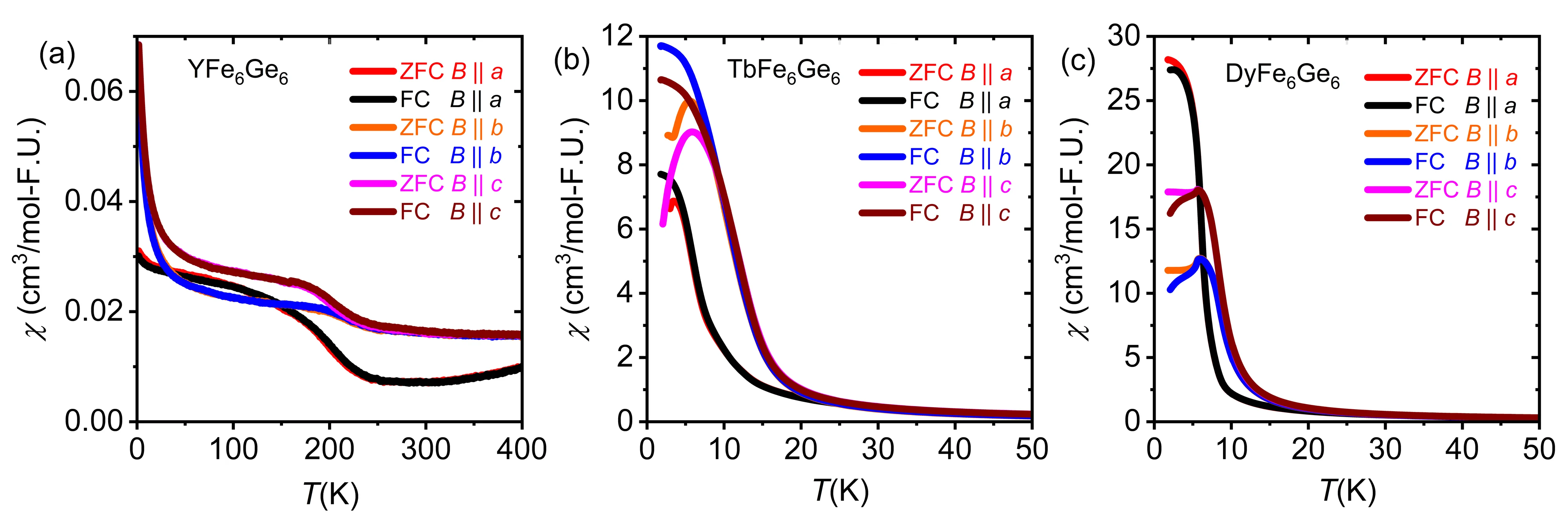
Kagome magnets represent a promising class of materials that exhibit intriguing electronic and magnetic properties, and they have recently garnered significant attention. While most kagome-lattice compounds are hexagonal, we report here single-crystal growth and physical property measurements of $$R$$Fe$$_6$$Ge$$_6$$ ($$R$$ = Y, Dy, Tb) compounds, which crystallize in an orthorhombic structure. The structure can be derived from a hexagonal prototype $$R$$Fe$$_3$$Ge$$_2$$ by replacing every other $$R$$ atom with a covalent Ge$$_2$$ dimer. Ordering of these dimers renders the structure orthorhombic, slightly distorts the kagome net, and makes the three Fe sites formally inequivalent. The iron and rare-earth sublattices order independently. Fe moments order above 400 K, forming ferromagnetic kagome planes stacked antiferromagnetically, while rare-earth moments order below 9 K. TbFe$$_6$$Ge$$_6$$ exhibits a single magnetic ordering transition associated with the Tb atoms, whereas DyFe$$_6$$Ge$$_6$$ shows two distinct magnetic phase transitions, strongly influenced by crystal electric field effects on the Dy$$^{3+}$$ ions. Density functional theory (DFT) calculations indicate that the ferromagnetic ordering of the Fe planes is driven by a high density of states at the Fermi energy. They also reveal three dramatically different structural energy scales: $$R$$ and Ge$$_2$$ form alternating 1D chains perpendicular to the kagome planes, and violating this alternation incurs a large energy cost. Aligning these chains is less costly, and achieving a two-dimensional order of anti-aligned chains requires very little energy. These compounds represent a unique class of materials, offering new opportunities to investigate the interplay between the distinct crystal lattice geometry and the underlying electronic and magnetic properties.
Слово «кагоме» переводится с японского как «плетеная корзина» — именно такой узор из треугольников образуют атомы.