Как галактики «варили» металлы в эпоху космического полудня экспресс
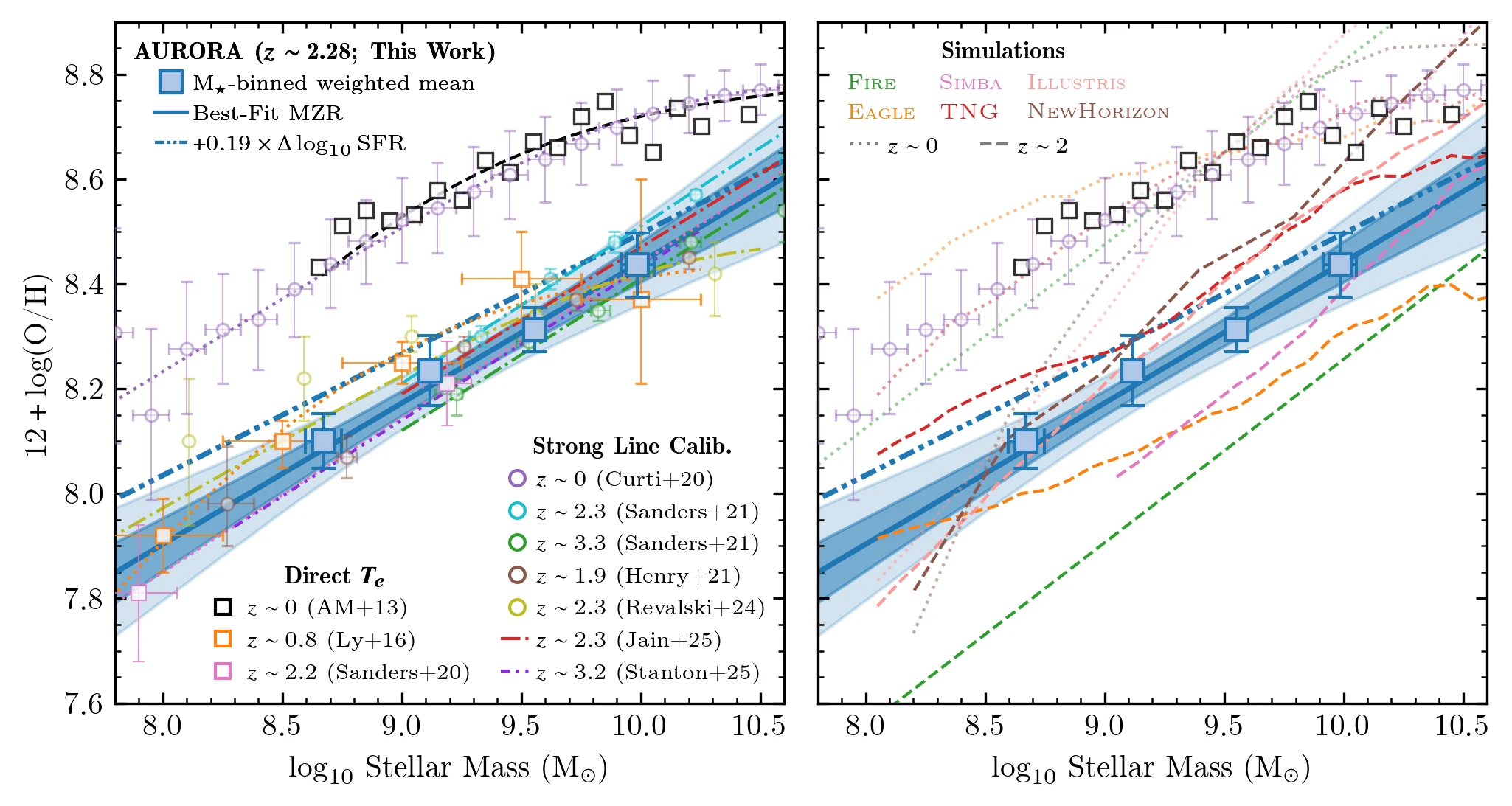
Галактики похожи на исполинские кухни, где в звёздных недрах лёгкие атомы сжимаются в тяжёлые — словно из муки и воды получается хлеб. Когда звезда умирает, она выбрасывает накопленное в межзвёздный газ, обогащая его «специями»: кислородом, углеродом, железом. Телескоп Джеймса Уэбба разглядел слабое свечение разогретого кислорода в 34 галактиках, сиявших через 3 миллиарда лет после Большого взрыва. По яркости этого света, как по температуре пламени, астрономы вычислили долю кислорода — разложение света на цвета здесь работает точнее кухонного термометра.
Выяснилось: чем тяжелее галактика, тем больше в ней кислорода — зависимость почти та же, что у современных соседей. Но компьютерные симуляции эволюции Вселенной не смогли воспроизвести это постоянство. В эпоху расширения Вселенной 10 миллиардов лет назад звёзды рождались гораздо быстрее, однако рецепт обогащения металлами не сбился — как если бы повар, готовящий вдесятеро быстрее, не ошибся ни в грамме приправ.
Оригинальная аннотация
как её написали авторы, на английском arXiv:2512.16989
We present new constraints on the Mass -- Metallicity (MZR) and Fundamental Metallicity Relations (FMR) using a sample of 34 galaxies at $$1.38\leq~z\leq~3.5$$ (median $$z=2.28$$). These galaxies have direct $$T_e$$ measurements from [O\sc{iii}]4363\AA~and/or [O\sc{ii}]7320,7331\AA~auroral emission lines detected with \textit{JWST}/NIRSpec as part of the AURORA survey. The detection of both oxygen auroral lines allows for dual-zone direct $$T_e$$ measurements and expands the dynamic range in $$12+\log\mathrm{(O/H)}$$ (7.68 to 8.65 dex), stellar mass ($$10^{8}$$ to $$10^{10.4}$$ M$$_\odot$$), and star-formation rate ($$1$$ to $$100$$ M$$_\odot$$ yr$$^{-1}$$) compared to previous direct $$T_e$$ studies of the high-redshift MZR and FMR. We characterize the $$z\sim2$$ MZR and find a slope of $$0.27\pm0.04$$ and normalization of $$12+\log\mathrm{(O/H)} = 8.44\pm0.04$$ at $$10^{10}$$ M$$_\odot$$ with an intrinsic scatter of 0.10 dex, consistent with past strong-line MZR measurements. Comparisons with $$z\sim2$$ predictions from six simulations reveal that none reproduce our observed MZR normalization evolution between $$z\sim0$$ and $$z\sim2$$. This discrepancy suggests current models do not fully capture the chemical enrichment and feedback processes occurring at cosmic noon. However, all 34 galaxies are on or above the star-forming main sequence such that our sample may be biased towards lower $$12+\log\mathrm{(O/H)}$$ if the FMR persists at $$z\sim2$$. Correcting for this selection effect would increase O/H by $$\approx0.1$$ dex at 10$$^{9.3}$$ M$$_\odot$$ (the median mass of our sample) bringing our MZR into better agreement with that of \texttt{TNG}. Lastly, we find our $$z\sim2.3$$ sample is consistent with the $$z\sim0$$ FMR within 0.1 dex in O/H, indicating that the smooth secular mechanisms regulating chemical enrichment, star formation, stellar mass, and outflows were in place at cosmic noon.
Кислород в нашем дыхании когда-то был выброшен взрывом массивной звезды — мы дышим пеплом сверхновых.