Popular

Karl Glazebrook

5 articles · 30 co-authors · latest: 2026-07-01

Radio Message from When the Universe Was Young

A brief radio flash came from a galaxy that existed soon after the Big Bang. The James Webb Space Telescope helped pinpoint its source—a small, clumpy cluster of stars bustling with star birth. This is the first flash traced to an object at such a distance, and it now allows us to study invisible ga
arXiv:2508.01648 · 2025-08-03

How Galaxies 'Simmered' Metals in the Cosmic Noon Era

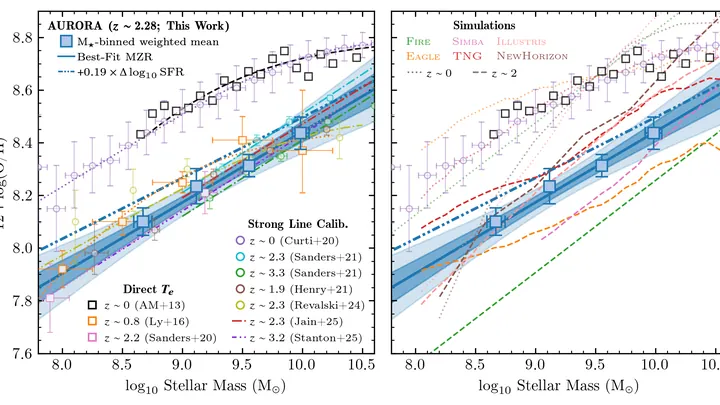
Astronomers studied 34 ancient galaxies with the James Webb Telescope. They precisely measured oxygen content and found that more massive galaxies are richer in heavy elements. This relationship turned out to be similar to the modern one, but computer models couldn't reproduce it. It seems the basic
arXiv:2512.16989 · 2025-12-18

Cold Water Trail in the Red Dots of Space

The James Webb Telescope discovered that the mysterious red dots are not hot disks around black holes, but dense clouds of water vapor with temperatures around 2000–4000 °C. This reduced the mass estimates of black holes by an order of magnitude.
arXiv:2602.06024 · 2026-02-05

The Mystery of 'Impossible' Galaxies: How Outer Color Maps Are Rescuing Cosmology

Using NIRCam on JWST, astronomers studied four supermassive quiescent galaxies whose light has been traveling to us for over 11 billion years. It turns out that in three of them, the color shifts smoothly from center to outskirts: red old cores surrounded by bluer, younger regions. This color map re
arXiv:2606.02698v1 · 2026-06-01

The Hourglass of an Ancient Galaxy: JWST Spots Maturity That Arrived Too Soon

Analysis of images from JWST and Hubble with NIRSpec spectroscopy has revealed details of a distant disk galaxy at z=0.92. Multi-component modeling showed that an X-shaped bulge 4.5 kpc long and a bar of about 12 kpc were already present when the Universe was only 6.2 billion years old. A total stel
arXiv:2607.00982v1 · 2026-07-01