Первые звёзды: фейерверки, которые увидел Уэбб экспресс
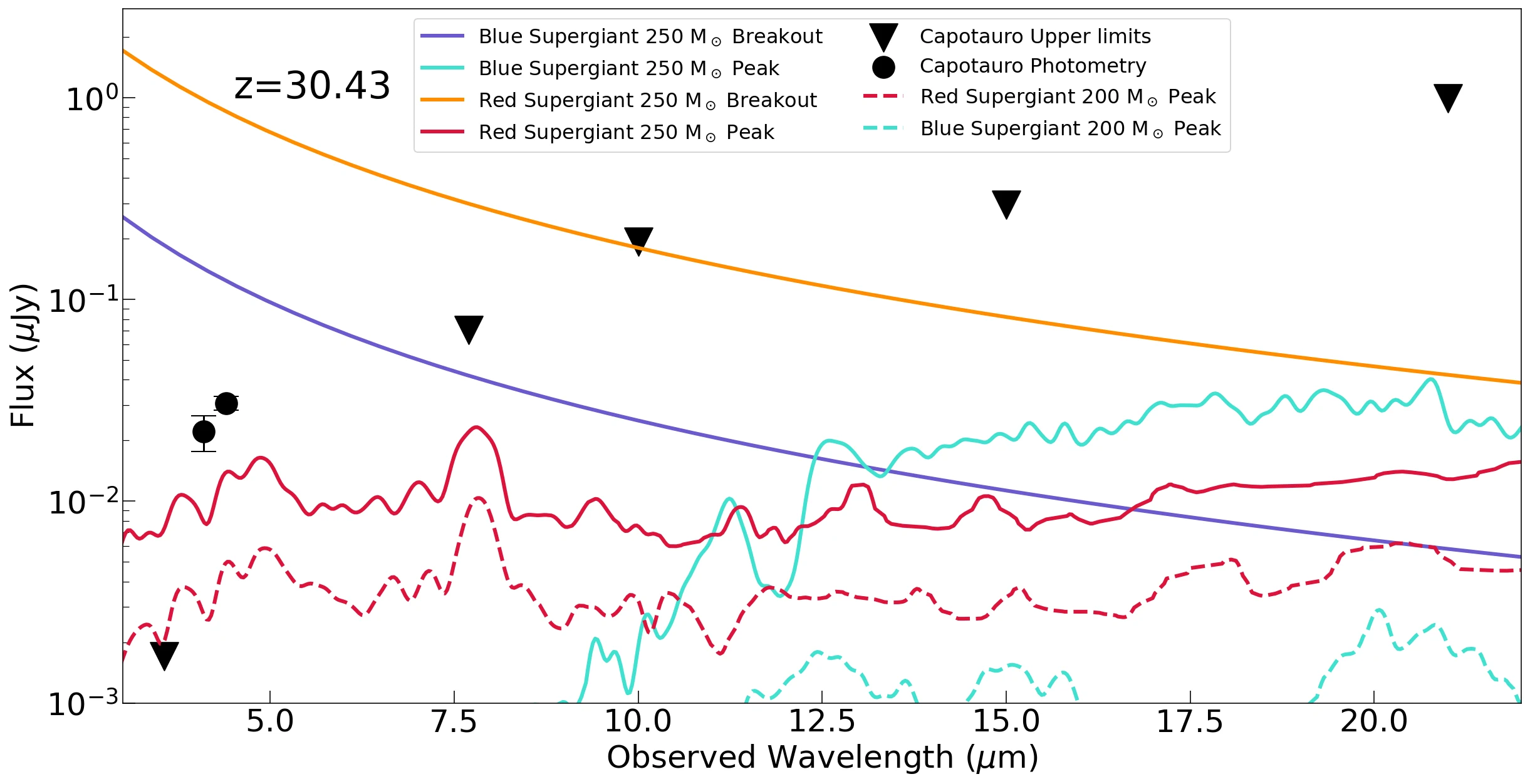
Космический телескоп Джеймс Уэбб заметил яркие точки света из эпохи, когда после Большого Взрыва прошло всего 100–300 миллионов лет. Сначала их приняли за далекие галактики, но теперь есть гипотеза: возможно, это одиночные фейерверки — взрывы самых первых звезд. Из-за расширения Вселенной их свет сильно растянут, но Уэбб способен его уловить.
Такие взрывы называют парно-нестабильными сверхновыми. В недрах гигантской звезды, почти целиком из водорода и гелия, свет превращался в частицы и античастицы, что мгновенно разрушало звезду. Подобные события крайне редки — один такой фейерверк на огромный объем пространства. Но если Уэбб зафиксирует хотя бы одну вспышку, это станет первым прямым наблюдением рождения звезд во Вселенной.
Оригинальная аннотация
как её написали авторы, на английском arXiv:2601.02469v2
The James Webb Space Telescope (JWST) has spectroscopically confirmed galaxies up to $$z\sim14$$, 300 Myr after the Big Bang, and several candidates have been discovered at $$z\sim15-25$$, with one candidate as high as $$z\sim30$$, only 100 Myr after the Big Bang. Such objects are unexpected, since theoretical studies have not predicted the existence of detectable galaxies at $$z\sim30$$. While any $$z\sim30$$ candidates may be contaminants at lower redshifts, we explore whether such extreme redshift sources could be consistent with hyper-energetic transient events linked to the formation of the first, metal-free, stars. Specifically, we consider pair-instability supernovae (PISNe), a predicted class of extreme thermonuclear explosions that leave no remnant behind. Using cosmological simulations, we investigate an overdense cosmic region, where star formation and subsequent PISNe occur at $$z\sim30-40$$, even within standard cosmology. Assessing the likelihood of such a region, the corresponding number of PISNe at $$z\gtrsim20$$, and their observed flux, we find that JWST has a non-negligible chance to detect a PISN event at extremely high redshifts. If a transient event were confirmed at $$z\sim30$$, this would provide a direct glimpse into the epoch of first star formation, dramatically extending the empirical reach of astronomy.
Парно-нестабильные сверхновые происходят только у звезд в 130–250 раз массивнее Солнца. Итог: звезда полностью превращается в излучение, не оставляя ни нейтронной звезды, ни черной дыры.
Эти первые фейерверки напоминают «Момент творения» из научной фантастики: вспыхнули, осветили первозданную тьму и исчезли, открыв дорогу будущим галактикам и жизни.