Popular

Steven L. Finkelstein

5 articles · 30 co-authors · latest: 2026-07-02

First Stars: Fireworks Seen by Webb

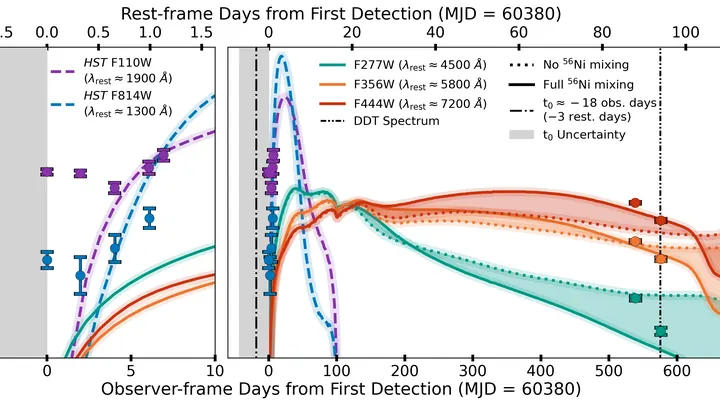
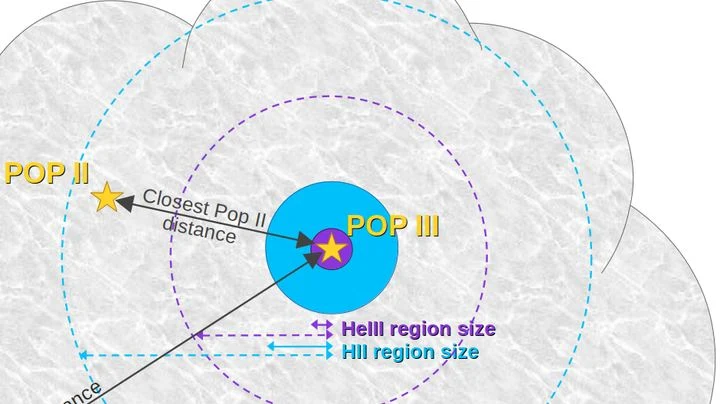
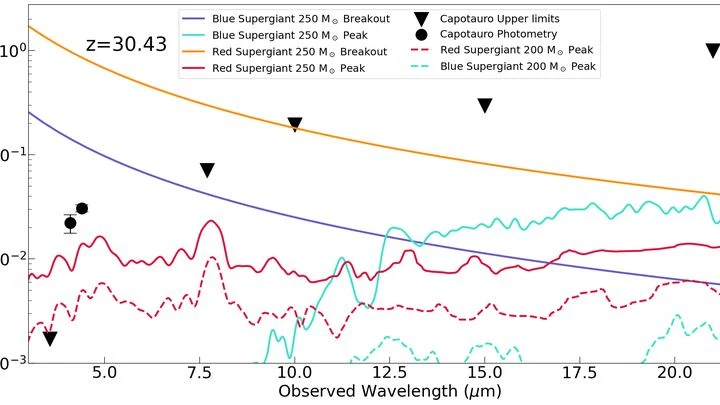
In the James Webb Space Telescope's images, bright dots thought to be distant galaxies might actually be explosions of the first stars — pair-instability supernovae. These cosmic fireworks happen when a massive star made of pure hydrogen and helium is torn apart as light transforms into matter and a
arXiv:2601.02469v2 · 2026-01-05

Сверхновая из детства Вселенной

Самую далёкую сверхновую SN Eos подтвердили, разложив её свет в спектр. Взрыв произошёл в среде, почти лишённой тяжёлых элементов, — прямое доказательство рождения массивных звёзд в ранней Вселенной. Открытие стало возможным только благодаря гравитационному линзированию и поможет уточнить темп рожде
arXiv:2601.04156v2 · 2026-01-07

Red Eyes: Cosmic Lens Reveals a Pair of Black Holes

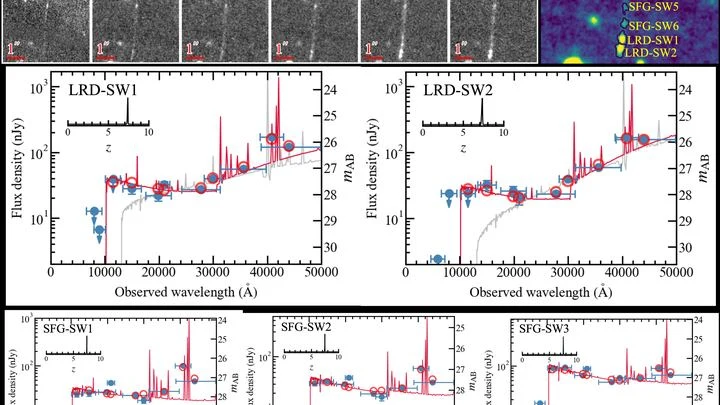
Using a gravitational lens — a massive cluster of galaxies bending light — the James Webb Space Telescope detected two red dots in a distant galaxy. These are intermediate-mass black holes, located not in the center but on the outskirts. The discovery suggests such invisible objects might be widespr
arXiv:2601.06015v1 · 2026-01-09

Quasi-stars: The Furnaces Where Supermassive Black Holes Are Born

The James Webb Space Telescope has spotted mysterious "Little Red Dots" in the early universe—compact objects that don't fit standard models. A new study suggests they may be quasi-stars: black holes shrouded in a dense gas cocoon that thermalizes radiation like a giant furnace. Calculations using t
arXiv:2606.06575v1 · 2026-06-04

Cosmic Cocoons: MEOW's Infrared Hunt Reveals the Secret Growth of Black Holes

In a new study presented in the MEOW survey, astronomers used the MIRI infrared camera on the James Webb Space Telescope to search for dust-obscured active galactic nuclei from an era when the Universe was less than a billion years old. Analyzing the emission from hot dust allowed them to identify 1
arXiv:2607.02666v1 · 2026-07-02