Лазерный луч управляет сверхпроводимостью экспресс
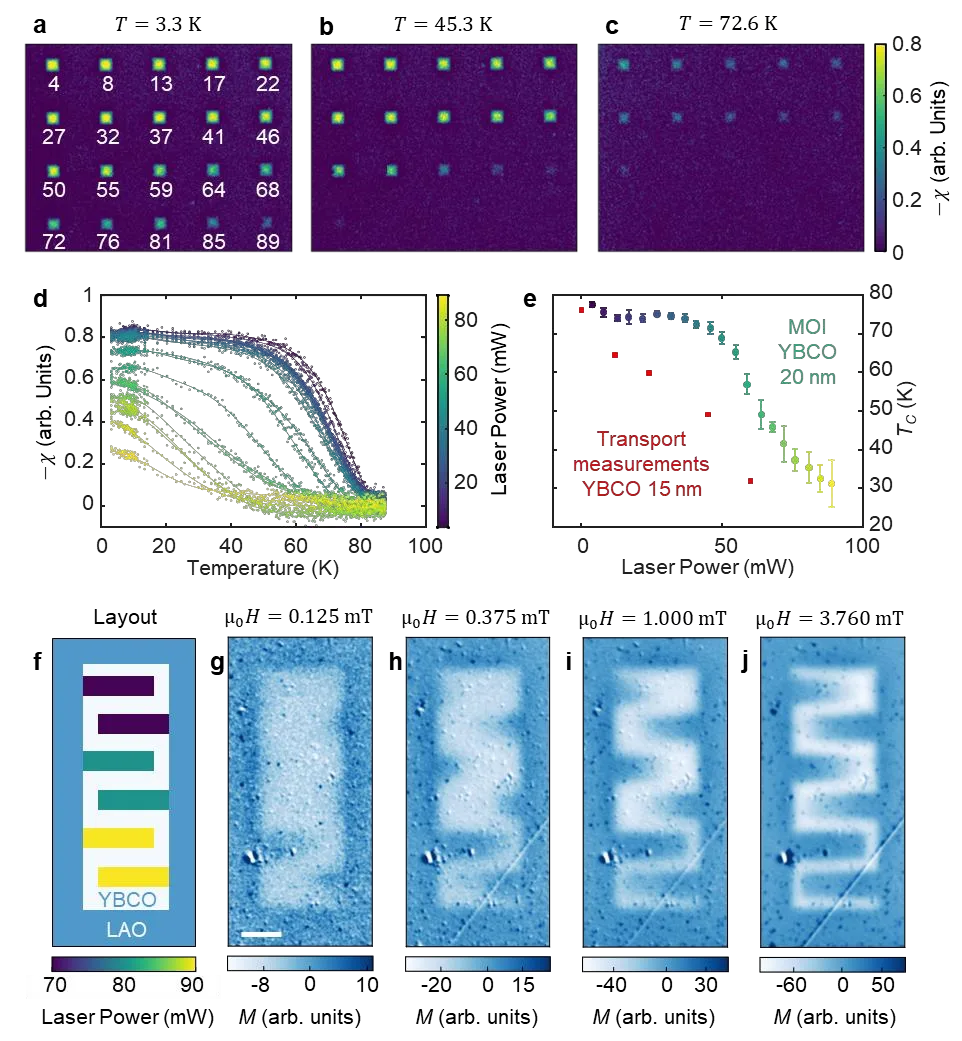
Лазерный луч, как тонкий резец, выжигает кислород из сверхпроводящей плёнки. Там, где кислорода становится меньше, материал перестаёт проводить ток без сопротивления. Учёные использовали этот приём, чтобы рисовать на плёнке узоры, меняющие её свойства.
В опытах с оксидом иттрия-бария-меди (YBCO) исследователи направляли лазер на тонкую плёнку и плавно меняли его мощность. Чем сильнее луч, тем больше кислорода уходит, и тем ниже температура, при которой материал становится сверхпроводящим. Так удалось создать участки с разными свойствами — как художник, который смешивает краски, чтобы получить нужный оттенок.
Этот метод позволяет рисовать на плёнке сложные схемы с плавными переходами свойств. Такие структуры могут пригодиться в квантовых сенсорах и сверхпроводящей электронике.
Оригинальная аннотация
как её написали авторы, на английском arXiv:2601.09513
Cuprate high-temperature superconductors, such as Yttrium Barium Copper Oxide (YBCO), are extremely promising for emerging technologies such as low-power computing, data storage, quantum sensors and superconducting electronics. However, the realization of high-performance functional nanostructures presents formidable challenges due to the difficulty of applying conventional nanofabrication methods to such sensitive materials, making the search for alternative methods a key enabling factor. Since YBCO's superconducting and normal-state properties are highly dependent on oxygen stoichiometry, precise nanoscale control of the oxygen content represents a highly appealing approach for creating advanced nanoengineered devices. In this work, we demonstrate the precise fabrication of sub-micrometer, grayscale patterns over large areas in epitaxial YBCO thin films, achieving finely tuned optical and superconducting transport properties by locally controlling the stoichiometry through maskless direct laser writing under ambient conditions. Cryogenic magneto-optical imaging and transport measurements in irradiated devices directly demonstrate the spatial tuning of the critical temperature and carrier density with the patterning conditions. Correlated Raman microscopy and reflectometry indicate a laser-power dependent oxygen depletion in the irradiated regions. The proposed laser-controlled stoichiometry approach provides a direct and scalable method to navigate the phase diagram of high-TC superconducting oxides, offering new possibilities for integrating functional nanostructures into superconducting devices.
YBCO — один из самых известных высокотемпературных сверхпроводников, открытый в 1987 году. Он работает при температурах выше, чем у традиционных сверхпроводников, но всё равно требует охлаждения жидким азотом.