Радиоухо MeerKAT слышит шепот солнечных вспышек экспресс
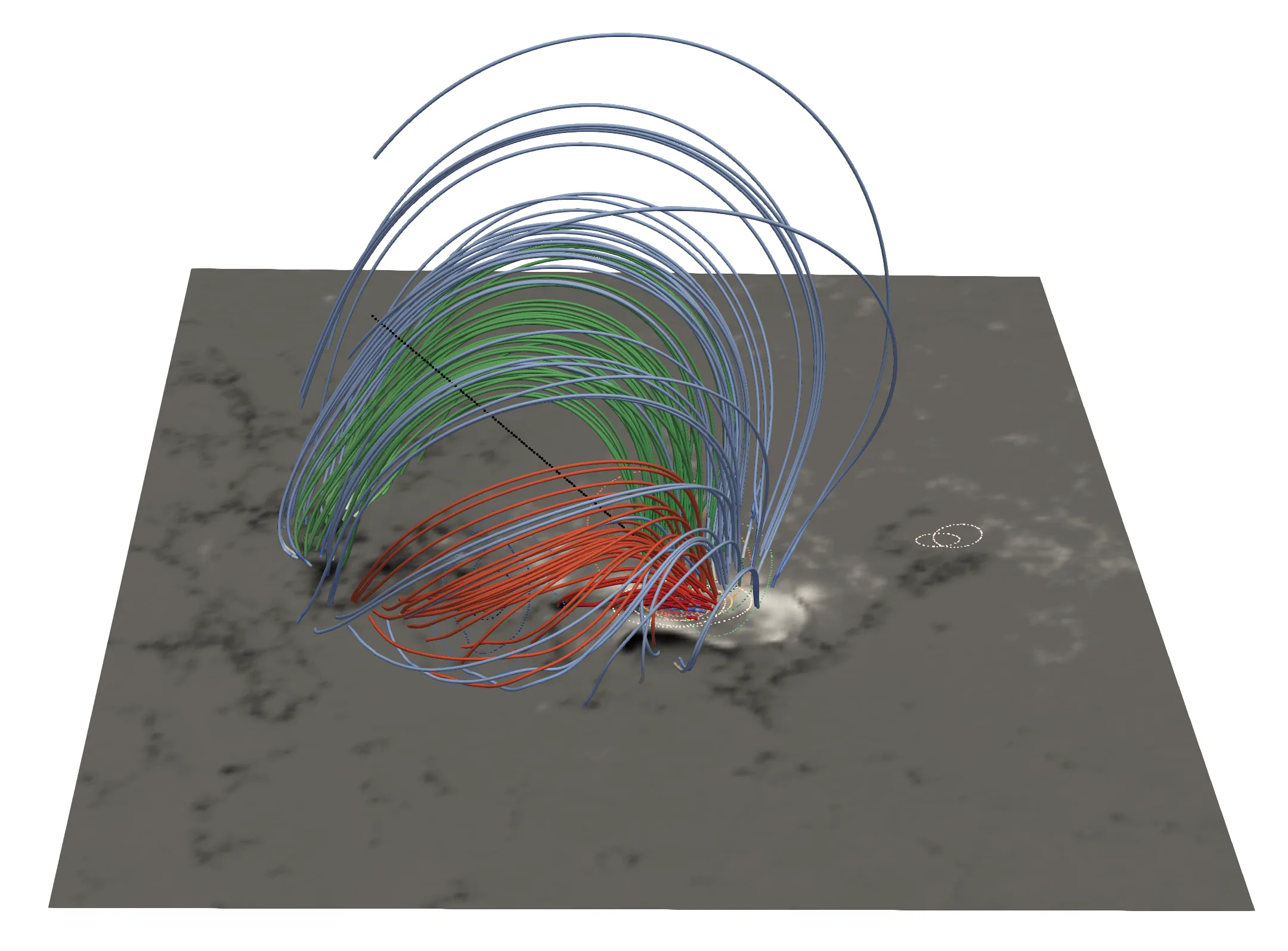
Солнечная вспышка — как гром среди ясного неба: короткий, но мощный выброс энергии. Радиотелескоп MeerKAT в Южной Африке поймал одну такую вспышку класса M1.3 и рассмотрел ее с беспрецедентной четкостью. Обычные приборы видят либо яркие детали, либо слабые, но не оба сразу. MeerKAT справился с обоими, как ухо, которое слышит и удар барабана, и шелест листвы одновременно.
В радиодиапазоне вспышка предстала в виде нескольких отдельных источников. Одни — яркие когерентные всплески, похожие на резкие щелчки, другие — слабое некогерентное свечение, разлитое по активной области. Это значит, что разные группы электронов, разогнанных магнитными полями, светят по-разному. Сопоставив радиокарту с рентгеновскими снимками и расчетами магнитных полей, астрономы увидели: каждый источник сидит в своей магнитной петле.
Этот результат — не просто красивая картинка. Он показывает, как будущая гигантская решетка SKA-Mid сможет разбирать вспышки по косточкам: откуда берутся ускоренные частицы, где именно рвутся магнитные линии и как энергия перетекает из одного места в другое. MeerKAT — это пробный камень, и он уже оправдал ожидания.
Оригинальная аннотация
как её написали авторы, на английском arXiv:2602.05282
Radio observations provide powerful diagnostics of energy release, particle acceleration, and transport processes in solar flares. However, despite recent progress in radio interferometric imaging spectroscopy, current instruments still face limitations in image fidelity and resolution, restricting detailed spectroscopic studies of flaring regions. Here we present high-fidelity imaging spectroscopy of a M1.3 GOES class flare with MeerKAT, a precursor to the future-generation array SKA-Mid. Radio emissions at the observed frequencies typically originate in the low corona, offering valuable insights into magnetic reconnection and primary energy-release sites. The obtained images achieve an unprecedented dynamic range exceeding 10^3, enabling simultaneous analysis of bright coherent bursts and faint incoherent emission from the active region. Multiple spatially distinct coherent sources are identified, implying contributions from different populations of accelerated electrons. The incoherent emission extends beyond AIA structures, highlighting MeerKAT's ability to detect dilute but hot plasma invisible to Extreme Ultraviolet instruments. Combined with co-temporal Hard X-ray images and magnetic field extrapolations, the radio sources are located within distinct magnetic structures, further revealing their association with different populations of accelerated electrons. These results demonstrate MeerKAT imaging spectroscopy as powerful diagnostics of solar flares and pave the way for future solar flare studies with SKA-Mid.
Динамический диапазон полученных изображений превышает 1000 — это как одновременно разглядеть и яркую лампу, и тлеющий уголек в одной фотографии без пересвета.