Охота на тёмные фотоны с зеркальным телескопом экспресс
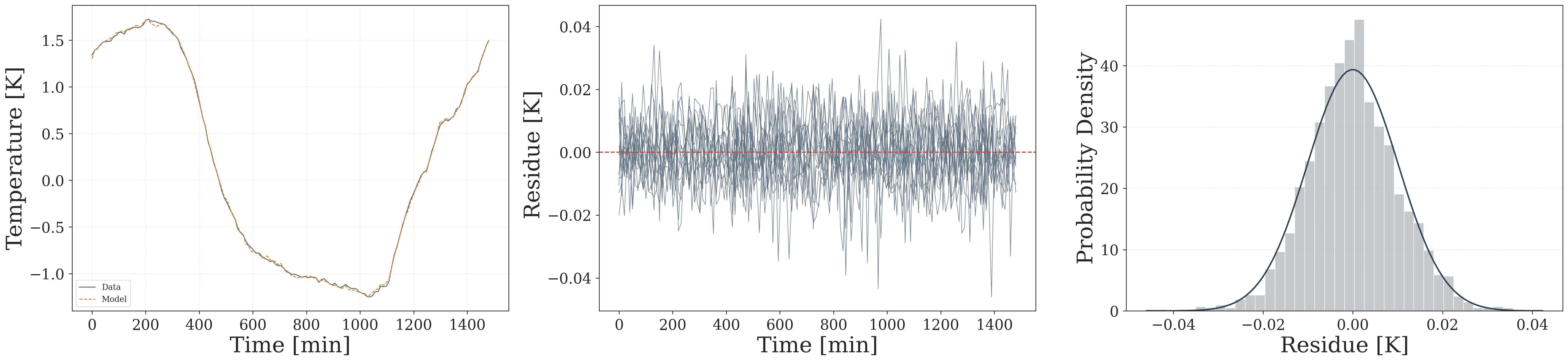
Вселенную удерживает невидимый каркас из тёмной материи. Возможно, её часть — тёмные фотоны, призрачные копии света, проходящие сквозь вещество. Эксперимент Dandelion превратил сферическое зеркало в сверхчуткое ухо: оно собирает тёмные фотоны и переводит их на язык радиоволн. 221 детектор, охлаждённый почти до абсолютного нуля, слушал этот шёпот 1480 минут.
Проблема в том, что шёпот заглушается грохотом — тепловым шумом комнаты и электроники. Физики применили спектральный анализ как шумоподавление: записали фон с датчиков, которые не смотрят на цель, и вычли его из основных данных.
Тишина осталась абсолютной. Но она не бесполезна: эксперимент впервые с помощью квантовых детекторов фотометрии установил самый жёсткий предел на способность тёмных фотонов превращаться в обычный свет в диапазоне масс 0.6–1.4 meV.
Оригинальная аннотация
как её написали авторы, на английском arXiv:2602.18218
This paper presents the first results from the Dandelion experiment, a directional detection, which searches for 1 meV dark photon dark matter. We use a spherical mirror to convert dark photons into standard millimeter-wavelength photons that can then be detected with an array of 221 Kinetic Inductance Detectors (KIDs) cooled down to 150 mK within the KISS-NIKA camera ( (KIDs Interferometric Spectral Surveyor) and operating between 150 and 350 GHz. We used 1480 minutes of data to search for the signal of dark photons in the KID detectors, which is expected to be modulated due to the Earth's rotation. Our main challenge was to deal with a large background from room temperature and stray-light fluctuations. We used a de-correlation analysis to remove these background fluctuations. Templates of the background fluctuations were constructed from a Principal Component Analysis decomposition of detector measurements outside the expected Field of View trajectory of dark photons. We found that the dark photon signal was consistent with zero, giving a new upper limit on the dark photon's kinetic mixing, $$\chi$$, with masses between 0.6 meV and 1.4 meV. These are the first constraints on dark photons as a dark matter candidate using an array of KIDs at millimeter wavelength.
Тёмный фотон с массой 1 meV в полмиллиона раз легче электрона — самой лёгкой частицы с ненулевой массой.