Как пузырь становится грушей экспресс
Мочевой пузырь похож на воздушный шарик: пока он наполняется, стенка растягивается, и форма меняется. Врачи обычно следят за давлением внутри и за тем, сколько жидкости вошло, но почти не смотрят на саму геометрию — как именно изгибается поверхность. А ведь неровности могут появиться ещё до того, как испортятся привычные показатели.
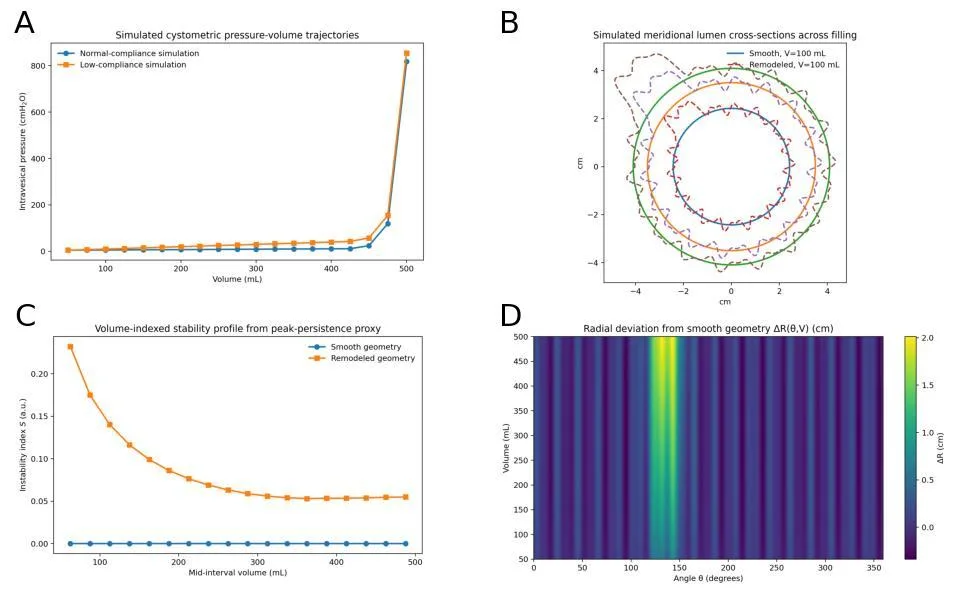
Авторы работы сделали компьютерную модель: задали механические свойства стенки из литературы и постепенно «наливали» жидкость, как в реальной жизни. Для каждого объёма вычисляли форму и проверяли, остаётся ли она гладкой и устойчивой. Затем сравнили два сценария: здоровое равномерное растяжение и скрытую перестройку ткани, когда одни участки стенки становятся жёстче или тоньше других. Давление и податливость при этом почти не отличались, а вот геометрия — сильно.
Такой подход напоминает наблюдение за воздушным шаром: если на нём есть слабое место, оно выпячивается раньше, чем шар лопнет. Точно так же ранние неровности стенки пузыря могут указывать на будущие дивертикулы (выпячивания) или потерю тонуса. Если делать снимки через равные промежутки времени и сравнивать форму, можно заметить опасные изменения до того, как появятся жалобы.
Оригинальная аннотация
как её написали авторы, на английском arXiv:2603.01054
Bladder function is typically assessed through pressure volume relations, compliance indices and flow measurements, whereas structural evaluation relies largely on qualitative imaging findings. These approaches do not formally quantify how bladder geometry changes during filling. To distinguish structural reorganization from pure mechanical stiffness, we developed a simulation based topological analysis of bladder filling grounded in mechanical parameters derived from the literature. Progressive filling was modeled under quasi static conditions, generating multi volume geometries from which spatial descriptors were computed. Drawing on the Freudenthal suspension theorem, filling was interpreted as a dimensional expansion process and structural stability was evaluated by testing whether geometric invariants remain preserved across increasing volumes. Simulated smooth expansion and controlled structural perturbations were compared under identical loading conditions. Pressure trajectories and wall stress estimates were similar across configurations when compliance was matched, whereas geometric descriptors showed divergent volume indexed stability profiles in the presence of remodeling. Computable instability measures identified progressive spatial heterogeneity despite preserved global pressure behavior. By providing a quantitative measure of geometric continuity across successive filling states, our approach indicates that structural remodeling may become detectable before conventional functional impairment appears. Progressive surface irregularity can arise even when compliance, detrusor pressure and flow parameters remain within reference limits. Serial imaging over time may support identification of individuals at greater risk of diverticula formation, decompensation or structural complications despite stable pressure measurements.
Мочевой пузырь человека в среднем вмещает 400–600 мл, но позыв к мочеиспусканию возникает уже при 150–200 мл — задолго до полного растяжения.
В фантастике часто описывают биосенсоры, предупреждающие о болезни по малейшим изменениям тела; здесь похожая идея — следить за формой органа, а не только за его функцией.