Сверхпроводник, который запоминает экспресс
Обычная компьютерная память постоянно тратит энергию, чтобы хранить единицы и нули. А сверхпроводники проводят ток вообще без потерь — если бы из них собрать память, она почти не потребляла бы электричества. Проблема в том, что сверхпроводники не умеют запоминать: их состояние слишком легко меняется.
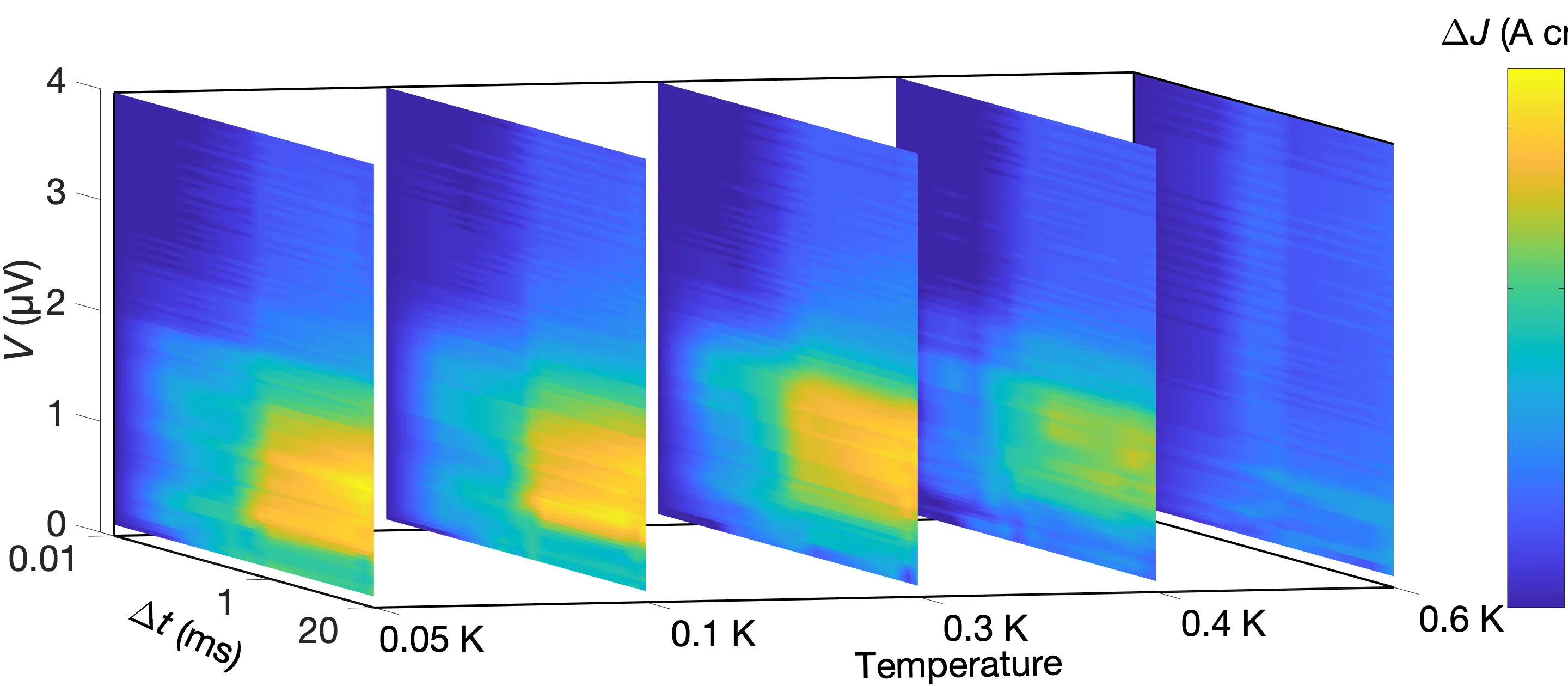
Кристалл уран-дителлурида оказался исключением. Если его поместить в магнитное поле и подать короткий импульс тока, он переходит в состояние, где ток течёт ещё лучше. Повторный импульс возвращает его обратно. Материал «помнит», в каком он состоянии, часами.
Внутри сверхпроводника магнитное поле собирается в вихревые нити — крошечные трубки, вокруг которых течёт ток. В уран-дителлуриде есть два типа таких нитей. Импульс тока перемешивает их, создавая беспорядок, который крепче держит нити на месте. Поэтому ток течёт сильнее. Это похоже на кучу песка: если её встряхнуть, песчинки упадут плотнее и куча станет устойчивее.
Такая память не требует сложных дополнительных слоёв из магнетиков или полупроводников — всё нужное уже есть в самом кристалле. Это открывает путь к сверхэкономичным запоминающим устройствам для компьютеров будущего.
Оригинальная аннотация
как её написали авторы, на английском arXiv:2603.02450
If a computer could be assembled from superconducting components, the energy efficiency would far surpass that of conventional electronics. Historic research efforts towards this goal yielded pivotal breakthroughs in the development and discovery of scanning tunnelling microscopy and high temperature superconductivity. Although recent strides have been taken in advancing superconducting diode and switching technologies, harnessing read/writeable memory functionality in superconducting platforms has remained challenging. Here we show that bulk single crystal specimens of the triplet superconductor candidate uranium ditelluride (UTe$$_2$$) possess such properties. Upon applying a magnetic field to access an intermediate regime straddling two distinct superconducting phases, we find that direct current pulses can push the material in and out of a metastable state possessing an enhanced critical current $$J_c$$. This switching is controllable by the strength and duration of the stimuli, with the system `remembering' whether it is in the high or low $$J_c$$ state for extended periods. We interpret this to be due to competition between two distinct vortex species, which can be perturbatively pushed into a non-equilibrium high-disorder configuration with stronger pinning forces and thus higher $$J_c$$. Rather than requiring proximate magnetic or semiconducting interfaces, this memory functionality appears to be an intrinsic property of UTe$$_2$$ rooted in the superconducting order itself. Our findings underscore the rich complexity of quantum vortex matter, and demonstrate the viability of engineering a new class of superconducting memory elements with ultralow-power switching.
Сверхпроводник уран-дителлурид остаётся сверхпроводящим даже в очень сильном магнитном поле, где обычные сверхпроводники сдаются.