Термоядерный котел с горячей плазмой экспресс
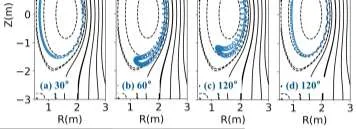
Магнитная ловушка в форме бублика удерживает плазму из бора и водорода. Внутри неё температура поднимается выше ста миллионов градусов — жарче, чем в центре Солнца. При такой жаре ядра сталкиваются и сливаются, выделяя энергию.
Плазма в установке вращается, как карусель: тяжёлые ионы бора отстают от лёгких протонов. Магнитное поле и электрические силы удерживают каждую группу по-своему. Благодаря этому горячая зона не разваливается, и реакция идёт дольше.
Такая схема подходит для компактного реактора радиусом 1.4 метра с током 13 миллионов ампер. Если её удастся воплотить, энергия будет получаться без нейтронного излучения — чище и безопаснее.
Оригинальная аннотация
как её написали авторы, на английском arXiv:2604.04002
A spherical torus (ST) p B11 plasma model that satisfies multi-magnetofluid force balance is developed, which includes small fractions of suprathermal ions with temperatures around 0.5 MeV and suprathermal electrons in the MeV range. Alongside the primary thermal plasma with ion temperatures exceeding 100 keV and densities above 10E20 m-3, these components enhance fusion reaction rates by leveraging the p B11 double-peak fusion cross section. Suprathermal ions and strong toroidal rotation driven by neutral beam injection have been observed in devices such as START, MAST, NSTX, Globus-M2, and ST40. Central-solenoid-free plasma initiation, ramp-up, and sustainment were tested on EXL-50 and replicated on EXL-50U with partial central induction, demonstrating efficient current drive and consistent with the multi-magnetofluid equilibrium model. Motivated by ENN's aneutronic commercial fusion roadmap, this paper presents a rotating, thermally un-equilibrated ST p B11 plasma with unique properties: fluid components experience separate balance under centripetal, electrostatic, and Lorentz forces with common electric and magnetic fields, leading to large rotation speed differences between thermal boron ions and suprathermal protons; a large outboard region with magnetic well and omnigeneity is created, affecting neoclassical transport and gradient-driven turbulence; suprathermal charged particles can extend beyond the last closed flux surface and be limited by plasma-facing components, influencing recycling and pedestal conditions; and the superposition of these plasma components modifies sources and sinks of free energy, prompting renewed evaluation of stability, turbulence, transport, heating, current drive, and flux diffusion. Challenges and opportunities for sustained burn are discussed for a compact p B11 ST with 1.4-meter major radius, 13-MA current, and 3-T toroidal field.
В этой плазме тяжёлые ионы бора вращаются заметно медленнее лёгких протонов — как фигуристы на катке: массивные партнёры держатся ближе к центру, а лёгкие обгоняют их по внешнему кругу.
Идея безнейтронного синтеза напоминает реакторы из «Звёздного пути», где топливом служит дейтерий, а здесь — бор с водородом.