Галактическое семейное древо: как химия звёзд рассказывает историю экспресс
Звезда наследует химический состав газового облака — как ребенок гены родителей. Астрономы превратили это в метод: по доле углерода и других элементов, измеренной с помощью спектроскопии (разложения света на цвета), выстраивают родословные древа звёзд галактики. Это похоже на генеалогию, только вместо ДНК — химия.
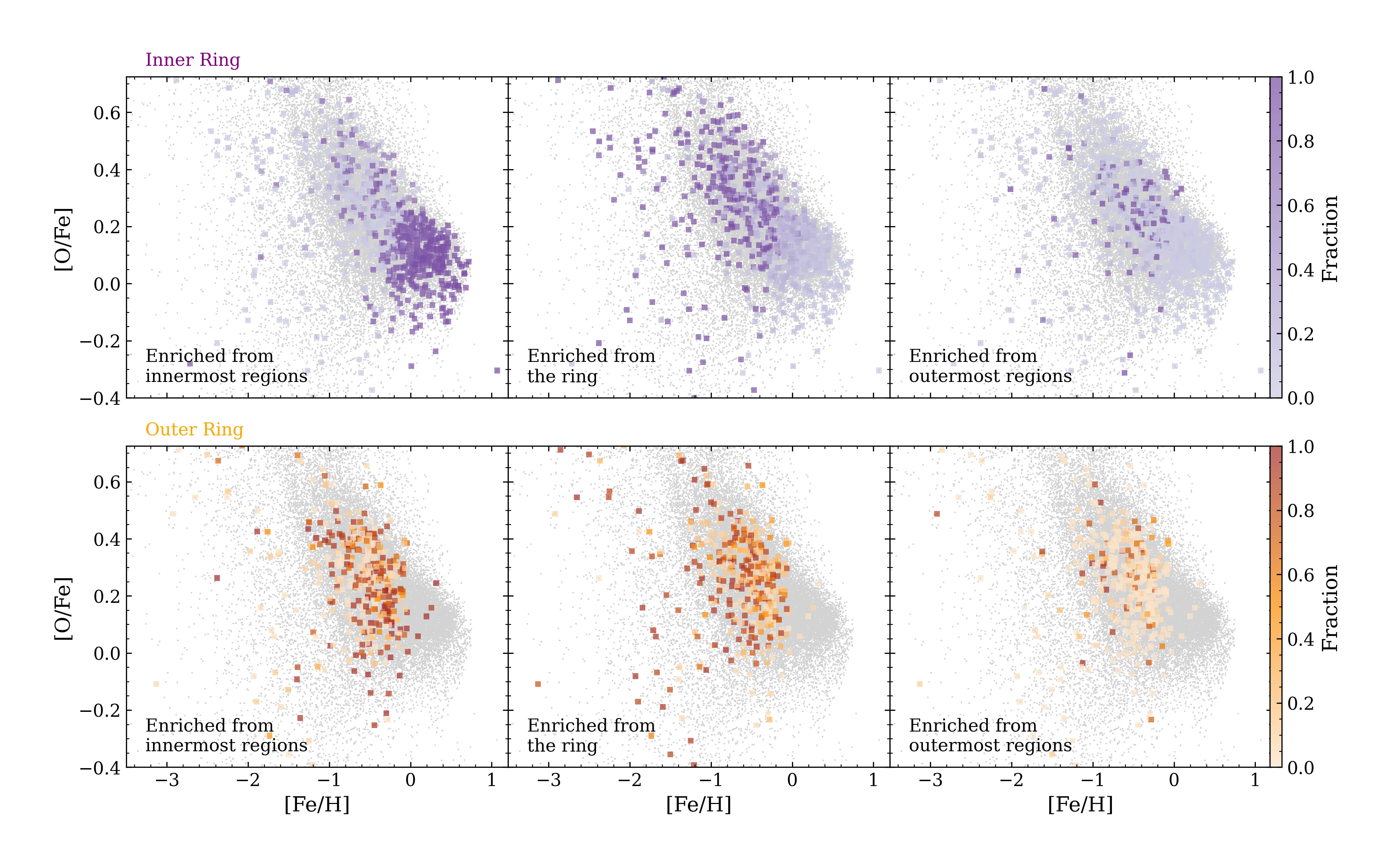
В центре Млечного Пути газ стекался бурными потоками, звезды рождались стремительно, обогащаясь взрывами сверхновых. Их древо — спутанный куст с короткими толстыми ветвями. На окраине, под действием спиральных рукавов, процесс шёл плавно: дерево выросло с тонкими, длинными, симметричными ветвями.
Такая химическая родословная — машина времени для галактик. По «окаменелостям» мы читаем историю вспышек и звёздных ветров, восстанавливая рост нашей собственной Галактики.
Оригинальная аннотация
как её написали авторы, на английском arXiv:2604.11974
Phylogenetic methods, traditionally used in biology to trace the evolutionary relationships among species, are emerging as a powerful framework to reconstruct evolutionary processes in galaxies from chemical information. We apply galactic phylogenetics to study the chemical evolution of stellar populations in distinct regions of a simulated disc galaxy, assessing its capability to unveil assembly histories. We used a high-resolution simulation that follows the chemical enrichment of an isolated disc galaxy, by different stellar progenitors. We track gas particles as they turn into stars and inherit their parent gas chemical composition. Target particles are selected to store the chemical history of each chemical element considered in the simulation. Two regions were analysed: an inner ring, influenced by early bar-driven inflows, and an outer ring, shaped by spiral arms. We built phylogenetic trees for stellar populations in each region and quantified their structure using the Corrected Colless index, a standard metric of tree balance used in biology. The inner ring tree reveals a compact clade of old stars enriched by rapid SNII feedback, followed by a hierarchical sequence with increasing SNIa and AGB contributions. In contrast, the outer ring exhibits more symmetric, caterpillar-like trees with smoother abundance gradients, consistent with more prolonged star formation and efficient local mixing. Chemical enrichment rates corroborate these trends, showing fast early enrichment in the inner ring and gradual, spatially extended enrichment in the outer disc. The structural indices differ significantly between the two regions and converge robustly even for modest stellar samples (NSSP = 100). Galactic phylogenetics provides a novel and complementary tool to decode the fossil record of galaxies.
Некоторые старейшие звёзды Млечного Пути почти не содержат тяжёлых элементов, как будто застыли в эпохе ранней Вселенной.