Чёрная дыра-веретено: тень меняет форму экспресс
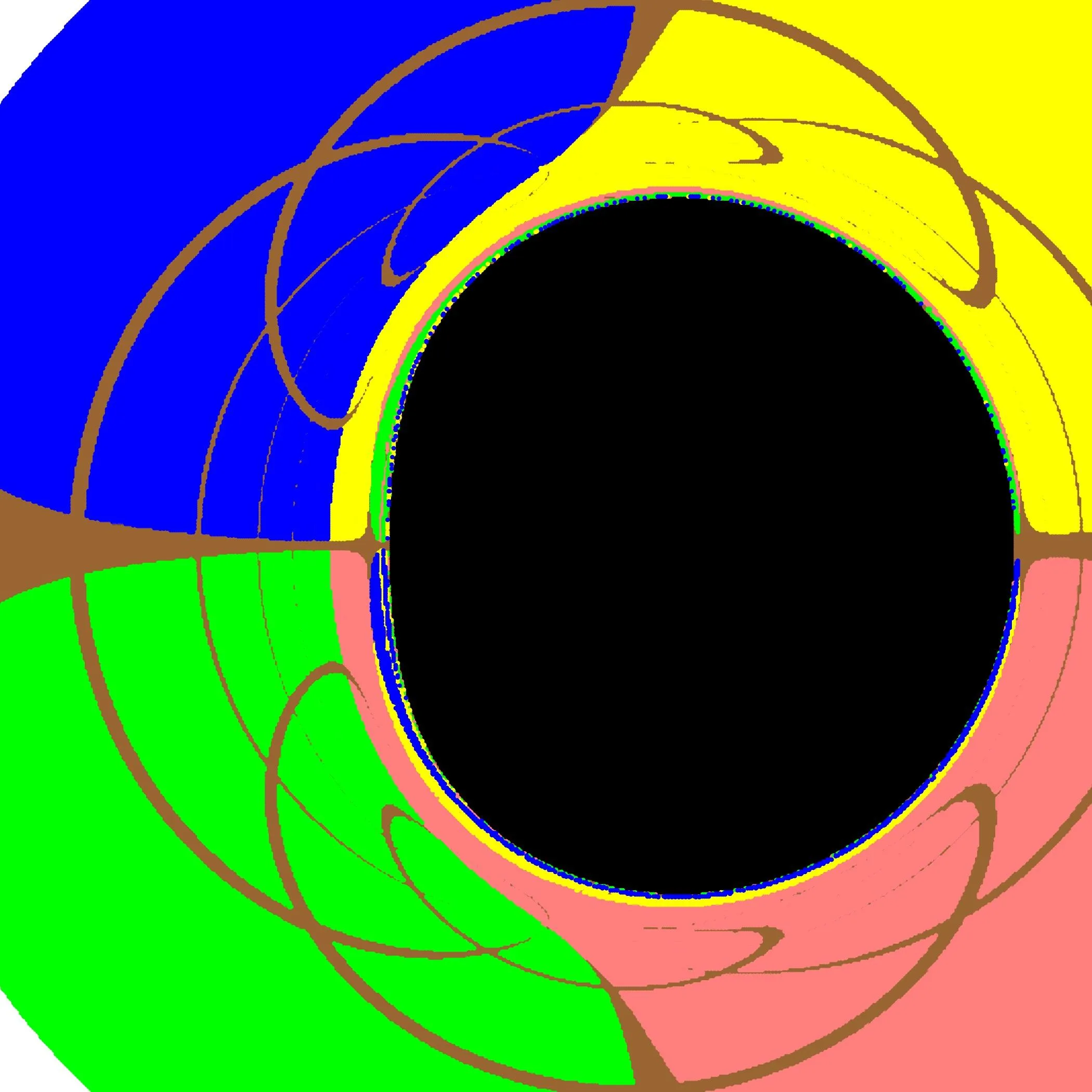
В центре внимания — чёрная дыра необычной формы. Её геометрия напоминает веретено: к обычному вращению добавлена лёгкая вытянутость. Параметр B измеряет эту деформацию.
Движение частиц меняется. Для массивных тел внутренняя устойчивая круговая орбита (ISCO) сдвигается, и появляется внешняя устойчивая орбита (OSCO) — раньше такого не было. Световые лучи (фотоны) ведут себя иначе: их траектории удалось разделить на части только приближённо, в первом порядке по B². Это позволило построить область фотонов и тень чёрной дыры.
Численная проверка подтвердила: тень действительно отличается от керровской. Отклонения малы, но заметны — как если бы знакомый силуэт чуть вытянулся в одном направлении.
Оригинальная аннотация
как её написали авторы, на английском arXiv:2607.10533
Recently, a new exact Ricci-flat rotating black-hole solution was constructed in four-dimensional general relativity, in which an additional parameter $$B$$ characterizes a spindle deformation of the Kerr geometry. We study geodesic motion and black-hole shadows in this spacetime. The Hamilton-Jacobi equation is not exactly separable for either timelike or null geodesics. Remarkably, however, at the leading nontrivial order, $${\cal O}(B^2)$$, null but not timelike geodesics become separable. In the timelike sector, the spindle deformation shifts the innermost stable circular orbit and can give rise to an outermost stable circular orbit. In the null sector, exploiting the perturbatively separated equations, we analytically determine the photon region, equatorial photon orbits, and black-hole shadow, and compare the resulting predictions with direct ray tracing in the exact spacetime. The numerical results validate the perturbative treatment and quantify the deviations from Kerr.
Параметр деформации B так мал, что на глаз тень почти неотличима от керровской — но точные измерения могут уловить разницу.