Магнитный щит для поиска асимметрии электрона экспресс
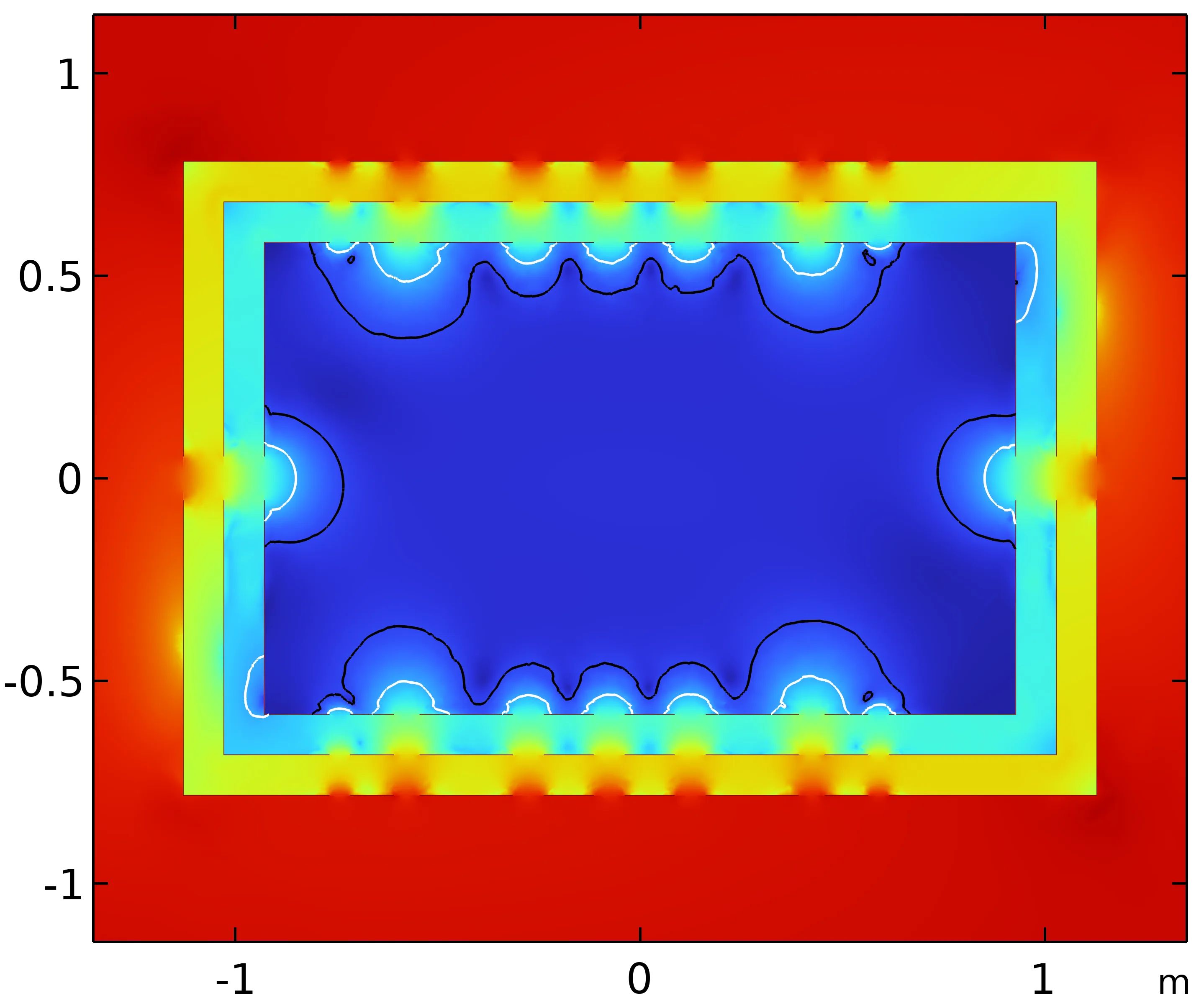
Магнитное поле в этой установке должно быть ровным, как стекло: малейшая рябь смажет сигнал. Инженеры собрали две катушки, которые сами компенсируют поле друг друга снаружи, и упаковали их в три слоя ферромагнитных пластин. Внутри получился объём метр на четыре сантиметра, где поле меняется меньше, чем на одну миллиардную теслы — это как если бы уровень моря не колебался больше толщины волоса.
Пластины из мю-металла — сплава, который втягивает магнитные линии в себя, как губка воду, — сделаны разборными. Самая большая весит 19 килограммов и вдвоём переносится без труда. Главное было не погнуть пластины при сборке: изгиб оставляет в металле напряжение, и он начинает «помнить» старое поле. Поэтому крепления продуманы так, чтобы ничего не перекашивалось.
Когда поле внутри катушек меняют местами, чтобы отсеять ошибки, внешнее поле почти не выходит наружу. Благодаря этому экраны не намагничиваются и их не нужно размагничивать после каждого переключения. Остаточное поле держится ниже одной миллиардной теслы до 17 часов, даже если переключать поле каждые 30 секунд.
Итог: по сравнению с прошлой установкой ошибки, связанные с магнитным полем, уменьшились примерно в 40 раз. При этом рабочая зона стала в пять раз длиннее, а слоёв экранов — три вместо пяти. Искать электронный «перекос» теперь можно гораздо увереннее.
Оригинальная аннотация
как её написали авторы, на английском arXiv:2608.11439v1
A system of actively-shielded coils and mu-metal shields is devised, constructed and shown to provide the stable and spatially uniform magnetic field needed for the ACME III electron electric dipole moment (eEDM) measurement. Two layers of current-carrying coils, enclosed within three layers of ferromagnetic shields, produce a field that varies by less than 1 nT (10 $$\uG$$) within the 1 m $$\times$$ 4.2 cm $$\times$$ 4.2 cm interior volume in which a beam of ThO molecules are probed as they precess. The demountable shields are constructed from rectangular mu-metal plates. The largest, with a mass of 19 kg and an area of 2.18 m $$\times$$ 0.75 m, is easily carried by two people and just fits within a large available annealing oven. The assembly design facilitates low-stress mounting and handling to suppress changes in the magnetic properties of the mu metal, and also provides modular access to apparatus within the coils for maintenance and upgrades. The nearly static external ambient field is reduced within the shielded precession volume by up to a factor of $$10^5$$. During the magnetic field reversals that ACME uses to suppress systematic uncertainties, the ``actively-shielded'' coil largely cancels out its external fringing field to minimize the magnetization of the mu metal. Even though the shields are only 10 cm outside the coils, shield degaussing after every magnetic field reversal is not required. The non-reversing residual field stays below 1 nT for up to 17 hours when the field is reversed every 30 seconds, for example. The measured performance, compared to the previous generation ACME II apparatus, suggests that the magnetic-field-related systematic uncertainties for ACME III will be smaller by an estimated factor of 40 despite a five times longer precession volume and the use of three magnetic shielding layers rather than five.
Мю-металл настолько чувствителен к деформации, что даже лёгкий удар молотком может испортить его магнитные свойства, поэтому пластины переносят в специальных контейнерах и никогда не роняют.