Пыль в галактиках: комки вместо тумана экспресс
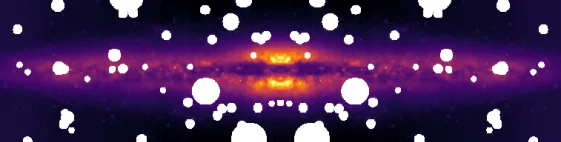
Свет далёкой галактики пробивается к нам сквозь собственную пыль. Пыль эта — не ровный туман, а рваные облака, похожие на клочья ваты. Старые модели считали её однородной дымкой, и тогда галактика не сходилась по энергии: слишком много света пропадало в ультрафиолете и слишком мало возвращалось в инфракрасном.
Астрономы поступили как повар, который вместо целой картофелины кладёт в суп кубики. Каждое плотное облако пыли они заменили виртуальной пылинкой-«псевдозерном» с теми же свойствами — как поглощает свет, как рассеивает, как светится в тепле. Такие псевдозёрна добавили в обычную модель пыли. Кривая поглощения стала более пологой: пыль перестала так жадно есть синий свет.
Применили модель к семи галактикам разного наклона. Оказалось, комковатая пыль пропускает больше света, чем считалось: максимальная оптическая толща в синем фильтре упала в 1.3–2.8 раза. Две галактики остались непрозрачными в центре, две — умеренно, три — прозрачными.
Комки меняют картину: пыли нужно меньше, чтобы объяснить то же поглощение. Значит, оценки массы пыли в галактиках, возможно, завышены. А свет от далёких звёзд доходит до нас легче, чем думали раньше.
Оригинальная аннотация
как её написали авторы, на английском arXiv:2608.14023v1
We attempt to resolve the long-standing energy balance problem encountered by Radiative Transfer (RT) models, particularly in edge-on galaxies by incorporating a treatment for the clumpy structure of the Interstellar Medium (ISM). A subgrid approach is adopted, treating the quiescent dust clouds as pseudo-dust grains, with equivalent optical and thermal emission properties. Deriving key quantities such as the absorption, scattering and extinction cross-sections enables the virtualisation of the macroscopic clump into a microscopic pseudo-grain that can be included alongside the existing dust model constituents. The addition of the pseudo-grain results in a flatter extinction curve. A library of clump emission spectral energy distributions (SEDs) is constructed for radiation fields of various colours and intensities. The new clumpy model is applied to the edge-on galaxy NGC 891 and, for the first time, is able to achieve a good energy balance, simultaneously fitting both the submm and Near Infrared (NIR) data. The clumpy model is further applied to a small sample of seven galaxies of various inclinations, and the results are compared with those from the purely diffuse models. The clumpy models are characterised by a reduction in dust opacity, and therefore attenuation, compared to their purely diffuse counterparts. Thus, the maximum face-on optical depth in the $$B$$-band, $${\mathrm max}(\tau^{\mathrm f}_{\mathrm B})$$, derived from the clumpy models is found to be lower by factors ranging from 1.3 to 2.8. Of the seven galaxies, two are found to be optically thick in their centres, two are found to be moderately optically thick, and three are found to be optically thin.
В галактике NGC 891 пыль собрана в облака, которые по форме напоминают гигантские «волокна» — их видно на снимках как тёмные прожилки поперёк диска.
В романе «Пыль» Чарльза Пеллегрино межзвёздная пыль становится угрозой для звездолёта — комковатая структура пыли делает столкновения более опасными.